I'm pretty sure I first discovered latch-hook rug-making from my paternal grand-dad, Thomas Smith. Grand-dad was disabled due to injured legs and latch-hooking was a hobby he could pursue while sitting down. My nan, Violet, was great at various needlecrafts and encouraged my poor attempts at knitting. I was very keen on Penelope tapestry kits, but my fingers weren't nimble enough for embroidery or cross-stitch (for some reason, woollen cross stitch on canvas didn't appeal to me) so I took up latch-hooking rugs. Part of the appeal was creating something useful as well as attractive. Mum's side of the family also made rugs; grand-dad John Saunders used to make rag-rugs, recycling old garments into something practical. The majority of the rugs on this page have been given to a charities that provide furnishings for people in need. I get my pleasure from making them, but don't have room to keep them all.
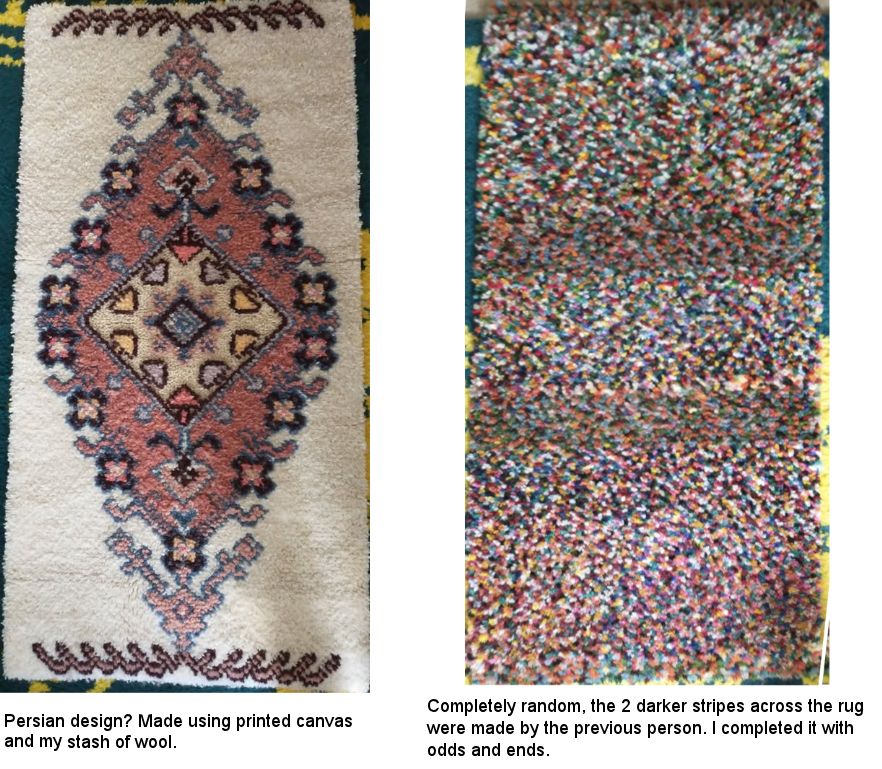
My first rug was a large tapestry style mat using recycled yarn from old sweaters. It was serviceable and very hard-wearing, but like all my tapestries it ended up on the skew due to uneven tension. My first tufted rugs were unfinished efforts inherited from grand-dad and from a friend's grand-dad when I was 16. These small rugs got finished in random swirling designs using wool oddments and were used as doormats just inside the front and back door. Along with the canvases, I inherited latch hooks and wooden yarn-cutting guides. I also picked up some tricks along the way. It's easiest to start at the bottom and work upwards. If you want to add fine detail, such as facial features, as well as knotting on the straight strands, you can add a knot on the adjacent twisted strands at 90 degrees. A few extra knots won't affect the overall texture. If you want to add textures to the rug, you can use the same trick (extra knots at 90 degrees) over larger areas to make the pile denser, or use areas with different length strands.
Over the years I've been collecting vintage rug pattern catalogues and ephemera. I'm scanning the catalogues, some of which date back to the 1920s, and putting them online at Flickr where they can be downloaded at full resolution for your own use. The ephemera includes adverts, cuttings, leaflets and the "printed matter" that Readicut supplied with their rug outfits. I've also put together as much relevant information as I can find on the British latch-hook rug wool/kit/accessories industry as these are part of our shared social history.
THE LATCH HOOKING BUG BITES
After my doormat sized "practice pieces" came the Teheran design which I bought half-made from a jumble sale when I was about 18. When finished, it was given to my parents for their annexe. From there I moved on to making my own designs. First was "Enjoy Cocaine," a subversion of a popular drinks logo when I was 19. Mum made me keep it folded whenever we went to watch dad sail (mum took her knitting, I took rugwork) so no-one could see the scandalous message! I quickly learnt that rugs where one colour dominates can be quite boring to do. I marked out the design in emulsion paint on the canvas.
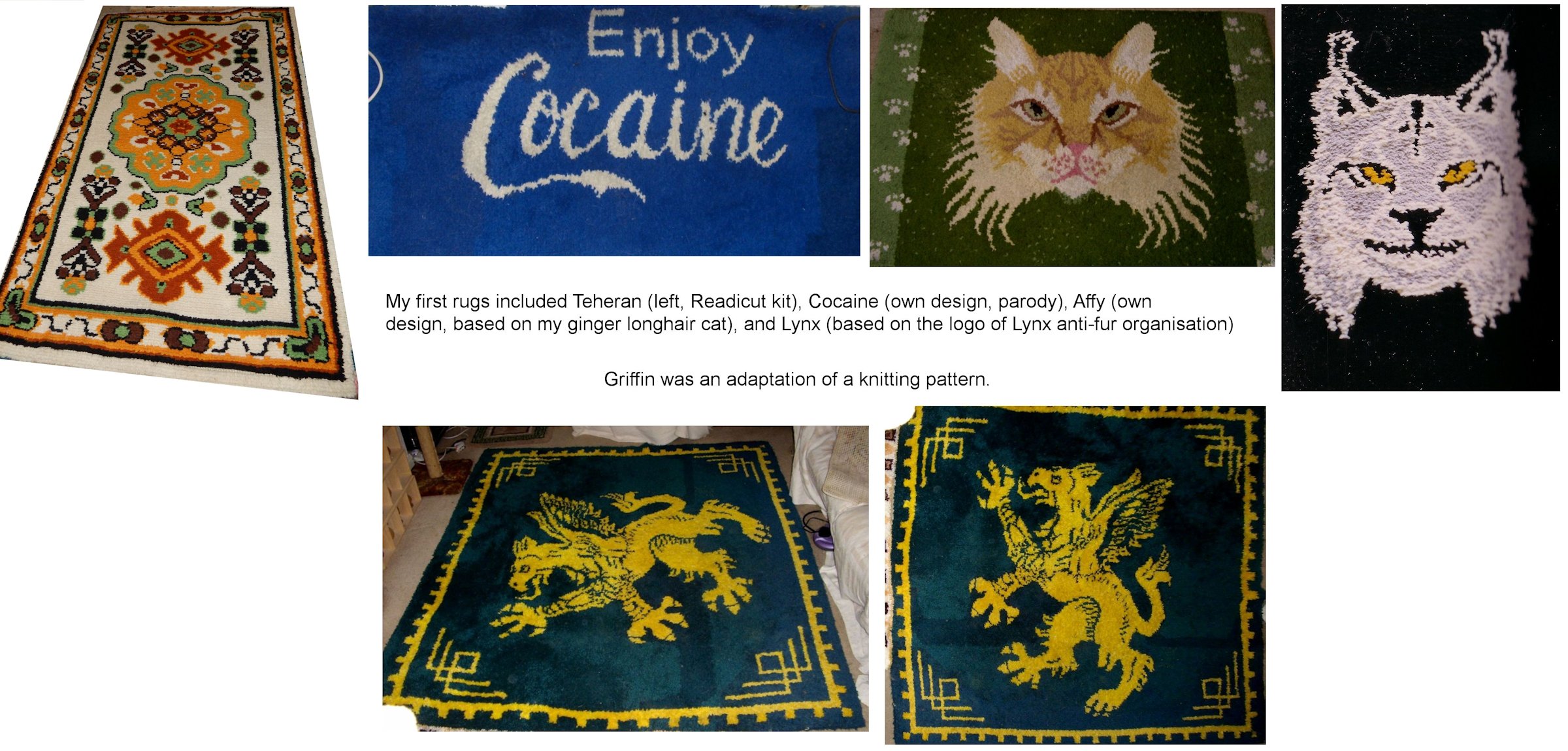
The next one, a couple of years later, was based on the Lynx (1980s anti-fur organisation) logo and was a stylized lynx face on a black background. I'd learnt to make the design fill as much of the canvas as possible. My only deviation from their black, grey and white logo was bright yellow eyes. I sent photos of it to Lynx. This time, I drew the design onto the canvas with black permanent marker. The "Affy Rug" was a larger project based on a photo of my beloved ginger longhair moggy of that name. It was completed in shades of cream through to ginger set on a green background with pawprints up and down the sides. The main design was marked using thread instead of marker pen, and I also had a colour/pattern chart on paper showing which wools went where. For almost 25 years it was my living room rug and was then retired to the dining room to make way for an even larger Griffin rug (more of that later). "Affy" was the most complex rug I'd attempted and I was very pleased to see it turn out so well. On the Lynx and Affy Cat rugs, I've used extra knots at 90 degrees to better define the eyes and other small markings.
A colleague gave me an unfinished rug she had started while hospitalised for several months. Seeing her design, I could understand why it was unfinished the only colours were beige and red supplied in bales at least twice as much as the size of rug required! Her design was to have been a Mary Quant flower on a plain background and it was a case of too little design on too much plain background, which made it a boring project to work on. I unpicked part of it and, using some of my collected oddments, turned the design into a long-stemmed red rose (from a cross-stitch pattern) on a beige background, with a red Greek key design running round the edge.
I sometimes find small unused canvases or bags of assorted pre-cut rug wool at jumble sales and charity shops. I had a surplus of beige wool from the revamped rose rug so the charity shop canvases became simple rugs with Greek key and other repeating patterns around the edge and a central motif. One has a Roman vase with 2 fern leaves (fromcross-stitch patterns) and used some stiffer yard to produce a texture around the border. Another is just a series of Greek key motifs. To avoid the beige being a dominant them in my home, I added flecks of paler brown to give it the appearance of stone. Sadly I failed to buy a "Texas Rose" rug kit that turned up in the British Heart Foundation shop in Chelmsford as I didn't have cash or chequebook on me and it had gone when I returned.
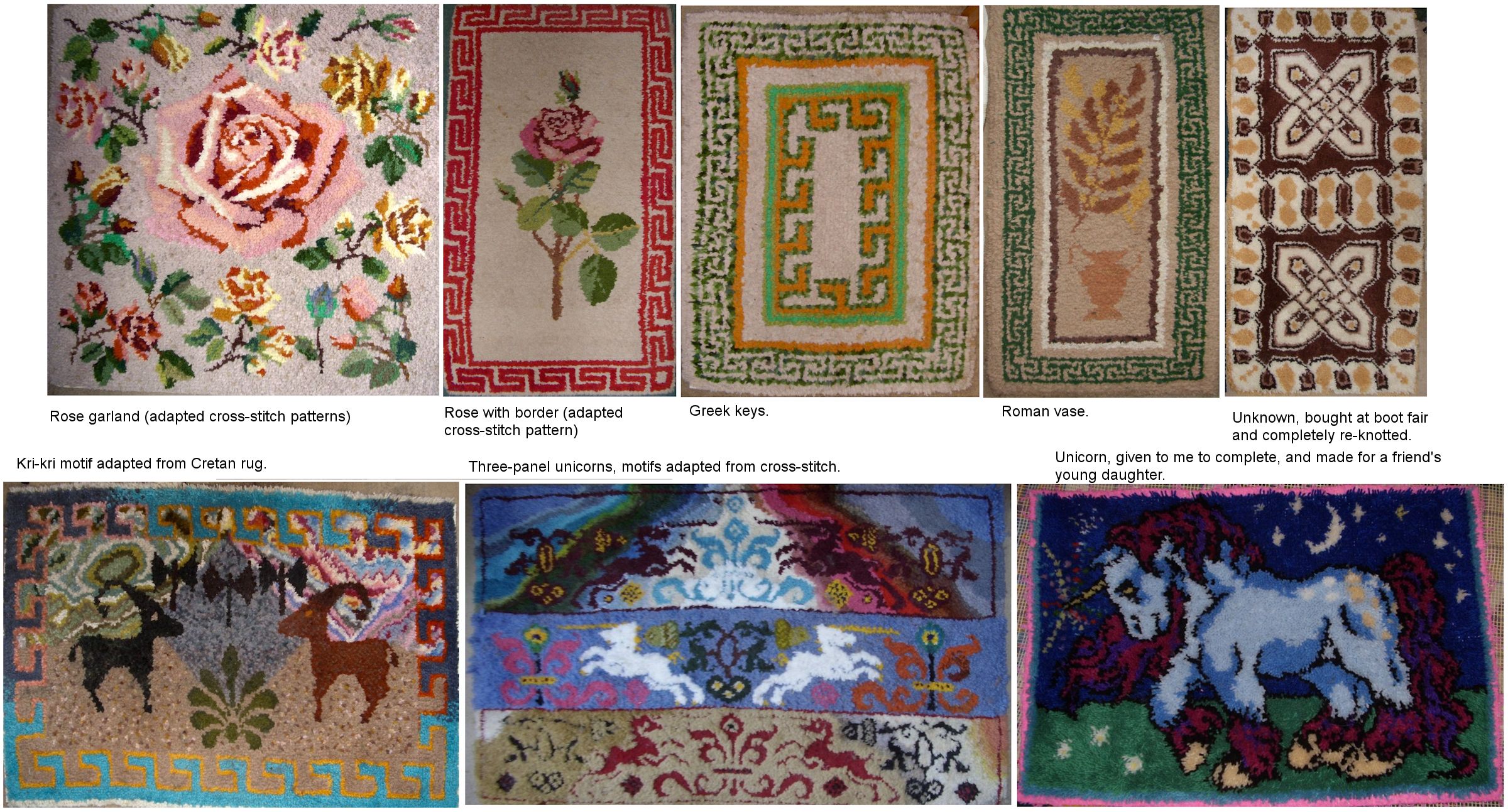
I still had a big bag of rug wool oddments picked up in Braintree years previously, along with more skeins of beige. I found a cross-stitch pattern for a large rose and began working this on a beige background. The beige was heavily flecked with a pinkish wool to make it warmer in tone. To prevent it being too boring and to use up oddments, I added a border of smaller roses and sprays with buds, also from cross-stitch patterns. A friend mentioned needing a bedroom rug and now has the rug.
In 2013, a large bag of assorted rug wool turned up in Chelmsford's Oxfam shop and 2 large bags of assorted tapestry wools turned up at a jumble sale in Haverhill. At the same time, a Disney rug kit turned up. This was my first encounter with cheap, thin acrylic rug wools. I like my rugs thickly tufted. Ignoring the Disney pattern, I used a combination of Readicut wool, Anchor tapestry wool (6-8 pieces together make a good tuft) and the supplied acrylic wool (using 2 or 3 pieces together to make thicker tufts). The end result was Cretan kri-kri (goats), a Cretan axe and a spray of foliage set on a background that mimics stone tiles and sliced geodes and with a Greek key effort around the edge in various shades of blue. The kri-kri, axe and foliage patterns were all created on my computer by overlaying a grid onto a photograph. The background pattern uses beige heavily flecks with other brown tones, a tile of slate grey/blue (also flecked), a tile of patterned greens that mimics a geode and a tile of blues, pinks and yellows based on folded and disrupted strata on sedimentary rock. These strata used up oddments and ended up a bit more garish than anticipated - not the best rug I've done, but a great way to use recycled materials and lovely and warm for my toes!
While buying a few extra packs of certain colours in Franklins, I found that the assistant had a part-done rug she wanted rid of so I bought it from her. It's a cutesy unicorn on a plain green (grass) and blue (sky) background. This was revamped so the unicorn now has contrasting dapples and has sparkles coming from its horn. I edged it in bright pink fancy yarn for my friend's daughter (who is into My Little Pony); she loves it so much she keeps it on her bed instead of the bedroom floor.
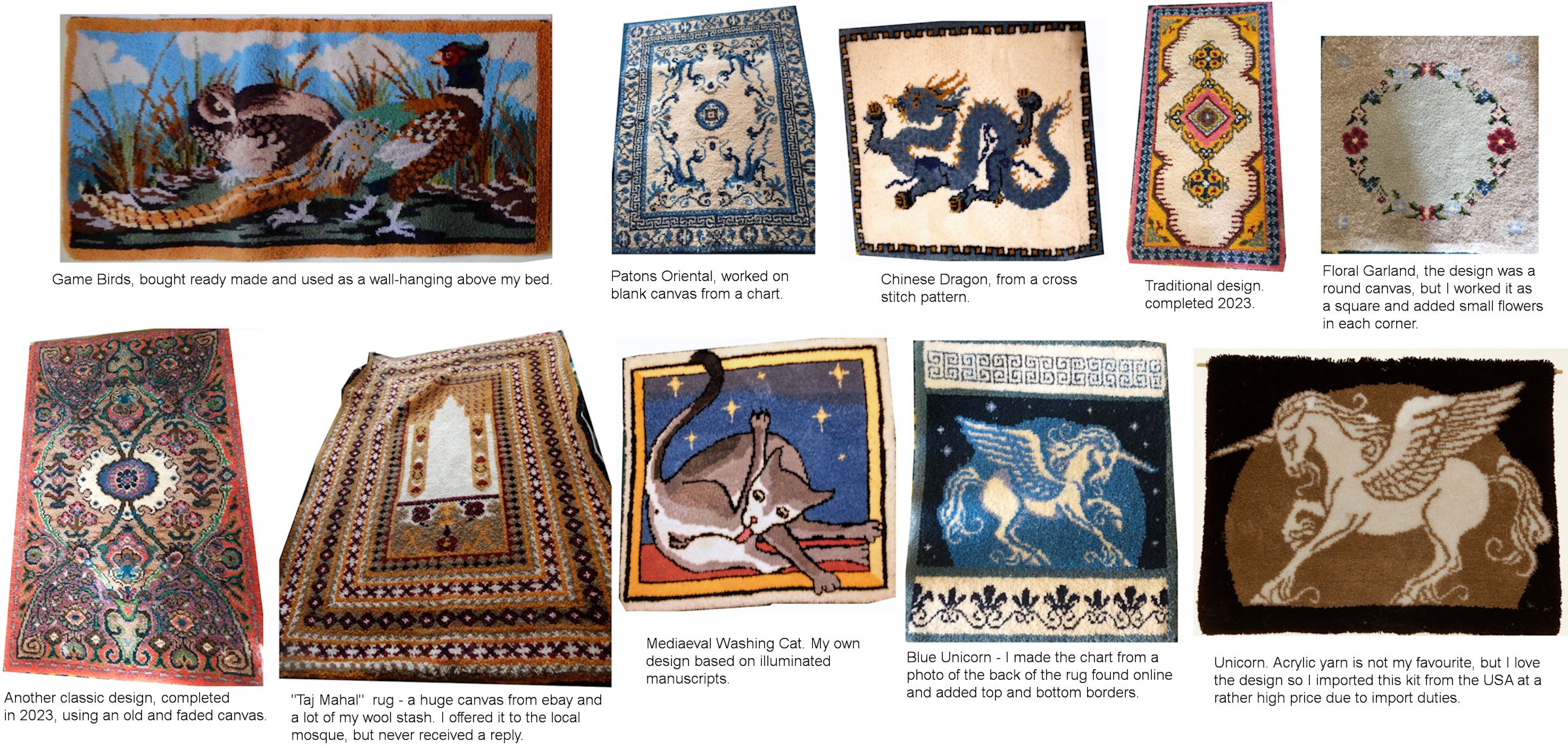
"Totem Bird" and "Peacock" also used up oddments (apart from the champagne background of Totem Bird) from boot sales and other projects. I had amassed a stockpile of wool and one of the designs I wanted to do was Readicut's "Leaping Tiger," but first I used up a 60 year old piece of part-worked 8-hole canvas and vintage Axminster rug wool into my Celtic Knot runner Parts of the canvas had been worked using the short-pile method so I designed around those areas. In time the texture will look the same across the rug.
Another couple of rug kits turned up in Oxfam (you wait ages and then three come along at once!). One was the Readicut "Texas Rose" semi-circular rug - the same design I had missed buying years eaerlier. The canvas was badly faded and I had to rely on the illustration booklet to make sure the yellow and cream went in the right places. During 2014, I found another Readicut (1969) Texas Rose hearth rug kit in Oxfam; this was barely started and on a maroon background (possibly an earlier version of the pattern or special customer request). This came in its original packaging with colour insert, instructions and latch hooks. The other looked like an occupational therapy effort: plain blue background with white Marguerite daisies in the middle. I had to unpick almost all of it because the previous owner had often hooked around 2 canvas threads at once and meandered around the canvas rather than following rows.
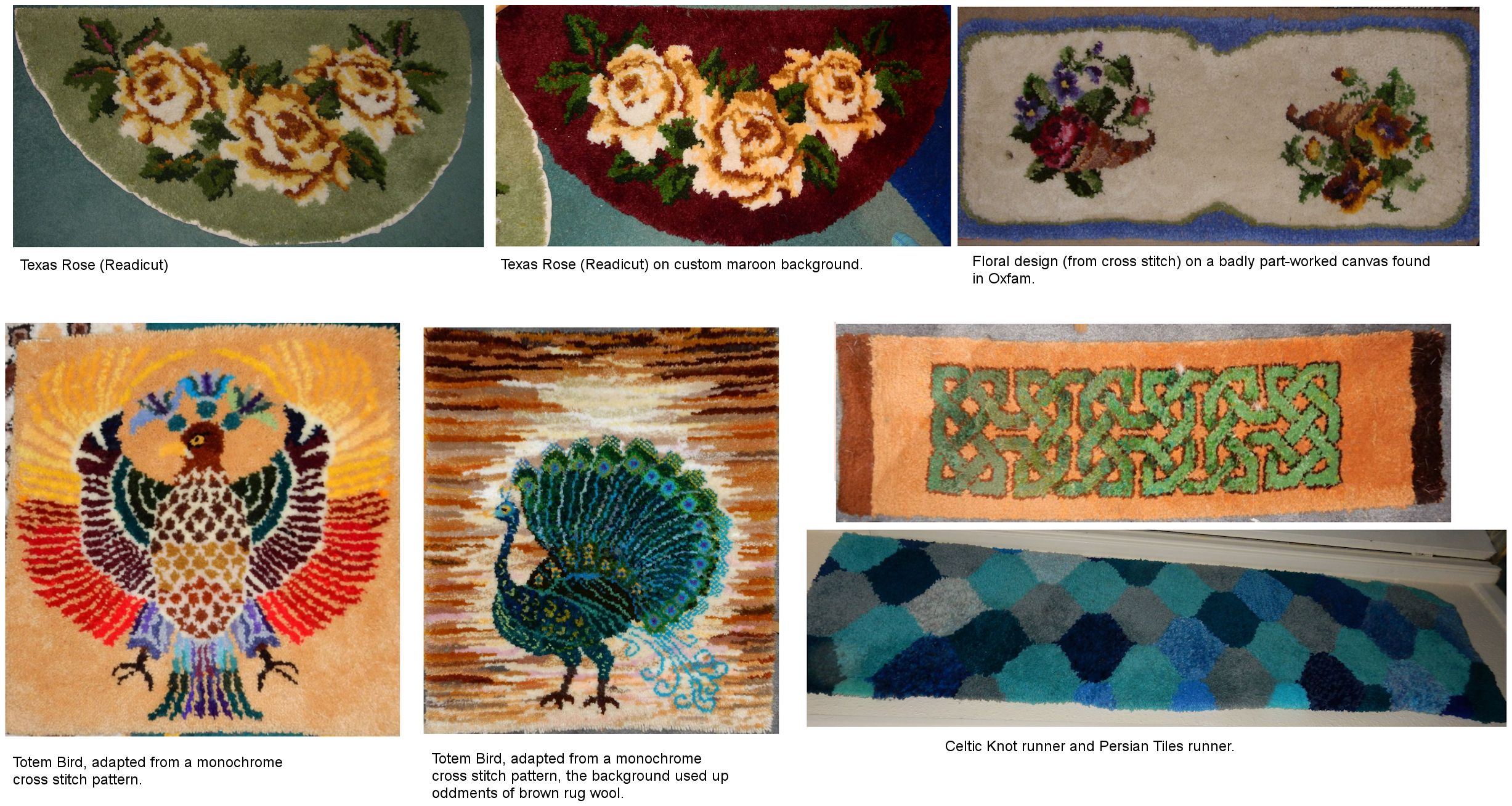
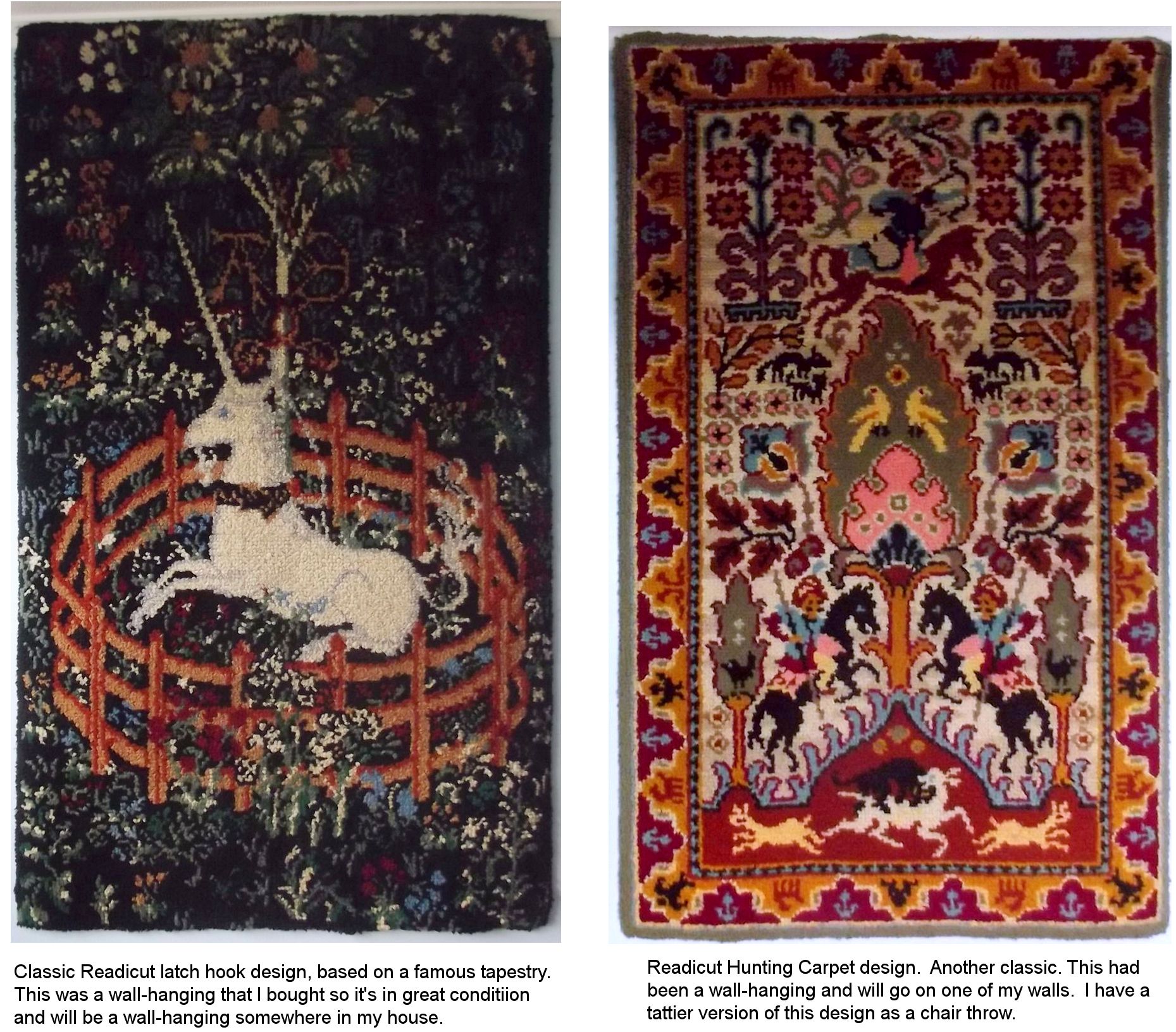
Oxfam also had a big bag of Readicut wool in reds, oranges and cream. I already had a large spare canvas and several skeins of "multipurpose" wool (actually meant for macrame) that I'd picked up in my travels around boot fairs and I decided on a 1400s-ish design of unicorns, feathers and trees (a cross-stitch pattern). Each row of unicorns has a different colour scheme which also used up the remaining oddments of cheap acrylic rug wool and the tapestry wool. The macrame wool made beautiful soft tufts. This left only the rather mangled "daisies" canvas to recycle and the griffin to finish off. The large griffin rug/carpet could only be worked on in spring and summer when my tabby moggy detaches himself from my lap. Hence the smaller rug was turned into a blue border around cream/white centre on which there are sprays of flowers from a cross-stitch pattern book. It looks rather cottagey.
I don't usually buy completed rugs, but "Turkish" (pink) and "Yaprok" (white and brown) were completed Iriss pure wool rugs (3 pounds each!) with minimal wear and these are the sort of patterns I make myself so they complemented my other rugs. I don't know the pattern name of the brown, white and beige reworked rug; the wool/acrylic mix yarn was very badly worn, but the canvas was in good condition. I replaced the worn yarn with pure wool, recreating the original pattern, albeit in slightly different shades. I noticed that the canvas was pre-printed so it was a rug kit.
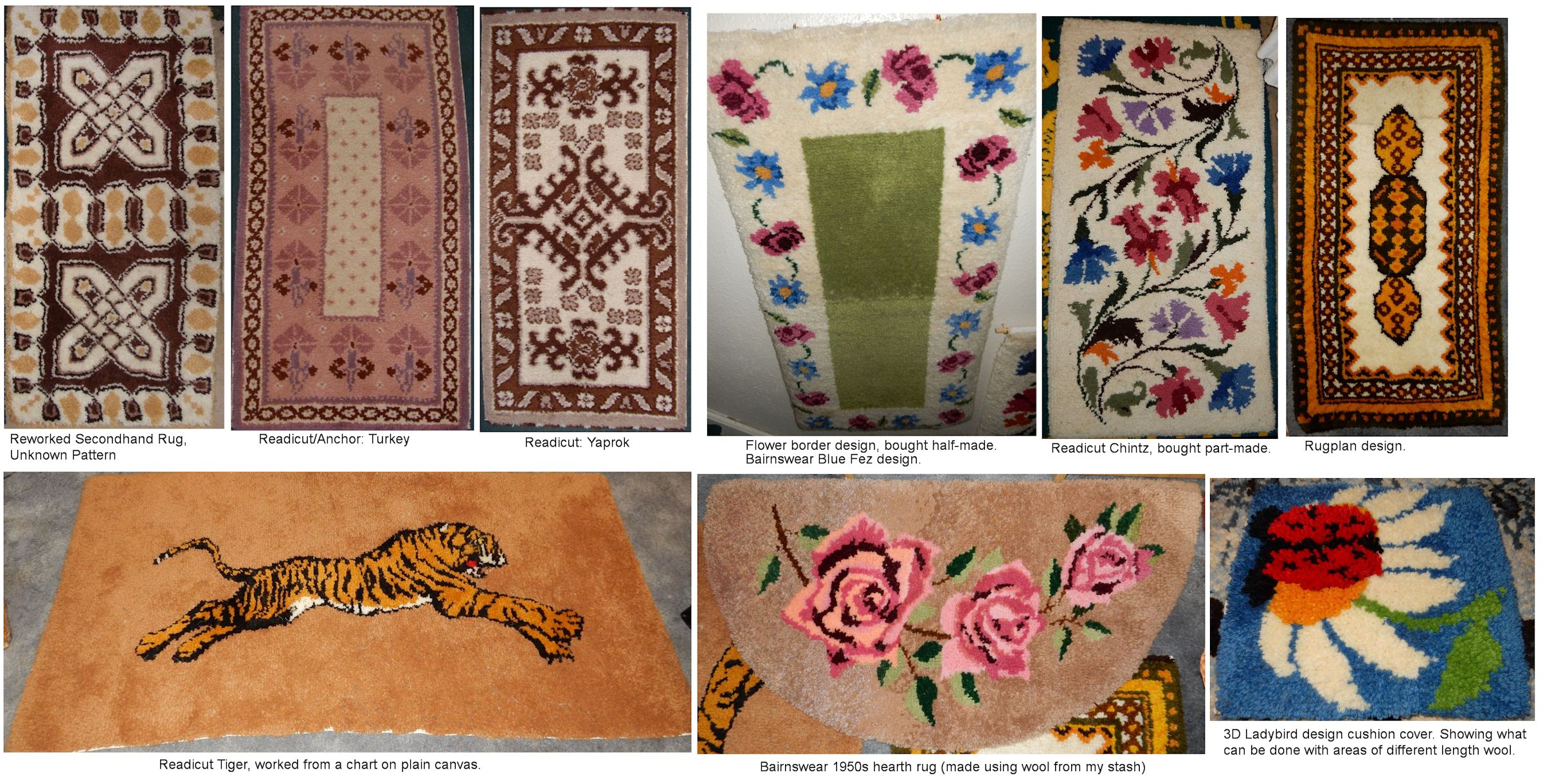
I used a large partly worked beige rug (second-hand) and downloaded the Readicut "Leaping Tiger" (which is actually their rendering of the Esso "Happy Motoring" logo) from a seller on Bonanza.com. In the catalogues, the tiger is bright orange and the background is bright blue, red or green. I used the existing beige and a more muted orange and there is a wider boarder around the design - which I think sets it off rather better than the Readicut size in the catalogues. I also added a little white on the tail-tip, ear and face.
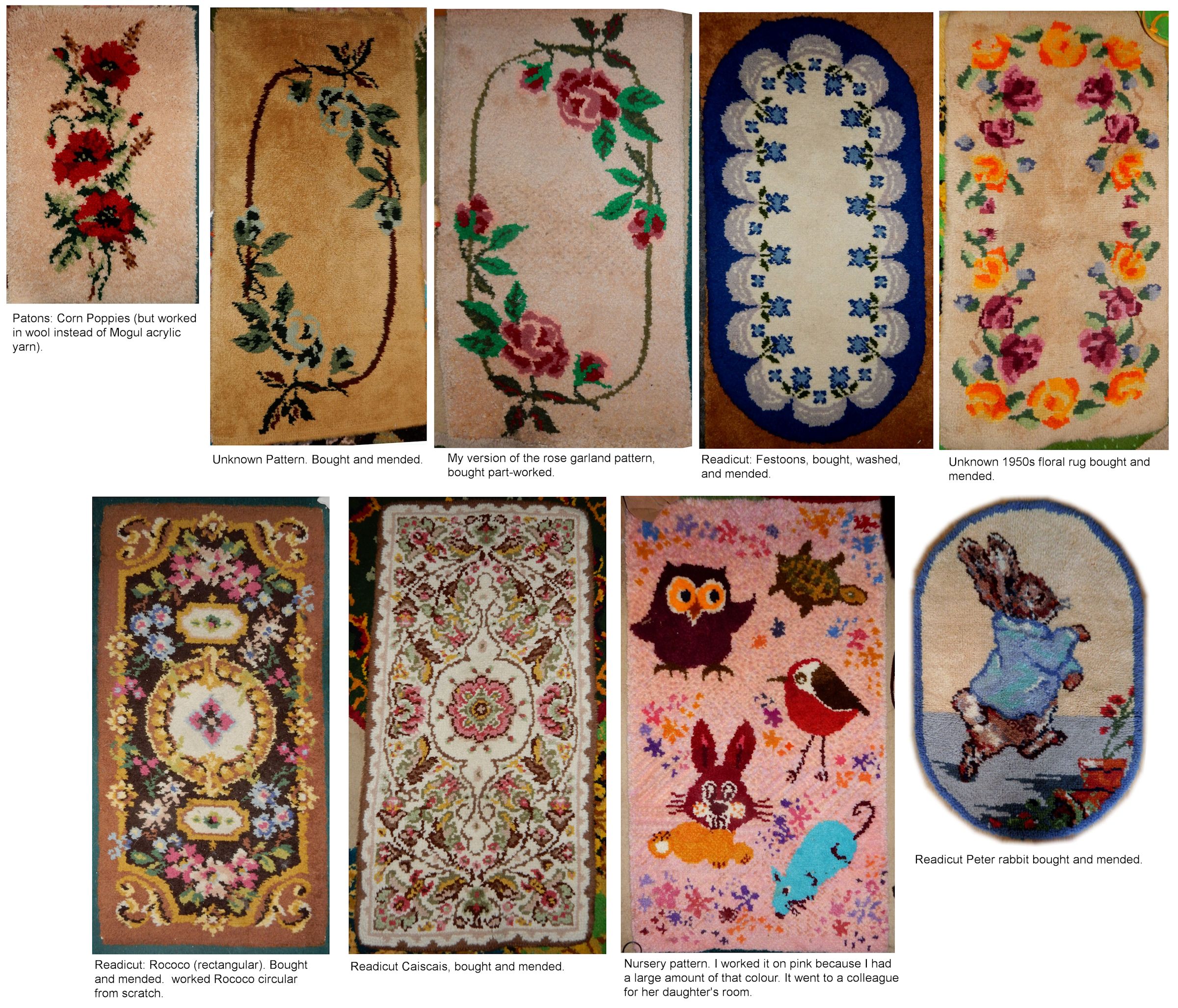
I bought the RugPlan rug one-fifth done and completed it in March 2015. It's a 1970s (name unknown) and I found the Irish-produced RugPlan wool lovely to work with (so nice that I found some more online). Irritatingly, I had to find extra mustard-colour wool from my hoard as the amount supplied was insufficient by about 40 strands. The RugPlan canvas was very precisely stencilled and there was green whipping wool for the edges though I haven't done this. I have to admit that early 1970s murky green and mustard (or gamboge) isn't my favourite colour scheme. Readicut "Chintz" was partly worked, but the owner's arthritis meant he couldn't finish it. It was one of their classic patterns. I got Readicut "Festoons" rug already made. This was a popular design, originally only available in blue until a customer requested a pink version in the late 1970s (part of the customising service). Readicut liked the outcome so much they added the pink version to their catalogue. This rug simply needed cleaning and fluffing up to return it to its original glory. Readicut recommended dry cleaning only, but the wool is colour fast in cold water. The Festoons (blue) design chart is available via Bonanza and can be adapted to any colour scheme you like to match your d cor (I think it would be interesting in yellow).
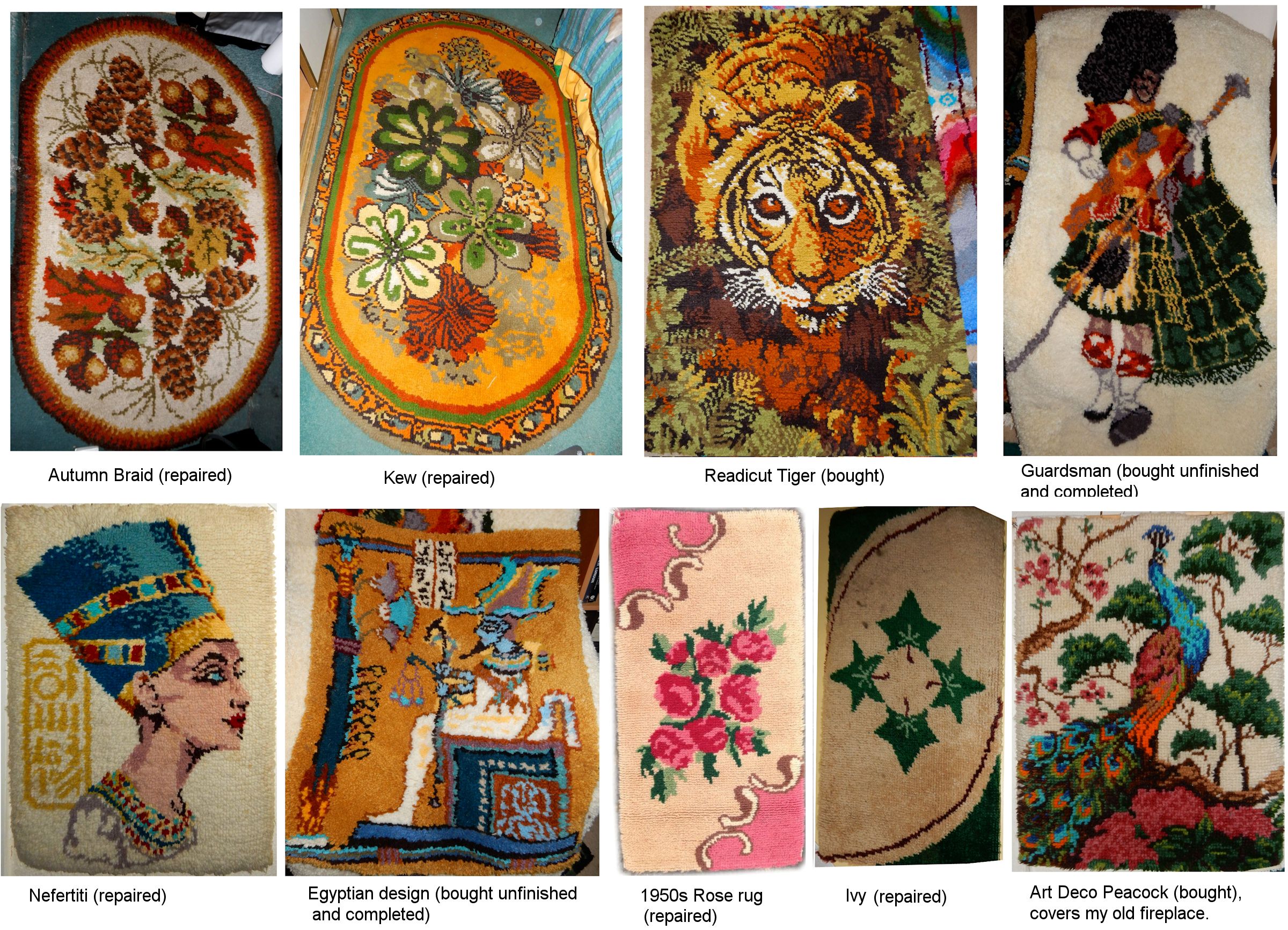
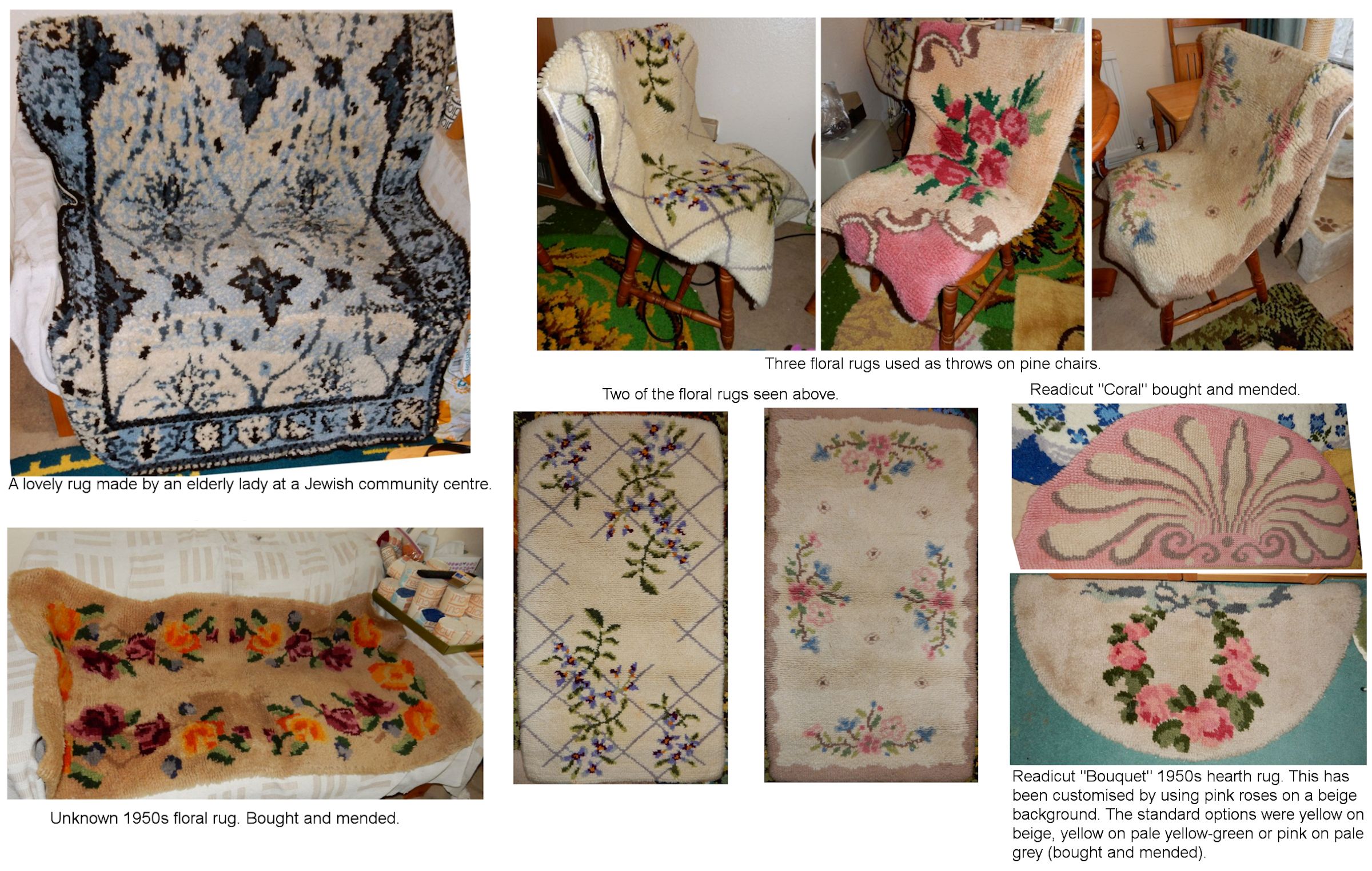
I picked up Readicut "Autumn Braid" remarkably cheaply and needing little more than a wash and fluff up. Readicut produced several intricate floral/foliage designs that moved away from roses or cottage flowers. The 1950s semi-circular roses and ribbon rug (I haven't found the design name) needed a bit of a clean and a few knots replacing to spruce it up. Semi-circle (or half-moon) rugs were originally intended as hearth rugs in the days when the open fire was a focal point of the living room.
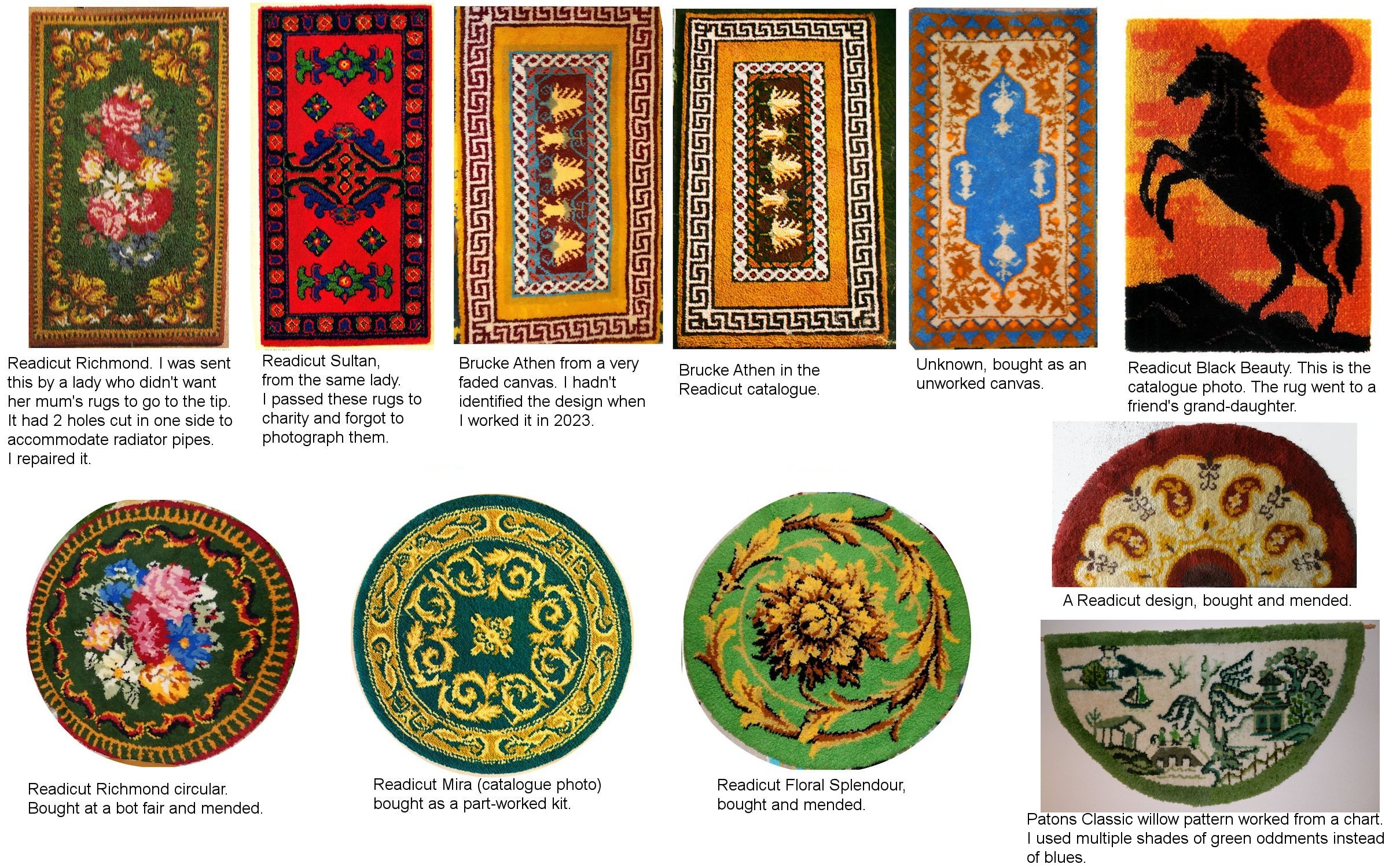
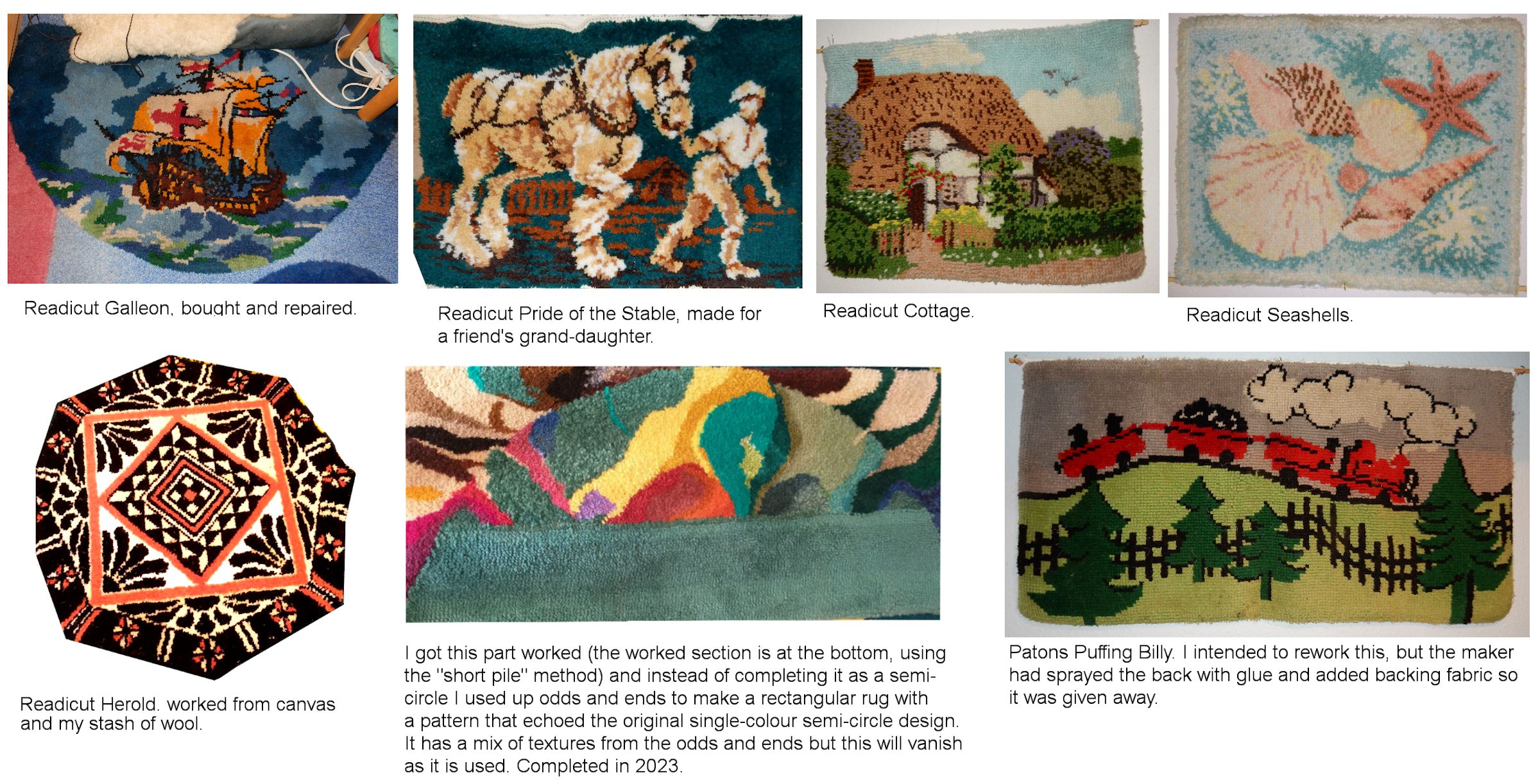
Under my desk I have a large dark pink rug to keep my toes warm. I didn't want to hide any of my patterned rugs away and this was exactly the right size and the cats love it too. Plain colour rugs can be more tedious to make because you can't see a pattern emerging. I like to add a border, if nothing else, when making a rug. My tiger rug started life as an unfinished plain beige rug and I unpicked part of the worked section when adding the central design. Patons Mogul "Corn Poppies" was a wall hanging bought as "canvas only." I worked it in pure wool instead of Mogul acrylic and it keeps my dad's feet cosy under his PC desk.
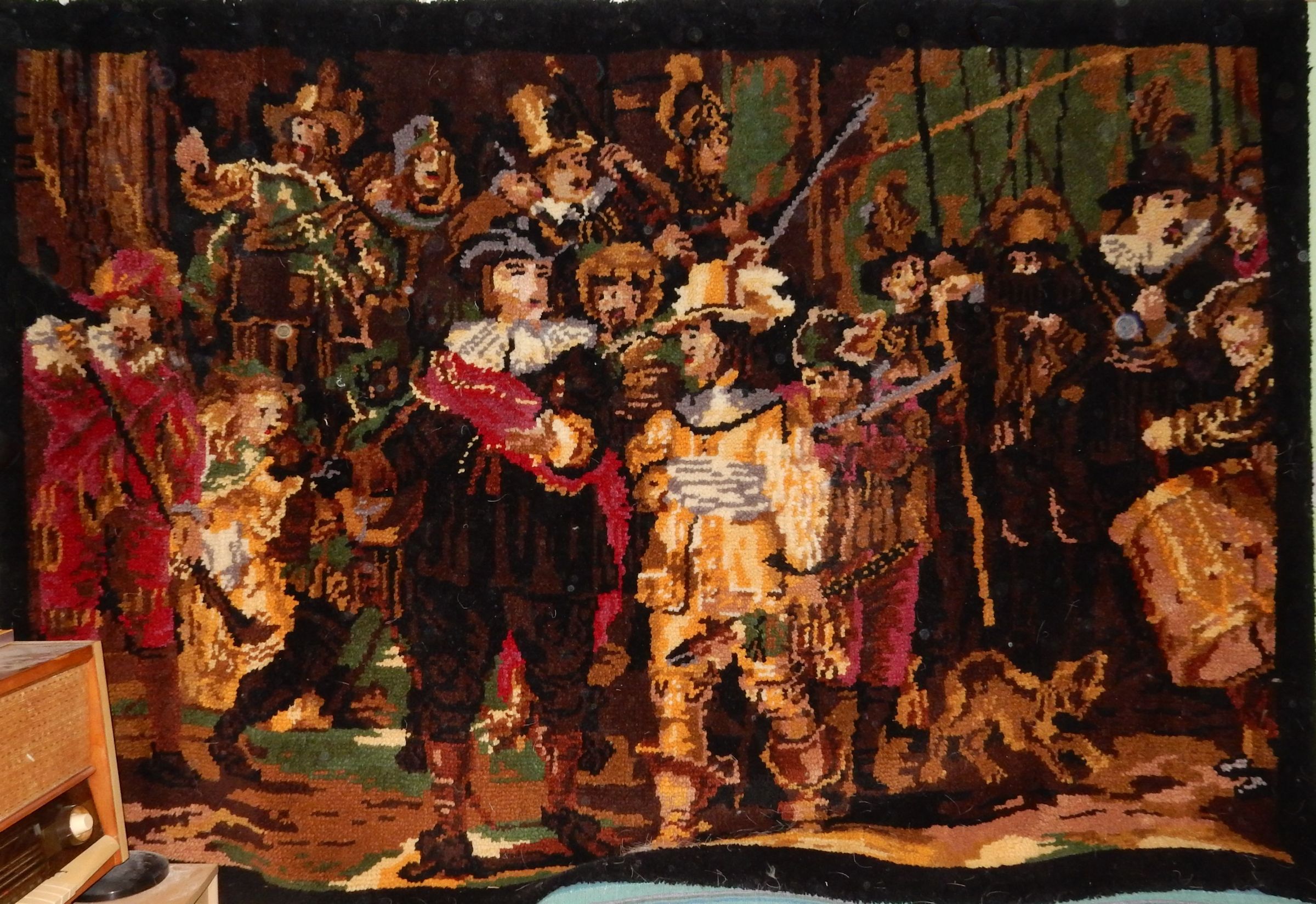
Night Watch is a huge custom design rug (bought); this takes up an entire wall of a bedroom. Titanic (possibly custom design) was bought and I just added the brown frame; it was made with acrylic yarn so my heavier wool frame makes it hang better. It is on the wall above my sofa.
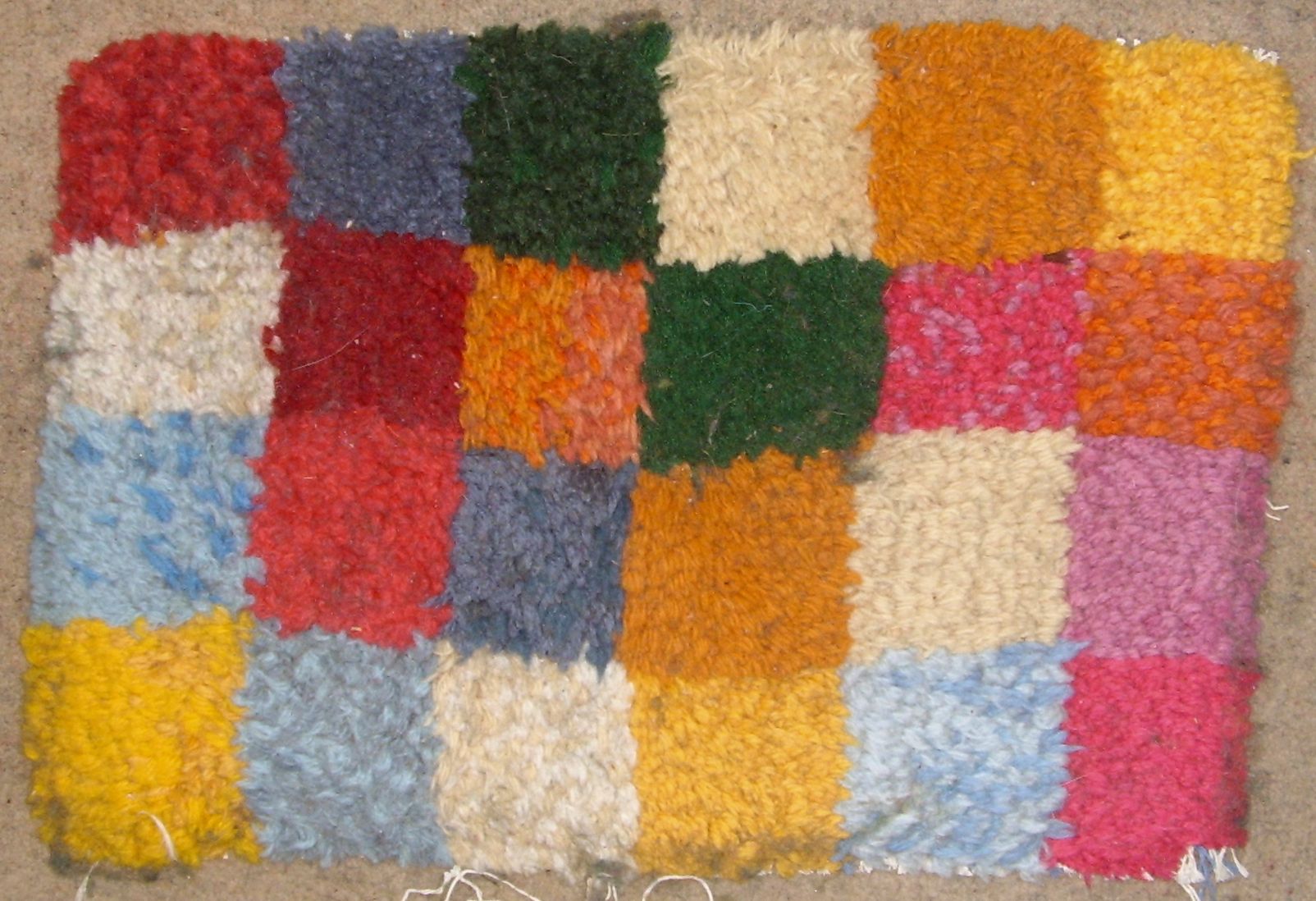
Scraps