
THE LADIES' FIELD "CAT GOSSIP" COLUMNS - 1910
CAT GOSSIP. The Ladies' Field, January 1, 1910, pg 252.
NATIONAL CAT CLUB SHOW
THE twenty-second Championship Show of the National Cat Club was held at the Crystal Palace, on December 14th and 15th, and was a great success. There were 570 entries, and all the leading cat fanciers were largely represented. The benching and penning was notably well arranged, and full-sized pens were provided. The pens were previously disinfected with methylated spirits, and this was done under the superintendence of the committee. The prize for the best long-haired cat in the show was awarded to Miss Whitney's Brayfort Victory, a beautiful sable tabby; the special for best short-haired cat in the show went to Lady Decies's Ch. Fulmer Tabby Boy, the celebrated silver tabby. The judges were: Mrs. Bennett, Mrs. Fosberry, Miss Forestier-Walker, Mr. Mason, Mr. Astley and Mr. Billett.
Long-hair (white male): First, Master B. Currie's Minley Remus, a fine white, in lovely coat, nice short ears and a good head, was afterwards claimed by Lady Decies for the catalogue price, 12 guineas; second, The Hon. Mrs. Clive Behrens's Swinton Meerschaum, in nice coat and condition; third, Lady Decies's Fulmer Sefton White Prince, a beautiful cat with the deepest of blue eyes, out of coat; v.h.c., Mrs. Behrens's.
Long-hair (white female): First, Mrs. Behrens's Daydream, a lovely white, rather pale in eyes; second, Lady Decies's Fulmer Snow Cloud, a very pretty cat, with the deepest of blue eyes, has a very short face and is full of quality; third, Mrs. Slingsby's White Rose of Thorpe, a beautifully coated queen, fails in shape and eyes a little pale; v.h.c., Lady Decies's Fulmer Snow Queen II.; h.c., Mr. Shaw's; c., Mrs. McDonald's.
Long-hair (black): First and championship, Mrs. Dee's Earlsfield Delta, a beautiful black in nice condition, a fine head; second, Mrs. Fisher White's Persephone, not such a good head, but has nice eyes; third, Miss Bell Irving's Rokeby Nesta, a large queen, with a fine head, but out of coat.
Blue (male): First and championship, Mrs. G. Savory's Billy Button, a lovely shaped cat, in lovely coat, fails a little in eyes; equal seconds, the Misses Ayre's Struwwelpeter and Mrs. George Wilson's Sir Archie II. of Arrandale, the former a dark blue, had a bad temper and bit the judge, the latter a lovely cat with gorgeous eyes, out of coat; third, Mrs. Fletcher's Crow Trees Martin; reserve, Messrs. Davidson and Sons' Tony III.; v.h.c., Mr. Shaw's, Mrs. Palmer's and Mrs. Davis's; c., Miss Chamberlayne's and Miss Lea's; absent, Mrs. Slingsby's and Mrs. Richardson's.
Blue (female: First and championship, Miss G. Savory's Regina, a nice-headed queen, a little dark; second, Mrs. G. Wilson's Bonny Jean of Arrandale, a gorgeous-eyed queen, and of a lovely colour; third, Mrs. Wilson's Blue Flame of Arrandale, a nice cat, has good eyes; reserve, Mrs. R. Fisher White's Sprite of Highgate, a pretty queen, weak in eyes; v.h.c., Mrs. Douglas's.
Chinchilla (male): First and championship and special, Mrs. Wellbye's Silver Milord II., a small cat, in nice coat: second, Mrs. G. Wilson's Silver Ariel of Arrandale, a very pale cat with lovely green eyes, a good round head, but out of coat; third, Miss Elliott's Silver Robin, a pale cat, but long in nose and bars on forelegs, in nice form; reserve, Mrs. Burt's Silver Jimeta. eyes wrong colour; v.h.c., Mrs. McLaren Morrison's; absent, Mrs. G. Wilson's.
Chinchilla (female): First and two specials, Lady Decies's Fulmer Ladybird, a nice little cat, but too dark, was sold directly the show opened for 12 guineas; second, Mrs. G. Wilson's Nymph of Arrandale, has nice green eyes, and a lovely pale colour; third, Mrs. Wilson's Silver Duchess of Arrandale, another very pale cat, but out of coat; reserve, Miss Frowd's, a good-coated queen, but has a slight mark on head; v.h.c., Mrs. Soame's.
Smoke (male): First, Mrs. Musson's Martini, a grand headed cat, in good coat and has fine eyes; second, Mrs. Clark's King Lobengula, a nice cat, but pale in eyes, and a long face; absent, Mrs. Stead's Ch. Ranji.
Smoke (female): First and championship. Dr. Prior's Ch. Bowness, in fine coat, a lovely head; second, Mrs. Stead's Rhoda, out of coat and face too long; third, Mrs. Singleton's Cigarette of the Cottage, a nice cat, sweet expression, too level in colour; reserve, Mr. Robert Little's Crissy, out of coat; v.h.c., Mrs. Cook's and Mrs. Robert's.
Silver tabby (male): First and championship, Mrs. Slingsby's Ch. Don Pasquale of Thorpe, a very large cat, in fine coat; second, Mr. Fleming's Peterflower, fails in markings, and a much smaller cat than winner; third, Mrs. Moore's Silver Tiger, a beautifully marked cat, a little brown on ears.
Silver tabby (female): First, Mrs. Meeson's Rettendon Chookie, a nicely marked cat; second, Miss Elliott's Princess Sonia, a nice head, markings not clear enough; third, Mr. Leycester's, a lovely head, a little out of coat; reserve, Mr. Leycester's Almasta; v.h.c., Mr. Leycester's; h.c., Mrs. Mitchell-Atkinson's.
Brown tabby (male): First, Miss R. Whitney's Brayfort Victory, the winner for best cat in the show, a real beauty - if anything, might be a little clearer on saddle, has fine eyes and markings.
Brown tabby (female): First, Miss R. Whitney's Brayfort Tip Topper, a grand-headed cat, lovely rich markings, a beauty; second, Mrs. Medding's Russet Prineess, a fine cat, but loses in markings to winner; third, Miss R. Whitney's Brayfort Jewel, rather a small head, nicely marked and a good colour; reserve, Miss Chamberlayne's Asthore of Ravenor, not such a rich colour as the others.
Orange tabby (male): First and championship, Mrs. Slingsby's Aquila of Thorpe, a fine coat in nice condition, a lovely colour; second, Mrs. Slingsby's Champion Red Eagle of Thorpe, good eyes, not so good in markings as winner; third, the Hon. Mrs. Behrens's Swinton Usquebaugh, another beauty, nice colour; v.h.c., Mrs. Western's.
Orange tabby (female): First, Mrs. R. Forsyth Forrest's Orange Marmalade, a big queen and a nice colour, but not good in markings; second, Mrs. Slingsby's Oriflamme of Thorpe, good colour, better markings than the winner; third, Mrs. Slingsby's Aigrette of Thorpe, too heavily marked on the back; v.h.c., Lady Decies's; h.c., Mrs. Slingsby's.
Cream (male): First, and championship, Mr. Helmer's Ch. Wildon Wily, a fine cat, in good condition, got reserve for best long-hair in the show; second, Mr. Helmer's Wildon Woolwinder, a lovely head and a nice colour; third, Mr. T. Cassels's Ailsa Prospect, not so level in colour, but a big cat; v.h.c., Mrs. Behrens's; h.c., Mrs. Bainbridge Smith's; c., Mrs. Slingsby's.
Cream (female): First, Mrs. F. Western's Wynnstay Daffodil, a little out of coat, but has a sweet face and lovely eyes; second, Mr. H. Maden's Rockcliffe Buttermilk, a rather long face, has a good colour and good eyes: third, Mrs. Slingsby's Georgette of Thorpe, a good colour, not such a good head; v.h.c., Miss Lea's Ruckholt Sunflower.
Orange, self or shaded (male): First, the Hon. Mrs. McLaren Morrison's Puck, a very nice head, almost unmarked; second, Miss Beal's Romaldkirk Ringdove, a lovely headed queen of a fine red colour; third, Mrs. Hall's Tower Wood Minoose, not so good in colour as the previous winners; v.h.c., Mrs. Neate's.
Orange, self or shaded (female): First, Mrs. Neate's Queen of Hearts, in nice coat, good head; second, Miss H. Lea's Ruckholt Poinsettia, a good-coloured orange, a little marked on the head; third, Mrs. H. Cool's Humming Bird, out of coat; v.h.c, Mrs. McLaren Morrison's Silverdale Lurline; h.c., Mrs. Neate's; c, Miss W. Beal's.
Tortoiseshell (male or female): First and championship. Mrs. Slingsby's Sunrose of Thorpe, a lovely cat, beautifully patched; second, Miss W. Beal's Romaldkirk Pallas II., a rather dark cat, but in nice coat; third, Mrs. L. C. Burt's Cream Toes, not in pen when reporting; v.h.c, Mrs. Cook's; h.c., Mrs. Western's.
Tortoiseshell and white (male or female): First and championship, Mr. J. Woods's Ch. Minette, a lovely head and fine patches; second, Mrs. Slingsby's Ch. Rosette of Thorpe, another nice cat, but loses to winner in coat; third, Miss A. Heslop's Fluffy Jane, not so well patched as the previous winners; v.h.c., Mrs. Brawn.
Breeders' classes (long-haired, over twelve months).
Blue (male or female): First, Miss G. Savory's Billy Button; second, Mrs. George Wilson's Sir Archie II., of Arrandale; third, Miss G. Savory's Regina.
Chinchilla, smoke or silver tabby (male or female): First, Mrs. Slingsby's Ch. Don Pasquale of Thorpe; second, Mrs. G. Wilson's Silver Ariel of Arrandale; third, Mrs. G. Wilson's Silver Nymph of Arrandale; reserve, Mrs. Meeson's Rettendon Chookie; v.h.c., Mrs. Elliott's and Mrs. Clark's; h.c., Mrs. Soame's.
Any other colour (male or female): First, Miss R. Whitney's Brayfort Victory; second, Mr. F. Helmer's Ch. Wildon Wily; third, the Hon. Mrs. Behrens's Swinton Usquebaugh; v.h.c., Master Currie's, Mrs. McLaren Morrison's and Mrs. Slingsby's; h.c., Mrs. Smith's.
Novice classes (long-haired cats or kittens).
Black, white or smoke (male or female): First, Lady Decies's Fulmer Snow Cloud; second, Mrs. Behrens's Swinton Meerschaum; third, Mrs. Slingsby's White Rose of Thorpe; v.h.c., Mrs. Robsons; h.c. Lady Decies's; c., Mrs. Bell Irving's; absent. Mrs. Dee's.
Blue (male): Equal seconds, Mrs. L. Ryder's Imperial Blue, a pretty kitten, a little rusty on the back, and Messrs. Davidson's Tony, out of coat; third, Mr. J. Palmer's Blue Sphinx; reserve, Miss Bainbridge Smith's Blue Nose of Persia; c., Mrs. Fahrmbacher's Moonraker; absent, Mrs. Slingsby's.
Blue (female): First, Mrs. Forsyth Forrest's Moonlight; second, Mrs. G. Wilson's Bonny Jean of Arrandale; third, Mrs. Singleton's Ulster Blue Forget-me-not; v.h.c., Mrs. Cooke's, Mrs. Wilson's and Mrs. Douglas's.
Chinchilla, silver tabby or smoke (male or female): First, Mrs. Wellbye's Silver Milord II.; second, Lady Decies's Fulmer Ladybird; third, Mrs. G. Wilson's Silver Nymph of Arrandale; reserve, Mrs. Meeson's Rettendon Chookie; v.h.c., Mrs. G. Wilson's, Miss Frowd's and Mrs. Elliott's; c., Mrs. Singleton's and Mrs. Mitchell Atkinson's; absent, Mrs. Slingsby's.
Any other colour (male or female): First, Mrs. Slingsby's Aquila of Thorpe; second, Mrs. F. Western's Wynnstay Daffodil; third, Mr. Helmer's Wildon Woolwindcr; reserve, Mrs. Forsyth Forrest's Orange Marmalade; v.h.c., Mrs. Bell Irving's, Mrs. Slingsby's, Mrs. Behrens's and Mrs. Lea's; h.c., Mrs. Bainbridge Smith's; c., Mrs. Slingsby's; absent, Mrs. Slingsby's and Master Currie's.
Selling class, £2 (any variety): Second, Mrs. Douglas's Oulton Puff Ball.
Black, white, or blue neuter (any variety): First, Mrs. Pares's Royal Rex, a lovely coated blue, with a very short face; second, Mrs. Palmer's Oscar, out of coat, and nose not short enough; third, Mrs. Fisher White's Attila of Highgate, another blue, too light in eyes; v.h.c., Mrs. Slingsby's; h.c., Mrs. Voules's; c., Mrs. Arbuthnot's.
Any other colour (neuter): First, Mrs. Palmer's Tintara, a lovely orange tabby, in grand coat; second, Mrs. Elliott's Sprig of Nobility, a shaded silver, rather small, but in good coat; third, Mrs. G. Quittenton's Timson, a nice smoke with a good head; h.c., Mrs. Dyson's and Mrs. Jerome's; absent, Mrs. Samuel's.
Brace, any variety long-hair (male or female): First, Mrs. Slingsby's brace; reserve. Mrs. Behrens's brace.
Team, any variety longhair (male or female): First, Miss R. Whitney's team; reserve, Mrs. Behrens's team.
Kitten classes, longhaired, white (male or female, three to nine months): First, Master Currie's Rogue of Minley, a little gem, with a very short face and a lovely coat; second, Mrs. G. Wilson's White Friar IV. of Arrandale, a long nose.
Black (male or female, three to nine months): First, Mrs. G. Billett's orange eyed black queen, in nice coat, has a good head; second, Mrs. Dale's Black and Gold, a poor head, and eyes too pale; third, Mr. E. Manuel's The Budget, a small kitten showing blue in the undercoat.
Blue (male, three to six months): First, Mrs. Avery's Loudwater Sonnie, a fine big kitten; equal seconds, Mr. R. Cooke's Xenophon. a pretty baby in nice coat good coloured eyes, and Miss Bainbridge Smith's Blue Nose of Persia, fails in the eyes; third, Miss A. Wilson's Bonny Boy Blue, slightly rusty in colour; reserve, Mr. F. Horton's Lincoln Sovereign, a nice kitten but had a cold in eyes: absent, Mrs. Hatch's.
Blue (male, six to twelve months): First, Miss Savory's Robin, a lovely shaped kitten, a beautiful colour: second, Mrs. Fisher White's Remus of Highgate, a sweet kitten, a little shaded on the frill; third, Mrs. Hughes's Peter the Hermit, a very cross cat, bit the steward's hand; reserve, Miss Savory's Lupin, a sound coloured blue, very good in eyes; v.h.c., Mrs. Rankine's, Mrs. Pease Bennett's, Mrs. Clements's and Mrs. Ryder's; absent, Mrs. Slingsby's and Mrs. Dee's.
Blue (female, three to six months): First, Miss Muriel Wilson's Roma of Arrandale, a beautiful blue, good in eyes; second, Miss G. Wright's Duchess of Highgate, a nice kitten, with tiny ears and a good head; equal thirds, Mrs. Hatch's and Mrs. Bazeley's Rowena, not so good as the two former winners; reserve, Mrs. Britton's Jupita, weak in eyes; h.c, Mrs. Lea's.
Blue (female, six to twelve months): First, Mrs. Lea Wynn's Sapphire of Castlethorpe, a beautiful little kitten, good head, glorious eyes, a real beauty; second, Mrs. Forsyth Forrest's Moonlight; third, Miss Clements's Mona Girl; reserve, Mrs. Sheppard's Llama; v.h.c., Mrs. Ayre's and Miss Savory's; c., Mrs. G. Wilson's; absent, Mrs. Slingsby's.
Chinchilla (mmale or female, three to six months): First, Miss Muriel Wilson's Rosalie of Arrandale, a lovely pale colour, with large round eyes; second, Mrs. G. Wilson's Silver Dora of Arrandale, a little out of coat, but a nice pale colour; third, Mrs. Stepple's Silver Edna, a good-coated kitten, pale in colour, but a little marked on its head.
Chinchilla (male or female, six to twelve months): First, Miss Elliott's Silver Rene, a nice-coated kitten, with a good head and eyes; second, Mrs. Soame's Sir Radford, rather dark, in nice coat; absent, Mrs. Slingsby's and Mrs. Bester's.
Smoke (male or female, three to nine months): First, Mrs. Singleton's Buddha of the Cottage, in fair coat, has a nice expression; second, Mrs. Singleton's Mystery of the Cottage, a bad undercoat, has a good head; third, Mrs. Robson's Sylvia's Hope, a trifle out of coat but a nice one; reserve, Miss A. Burton's Dusky Queen; v.h.c., Mrs.Geal's; h.c., Mrs. Musson's and Mrs. Horton's.
Silver tabby (male or female, three to six months): Second, Mrs. Meeson's Rettendon Pickle, brown on its nose.
Silver tabby (male or female, six to twelve months): First, Mrs. Meeson's Rettendon Lad; second, Mr. T. Furze's Marion; third, Mrs. Moore's Pickwick; absent, Mrs. Slingsby's.
Brown tabby (male or female, three to nine months): First, Mrs. Medding's Mr. Fillibuster Brown; second, Mrs. Medding‘s and Mrs. Schneider's.
Orange (male or female, three to six months): First, Miss Bell Irving's Rokeby Selfish One; second, Miss H. Lea's Ruckholt Noel; absent Mrs. Slingsby's.
Orange (male or female, six to twelve months): First, Miss E. Bell Irving's Rokeby Joan; second, Mrs. Hall's Tower Wood Pharoah; third, Mrs. Mappie's Cobham Henry; v.h.c., Mrs. Hardman's; absent Mrs. Slingsby's.
Cream (male or female, three to six months): First, Mrs. Forsyth Forrest's Flashlight; absent, Miss Bell Irving's.
Cream (male or female, six to twelve months): First, Mrs. Slingsby's Wisdom of Thorpe; absent, Mrs. Slingsby's.
Tortoiseshell or tortoiseshell and white (male or female, three to nine months): First, Mrs. J. Woods's Minorite.
Any colour (kitten): First, Master Currie's Minley Rambler, a fine white, eyes might be darker, took the special for best kitten in the show; second, Mrs. Slingsby's Wisdom of Thorpe; third, Mrs. Livesey's Zudi; reserve, Master Currie's Minley Raynor; v.h.c., Mrs. Robson's; h.c., Mrs. Pease Bennett's; c., Mrs. Hughes's; absent, Mrs. Slingsby's.
Junior class (male or female, white, black, smoke, brown tabby, tortoiseshell and tortoiseshell and white, nine to twelve months): All entries absent as could not report all the first day as the judging was not over till the afternoon, and kittens were removed the first day.
Kittens, breeders' classes, long-haired, blue (male or female, three to six months): First, Mr. A. Avery's Loudwater Sonnie; second, Mr. Cooke's Xenophon; third, Mr. E. Horton's Lincoln Sovereign.
Blue (male or female. six to twelve months): First, Miss Savory's Robin; second, Mrs. Fisher White's Remus of Highgate; third. Miss Clements's Mona Girl; reserve, Mrs. Hughes's Peter the Hermit; v.h.c., Mrs. Rankine's; h.c., Mrs. Ryder's; absent, Mrs. Slingsby's and Miss Savory's.
Any other colour (male or female, three to twelve months): First, Master Currie's Minley Rambler; second, Mrs. Meeson's Rettendon Lad; third, Master Currie's Minley Raynor; reserve, Mrs. Mceson's Rettendon Pickle; v.h.c., Mrs. Wilson's, Mrs. Meddings's and Mrs. Hardman's; h.c., Mrs. Horton's and Mrs. Meddings's; absent, Mrs. Slingsby's.
Kitten classes, pairs, long-haired (three to twelve months), blue (male or female): First, Miss Savory's pair; second, Miss Savory's June and Sylvie; third, Miss Clement's pair; reserve, Miss Lea's pair, Ruckholt Basil and Ruckholt Diana.
Chinchilla, smoke or silver tabby (male or female): First, Mrs. Meeson's pair, Rettendon Pickle and Rettendon Lad; r., Mrs. Medding's pair, Mr. Fillibuster Brown and Mrs. Schneider.
Any other colour: First, Master Currie's brace, Minley Rambler and Minley Raynor.
Criticisms on the show will be continued in next week's paper.
HOUNSLOW SHOW
THE second Hounslow show was held at the Public Baths, Hounslow, on Tuesday, December 7. There were about 400 entries. Miss Simpson and Mr. Mason were the judges. Some little difficulty arose as the pens were numbered in rather a complicated way.
Long-hairs (black or white): First, Miss Harper's Undine, a nice white, good blue eyes, shown in good condition; second, Mr. Spong's Mulberry, a black, with gorgeous eyes, unfortunately a little rusty in colour; third Miss Harper's Mollie II., another " white, eyes pale, nose might be shorter, in nice coat; reserve, Miss Hill Shaw's; v.h.c., Miss Harper's.
Blue (male): First, Mrs. Brewer's Tommy Tucker, a small cat, nice and cobby with glorious eyes, nice colour; second, Miss King's Gondolier, out of coat, good eyes, not in form yet; third, Mrs. Bergman's Macallum Mhor, not yet in good coat, medium eyes; reserve, Mrs. Kennaway's; v.h.c., Mrs. Stephens's; h.c., Miss Jay's; c., Mrs. Marshall's.
Blue (female): First, Mrs. Roper's Miskat, a very nice cat, sound in colour, good eyes and head; second, Dr. Woodcock's Winchmore Blue Belle, not in such full coat as winner, but a good cat; third, Mrs. Turner's Regina, another nice one, in good coat, and fine eyes; reserve, Miss Clements's; v.h.c., Mrs. Brewer's, Mrs. Menzie's, Mrs. Kennaway's, Miss Steel's and Mrs. Bevan's.
Chinchilla (male): First, Mrs. F. Western's Wynnstay Hercules, a very large cat, in fine coat, good eyes, fair colour; second, Mrs. Denyer's Lord Silvercote, a smaller cat than winner, eyes not so good. but a nice one: third, Mrs. Sinkins's Don, too dark in colour; reserve, Mrs. Sedgwick's; v.h.c., Miss Chamberlayne's.
Chinchilla (female): First, Mrs. Denyer's Silver Petal, a nice pale colour on body, a little shaded on tail; second, Mrs. Sedgwick's Thelma Lenore, us good in colour as winner, but head not so good; third, Mrs. Gow's Wendy, very dark on back; v.h.c., Miss Read's.
Any colour (tabby): First, Mrs. Western's Invincible, the well-known brown tabby, in good form; second, Mrs. Owen's Dunstan Primrose, a rich-coloured orange with beautiful markings; third, Miss Cochrane's Sweet Bud, a silver tabby, markings not clear enough.
Cream or orange: First and second, Mrs. F. Norris's Kew Ronald and Kew Comyn, these well-known cats were looking very well; third, Mrs. Kennaway's Junker, a lovely cream, but out of coat; reserve, Mrs. Norris's; v.h.c., Mrs. Owen's.
Any colour (novice): First, Mr. Wedekind's Tickey, a nice tortoiseshell, tail rather ragged; second, Mrs. Western's Wynnstay Hercules, the first prize chinchilla male; third, Mrs. Tucker's Tommy Tucker, the open male; reserve, Mrs. Gow's Wendy; v.h.c., Mrs. King's; h.c., Miss Hine's; c., Mrs. Wellbye's.
Any colour (breeders): First, Mrs. Denyer's Lord Silvercote, the second prize winning chinchilla male; second, Mrs. Norris's Ch. Kew Ronald; third, Mr. Wedekind's Tickey; reserve, Mrs. Brewer's; v.h.c., Mrs. Menzies', Mrs. Sedgwick's, Mrs. Kennaway's and Mrs. F. Owen's.
Any variety (members): Male: First, Mrs. Norris's Ch. Kew Ronald; second, Mrs. Western's Wynnstay Hercules; third, Miss Jay's Holmwood Kay, all previous winners; reserve, Mrs. Norris's; v.h.c., Mrs. Denyer's, Mrs. Spong's and Mrs. Kennaway's.
Any variety (members): Female First, Mrs. Denyer's Silver Petal, first in chinchillas; second, Mrs. Maxwell's Tibbert, a tortoiseshell, in nice form; third, Mrs. Sedgwick's Thelma Lenore, previously mentioned; reserve, Mrs. Maxwell's; v.h.c., Mrs. Bowtell's and Mrs. Norris's; h.c., Mrs. Owen's.
Self (neuter): First. Mrs. Palmer's Oscar, a large blue, in nice condition; second, Mrs. White's Attilla, another blue, rather small; third, Miss Moon's Twiddles, a nice white, a large cat; reserve, Miss Noakes's; v.h.c. Miss Kirk's; h.c., Miss Voules's.
Any other colour (neuter): First, Mrs. Hill's Poacher Kits, a beautiful brown tabby, secured special for best neuter in the show; second, Miss Hutchinson's Rose Croft Chum, shown in splendid form; third, Mrs. Gillespie's Silvio I., a large chinchilla; reserve, Miss Voules's; v.h.c., Miss Windson's and Miss Donnison's.
Short-hair (adults, Siamese or Abyssinian): First, Mrs. Kennaway's Rachel, a beautiful Siamese; second, Mrs. Clarke's Tsana, a very fine Abyssinian, well ticked; third, Dr. Hodson's Simona.
Any other colour (male): First, Mrs. F. Western's Rufus, a red tabby of a rich colour; second, Miss Hill Shaw's Romanoff, a very typical blue; third, Mrs. Cochrane's Blue Peter, another nice blue, but small.
Any colour (breeders): First, Mrs Kennaway's Rachel, the winning Siamese; second, Miss Comer's Sue of Garth.
Any colour (neuter): First, Miss Chamberlayne's Tibboo Tibs, the noted brown tabby; second, Mrs. Stagle's Blue Boy, a nice cat, but a little small; third, Mrs. Stiles's Rufus.
Working People's Classes (any colour): First, Mrs. Oliver's; second and third, Mr. Emmett's.
Long-hair kittens (blue male, five to nine months): First, Dr. Godson's Jules, a wonderfully coated kitten, good bone, eyes a little pale; second Mrs. Palmer's Blue Mascot, good eyes and nice colour; third, Miss May's' Blue Luckoo, rather long in face, good eyes; r., Miss Hine's; v.h.c Mrs. White's, Mrs. Oldham's and Mrs. Bevan's.
Blue (female, under nine months): First, Miss Grindley's Lady Molly, a lovely coated kitten, a good even colour, nice head, deep copper eyes, a fine specimen; second, Mrs. Stephens's Lady Sally, a nice light blue, in nice coat - this exhibit wants time to develop and will make one of the best; third, Mrs. Brewer's Miss Bill, a good kitten, a trifle shaded underneath; reserve, Mrs. Steel's; v.h.c., Mrs. Menzies's, Mrs. Hine's, Mrs. Clement's and Mrs. Bird's.
Chinchilla (kitten): First and second, Mrs. Todd's Silver Empress and Silver May, both nice chinchillas, nearly unmarked, a little out of coat; third, Mrs. Trywhitt Drake's Minoru, a good male, with plenty of bone, a little marked; reserve, Mrs. Drake's; v.h.c., Mrs. Sedgwick's; h.c, Mrs. Denyer's.
Cream or orange (kitten): First, Mrs. F, Western's Wynnstay Robin Redbreast, a splendid orange, won special for best kitten in show under five months, a fine red colour, short nose and lovely eyes, a gem; second, Mrs. Jacob's Dignity, a nice cream, but light in tail; third, Miss Jay's Ginger, not a good shape, but a good colour; reserve, Mrs. Owen's Primrose; v.h.c., Mrs. Western's; h.c., Mrs. Holbeach's; c., Mrs. William's.
Blue female (under eight months): First, Mr. Hodginson's Blue Heather, in grand coat, nice in bone and good copper eyes; second, Mrs. Stephens's Pansy, another very nice kitten, good eyes; third, Mrs. H. Williams's Miquette, a nice blue, a little unsound in colour; reserve, Mrs. Kirk's; v.h.c., Miss Cochrane's; h.c., Mrs. Corner's; c., Miss Cochrane's.
Blue male (under five months): First, Dr. Woodcock's Winchmore Blue Belle, second in adult females, wrongly entered here; second, Mrs. Stephens's Sir Chummie, a grand kitten, wonderful eyes; third, Mrs. Ruby Hope's Lila Singh, a nice kitten, but ears not so small as previous winner's.
Smoke (kitten): First, Mrs. Sinkins's Bettina, a lovely cat, won special for best kitten in the show; second not awarded; third, Mrs. Williams's Flip Flap, a moderate exhibit; reserve, Mrs. Sinkins's.
Brown (tabby): First, Mr. Powell's Brown Boy, a very cobby nice kitten; second, Mrs. Western's Invincible, first in open tabby class; third, Mrs. Corner's Ben, inferior in markings; reserve, mrs. Corner's; v.h.c., Mrs. Corner's; h.c., Mrs. Fleming's.
Any other colour (kitten): First, Mr. Spong's Mulberry, already mentioned; second, Mrs. Morris's Kew Pansy, a very nice tortoiseshell; third, Mrs. Wilde's Silver Tabs, not good in markings.
Blue (pairs): First, Mrs. Hodginson's; second, Miss Hine's; third, Miss Clements's; all previous winners.
Any colour (breeders): First, Mrs. Todd's Silver Empress; second, Dr. Godson's Jules; third, Mrs. Western's Robin Redbreast; all previous winners.
Breeders' (pairs): First, Mrs. Sinkins's Bettina and Spook; second, Mrs. Todd's Silver Empress and Silver May; third, Mrs. Western's Robin Redbreast and Wynnstay Junket.
Members' (any variety): First, Mrs. Sinkins's Bettina; second, Mrs. Todd's Silver Empress; third, Miss Hine's Teddy Bear.
Any colour (litter): First, Mrs. Manuel's litter of blues; second, Miss May's, another good litter of blues; third, Mrs. Kirk's blues; reserve, Miss Simner's.
Short-hair kittens (Siamese): First and second, Mrs. Maturin's well-known Asia and Belle of the Orient. Any other colour: First and second, Mrs. Western's Roaster and Rufus, a fine pair of reds; third, Miss Cochrane's Blue Peter.
Any colour (breeders): First, Miss Clarke's Young Belle of Bath, a nice blue. - SPIDER.
CAT GOSSIP. The Ladies' Field, January 8, 1910, pg 252.
TIGER-CATS IN CAPTIVITY.
By P. WELLINGTON FARMBOROUGH, F.Z.S., F.E.S., etc.
IT is curious that, considering the comparatively small cost at which they can be purchased, and the fact that they are not more troublesome to keep in captivity than many of the more highly nurtured varieties of their domesticated relations, the common species of the smaller tiger-cats are not more often seen than they are. Many species make remarkably handsome pets, and several of them can be sufficiently tamed so as to allow of their having a certain amount of restricted liberty, as, for example, the ocelot, the eyra and the Pampas cat. Most of the exotic species are possessed of beautifully marked and coloured fur, and if exhibited at the cat shows, either in the foreign or special classes, would create quite a sensation. For example, the ocelot is one of the loveliest cats there is, and when properly treated may be handled freely. One known to the writer is quite docile, and enjoys being taken notice of, although, naturally, it would not do to let young children play with, because it is a powerful creature, and would resent its tail being pulled in the usual manner that youngsters have of displaying their affection for the cat. If it did turn savage it would be a formidable foe, and capable of inflicting severe injuries. The only really savage cat the writer possessed was a fishing cat (Felis viverrina); this was an absolutely intractable example, and was shot after it had been in England less than a week owing to its ferocity. A friend of the writer's, however, had another example which was fairly tame but disliked strangers, so that possibly my experience with that particular species was an unfortunate one. Altogether I have had about eight distinct species at different times, so that my experience of tiger-cats has been a fairly extensive one for an amateur.
The nature of the diet exercises a considerable influence on the disposition of the felidae. Animal food in any form predisposes to fierceness and uncontrolled temper, and farinaceous foods, with plenty of milk, render these cats more tractable and amenable to influence. It is desirable that only one person should have the general charge of the foreign cats and perform the necessary cleaning operations, even though the animals are perfectly tame, as it often happens that the sight of a strange face excites them to a marked degree, and renders them treacherous to the new-comer.
All tiger-cats must be kept in cages, although, as I have just said, some may be allowed partial freedom temporarily under strict surveillance. The practice of allowing these creatures - pets though they may be - to play about the house at will is dangerous, as, while agreeing that many of them can be tamed to an astonishing degree, there are moments when, from possibly quite unforeseen causes, their natural ferocity becomes quite uncontrolled, with disastrous results to any living creatures, either in the way of domestic livestock or human beings, which might cross their path at these inopportune moments. Wild cats when enraged nearly always attack the head, face and neck, so that it behoves everyone who takes up the foreign cat-keeping as a hobby to exercise the strictest care and precaution against such accidents as have been hinted at; even an ocelot - which is one of the quietest - if not kept in the closest subjection, would clear out a poultry yard and kill the house dogs in about five minutes if it got its unobserved freedom during that length of time.
Speaking generally, the feeding of the various species of the foreign cats in captivity is not a very difficult matter, beef forming the staple article of diet with most of them; but there are some which do better on mutton. These will be noted when separately dealt with. Those of my readers who live in the country, where plenty of small birds and animals can be trapped, will have an easy task to feed their pets. A full-grown ocelot, or other cat of similar size, will want about a pound of beef every evening, with the exception of those times when the dietary is varied. Mutton, guinea-pigs, fowl giblets, hashed vegetables, rats, mice, small birds, etc., all form alternative diet, and the animals will be kept in better health when the food is varied. When the animals are young or ailing they will require a little more attention with regard to feeding, and should be given boiled milk, boiled meal and sloppy foods generally. Special tit-bits may be frequently given with advantage, if only for the reason that the recipient of the favours becomes tamer much more quickly; for instance, ocelots are very fond of eating land and fresh-water snails. Cut grass is very necessary and ought to be given at least three times a week, while a lump of rock-salt and one of sulphur may be put in the cage with advantage.
Foreign cats appear to suffer from few diseases, the principal ones being catarrh and inflammation of the lungs, both of which are generally caused by reason of the cage being not thoroughly and properly dried after being cleansed. Too much care cannot be exercised in seeing that the cage is always well dried every time it has been scrubbed out. When an animal suffers from these complaints, or indeed any other, it is almost impossible to administer medicine, as the cat nearly always resents being interfered with; all that can be done is to give half an ounce of the best castor oil in a saucerful of milk. The duration of these animals' lives in captivity is about the same as that of the domestic cat - from eight to twelve years; but, naturally, the length of time any captive animal lives depends in a great measure on the treatment it receives at the hands of those who are responsible for its care and well-being.
Cages for the small foreign cats must be of large size, with the fronts most securely fastened in, as all wild cats have a disconcerting habit of springing suddenly forward, whenever annoyed, on to the wire fronts of their cage, with the inevitable result that, if the front is not properly fixed in, it comes bodily away after a few repeated assaults, thus enabling the animal to be released into the room where its cage may be kept during an inopportune moment of savage annoyance. The most serviceable cage front is one made of quarter inch rod or bar iron, with cross-bars every 12in., through which the perpendicular ones pass; the cross bars should be made from three-quarter inch by one eighth inch metal, perforated every Ione-and-a-half inches. Galvanised wire netting can be used, but is not to be recommended; if, however, from reasons of economy its use is desired it must be the very strongest obtainable, used double, and placed so that the meshes do not fall directly over one another. It has to be very carefully put on as, unless it be done in a regular and level manner, the irregular-shaped meshes which are formed appear very displeasing to the eye, and the front as a whole has a slovenly appearance. A small wooden compartment must be placed in one corner of the cage, about 6in. from the back, in order that the cat may retire to sleep or to get away from inquisitive eyes; a door should be provided to this sleeping-box capable of being opened and closed from the outside of the large cage. This will be found to be a very great convenience whenever it is necessary to clean out the cage, as the tiger-cat can be coaxed or driven into the small box or retiring compartment, the door closed and the scrubbing out of the cage or any other necessary cleaning operation performed without any fear of either the attendant being scratched or bitten, or the animal escaping into the room.
The cage must be kept scrupulously clean, as wild cats are very odoriferous animals. If, however, their habitation be well scrubbed out with boiling water and a disinfectant soap, the strong and, to most female minds, offensive smell will be kept under and will not be noticeable. All these cats are most impatient of dampness, and must not be let out from their sleeping-box until the floor of the main compartment has become thoroughly dry. This can be hurried by heating the sawdust which is used as a floor covering very hot in an oven and strewing it over the wet boards (which will have had all the superfluous moisture rubbed off previously); by this means the floor is dried in a few moments. Sawdust is the best material to adopt as a floor covering, especially the pinewood sawdust, as it acts in the twofold capacity of absorbent and deodorant, although sifted dry earth is used now and again as a deodorant.
In the selection of a foreign or tiger cat as a pet it is most probable: that the choice made by my fair reader will fall upon the ocelot (Felis pardalis), if only for the beauty of its coloration and markings, which bring it a close second to Its cousin, the jaguar, the rosettes of the latter animal becoming elongated into streaks in the ocelot and the spots connected into lines. There are several varieties of the animal, each with a well-defined local distribution. The ocelot is the most playful of all the tiger-cats, and just in exactly the same manner that the domestic cat is fond of chasing anything in motion, whether it be a bit of string or tape dragged along the ground or moved by the breeze, or a bluebottle fly, so does the ocelot delight in the same thing, and it is most interesting to watch the frantic efforts put forth by a caged ocelot to catch a blow-fly which has been buzzing about and settled just out of reach of the animal's paw, and the evident delight of the same creature when the cage door is opened to allow it to chase the fly round the room. Two or three round wooden balls paced in the cage will keep a pet ocelot amused for hours, rolling them about and setting them in motion again when they have stopped.
This tiger-cat is an American animal, its range extending from Paraguay northwards through Central America and Mexico; it has been met with in the Southern States of North America. The name ocelot is of great antiquity, judging from its etymology, as it is a corrupted form of the old Aztec designation Thalocelotl. In habits the ocelot is exclusively a forest animal, and thus the reason why it does not extend beyond Paraguay in a southerly direction, as the adjacent country of Argentina is principally an open tract of undulating grass plains. They are naturally splendid climbers, and capture nearly all their prey in the branches of the large trees of the forests they are found in, principally seeking small mammals and birds.
Another tiger-ca which is prettily marked is the margay, or, as it is sometimes called, tigrine cat (Felix tigrine). This is a more treacherously tame animal than the preceding species, as it simulates the greatest affection for its owner, coming up to the bars of its cage, rubbing itself against them and "purring" with signs of pleasure at the sight of the familiar features; yet let the person be tempted by its friendly behaviour into stroking the creature, when it will at once repay the caress with a stroke of its talons - at least, such is my experience. It is stated that when taken young this cat becomes especially tame and gentle at all times, but evidently kittens of tigrina have not been brought to Europe. A curious habit displayed by this species in captivity is that of biting the hay and straw used for its bedding up into small pieces under half an inch in length; even if twigs are given them they do the same. Two or more margays agree well together and seem free from that disposition to quarrel which is so prevalent among these animals, with occasional exceptions. Curiously enough they never seem to get irritated with one another over food questions, but will come forward one at a time - seniores priores - for their allowance. They are much more ravenous feeders than the ocelot, and require from 3lb. to 4lb. of food per day. The sight of the domestic variety of the cat or dog has a most exciting effect upon them, and it is extremely unwise to allow one's domesticated pets to approach near the cage of a margay; it will probably kill them through the bars, unless wire netting be used, and devour the bodies. Rats, fowls, ducks, guinea-pigs and rabbits appear to suit the margay much better than a diet of raw beef or mutton flesh. Guinea-pigs form a very good staple diet, and as these small rodents breed very fast, it may be as well, especially for those of my readers who live in the town, to lay in a stock as a food supply. My country readers can easily obtain young rabbits; thus the keep of these cats will not be a heavy expense.
One of the prettiest of the small cats, but, unfortunately, one nearly as untamable as the fishing-cat, is the leopard cat (Felis bengalensis). It is very nervous and retiring in disposition, and most suspicious of any attempts to gain its confidence. In its habits it appears to be more truly nocturnal than the majority of these cats, and is always upset if disturbed during the daytime, when it deeply resents any liberties. Its undue liveliness during the night hours, and especially if it be at all hungry, occasionally renders it rather distressing to its owner and the members of the household. It has a curious habit of striking with its paws at the bars of the cafe, and does not indulge in that peculiar cat-like pacing to and fro which forms so noticeable trait in the greater number of the tiger-cats. This species is one with which beef does not seem to agree as an article of food, and the proper diet is bird-flesh in some form or other. Small birds, such as sparrows, may be freely given and are much relished; fowls' heads, too, can be used, as well as ducks' heads, and it would be advantageous to contract with a local poulterer to supply them day by day or at such times as may be desired. In order to vary the diet so that the the cat may not be satiated with one form of food, rates and mice may be given as a change of diet.
One of the rarest of the tiger-cats in captivity is the golden-cat (Felis temmincki). The writer knew a specimen which a friend of his possessed for a few years. It was extremely wide awake and active during the daytime, and had a habit of hiding its food under the bedding of its box while the sun was up, evidently with the intention of eating it at night, although it was never actually caught doing so. Beef does not appear to suit this species any more than it does Bengalensis, and the animal in question was in anything but a satisfactory state of health until the writer recommended that its use be discontinued and mutton given instead, supplemented with occasional live fowls, pigeons and rabbits; upon this advice being followed the animal speedily regained its health and strength.
The serval (Felis serval) is one of the "quiet" tiger-cats; it is somewhat like the cheetah in appearance, having the "lankiness" which is so characteristic of that animal. The fur is long and soft. Although usually quiet in demeanour and steady in temper it occasionally happens that certain individuals of this species of cat are just as unreliable as other tiger-cats of a different species which have a known ferocity, as, for example, the fishing-cat; but, speaking generally, the serval is quite as tractable as the ocelot. The hind-quarters of the serval are immensely powerful, and enable the animal to leap almost incredible distances. Tame servals are, according to my experience, extremely nervous of strangers, and if a person comes into a room where the animal may be enjoying temporary liberty, and whom it has never previously seen, the serval will evince signs of great uneasiness, coupled with feelings of inquisitiveness and curiosity.
The rusty-spotted-cat (F. rubiginosa) is nearly akin to the leopard-cat, but, unlike that species, is much more amiable in disposition and generally permits its owner to take many little liberties; it is very light and nimble in its movements, but does not care to show off before strangers. Some people who have kept this cat describe it as being morose and sulky in disposition, but I have not found this to be the case; quite the contrary, in fact. One specimen, however, formerly in my possession, was extremely nervous and continually crouched itself up in one corner of its cage, and if a stranger were present nothing would induce it to come to the front of its cage. It appears to be a short-lived creature in captivity, and about a couple of years seems to be its allotted span in this country. Birds appear to be a sine qua non for this cat, and beef or mutton seem not to suit it at all; sparrows and other small birds should form the staple diet.
The marbled-cat (F. marmorata) unfortunately does not reconcile itself to a life of captivity at all, but pines away gradually, fretting for its freedom. I do not remember any specimen of this cat surviving a year. Those people who have succeeded in keeping it a short time describe it as being extremely irritable and pugnacious in disposition. It is a beautiful little cat, and it seems a great pity that it is so short-lived when deprived of its liberty.
A very suitable cat for captivity is the pampas cat (F. pajeros). Owing to the great chest development this animal has a most ungainly walk; the fur on the back and sides is quite as long as that of the Persian (var. domestica). It is a robust looking creature, but in order that it may be kept in health bird meat is a necessary diet. If a live bird be given to it, this cat nearly always kills it with a round swing of the fore limb instead of pouncing upon it in the usual cat-like manner. Kittens can be trained to practically the same degree of tameness as the domestic varieties, and in the Argentine villages crosses between the wild pampas cat and the domestic ones are not uncommon. It would be a matter well worth any one's attention to procure a pampas cat that had been caught as a kitten and cross it with suitable domestic species, as very handsome and powerful-looking hybrids suitable for the show-bench could be obtained in this manner. Curiously enough, of all the cats that have been in the author's possession, the pampas cat was the most careless and negligent with regard to his toilet, cats are about the most fastidious animals there are; they are nearly always performing their toilet, yet pampas cats (the writer is not writing merely from an isolated example in his possession) even in a wild state seem to devote no attention at all to their fur, and nearly all specimens caught or shot have their long fluffy hair matted and soiled, the matted parts being full of dead hair. Before, therefore, a pampas cat could put on the show-bench, it would have to be prepared for some weeks by being regularly groomed until its coat had got into a presentable condition. Another remarkable feature of this cat is that it does not climb and is essentially a ground-loving animal. Another very handsome, but rather rare cat and, like the preceding species, a native of South America, is the eyra (F. eyra). Its colour - reddish brown- - and its peculiar shape, like that of a weasel, at once distinguishes it from all other tiger-cats. The temper of this species is extremely variable, some eyras being so tame as to be allowed nearly full freedom and others so treacherously savage - especially to children - as to necessitate their being kept continually caged.
The jungle-cat (F. chaus) is another cat upon which no reliance can be placed, except that of being always treacherous. It is quite as intractable as the fishing-cat, and spits and snarls with the utmost vindictiveness at any person who approaches too near to its cage.
Another cat variable in its temper is the caracal (F. caracal). This is a slender animal of a rufous fawn colour. If captured quite young this cat is easily tamed, but if caught later than two months old it is then rather treacherous and, as it is a very quick mover, far more so than the other wild cats, it becomes a dangerous pet. It is extremely restless in captivity and, whether tame or wild in its disposition, is constantly pacing up and down its cage or else round and round the four sides thereof. This cat, unlike nearly all the other tiger-cats, does not appear to be more lively at night, and on several occasions I have noticed the caracals have been fast asleep - not merely dozing - at night during the time that the other foreign cats were remarkably wide awake. Beef does not agree with caracals, and its use should be strictly avoided; live fowls, pigeons and rabbits will form the staple diet. The dietary must be closely watched and regular hours of feeding observed, as irregular and over feeding are conducive to diarrhoea and dysentery. These animals seem to be very prone to tumours, from which, according to my experience, they rarely recover. One that I had, had a large tumour form over the left eye; partial alleviation was effected by frequent lancing, to which the animal readily submitted; but owing to the increasing frequency with which the pus re-formed the creature was chloroformed and drowned during unconsciousness.
The Kaffir or Egyptian cat (F. libyca) is of interest as being the cat kept by the Egyptians and embalmed after death. The death penalty was inflicted upon any unfortunate Egyptian who was unlucky enough to kill one of these cats, which were sacred to the god Bubastis. In captivity they are rather long lived, and this is about all that can be said in their favour, for I am no more friendly with one now after twelve years then I was on the first day.
NATIONAL CAT CLUB SHOW. (continued.)
Short-haired cats over nine months, black (male): first and championship, Lady Alexander's Ballochmyle Black Master, a good-headed cat with wonderful eyes; second, Miss A. Burton's Money Maker, has fine eyes, but too long in nose and head too narrow; third, Mr. J. Haslam's Romney, not in n when reporting.
Black (female): First, Lady Alexander's Ballochmyle Torchlight, has a lovely texture of coat and large eyes; second, Miss S. Arbuthnot's Satanelle of Peterhead, a good coloured cat with nice eyes; third, Dr. Prior's Nocturna, not such a good specimen as the other two winners.
White (male or female): First and championship, Master A. Mann's Snowball Cutbarth, a nice-shaped cat, but too pale in eyes; second, the Hon. Mrs. Behrens's Swinton White Heather, in very good condition, but also eyes too pale; third, Lady Decies's Fulmer Snowflight, a very nice queen, with deep blue eyes; reserve, Lady Decies's Ch. Fulmer Snowstorm, the best eyes in the class, should have been higher; v.h.c., Mrs. Behrens's; h.c., Mrs. Brown's and Lady Alexander's.
Blue (male): First and championship, Lady Alexander's Ballochmyle Bumping Still, a very deep-eyed cat with a good coat; second, Miss Burton's Lick 'Em All, this cat should have been in the Russian type class.
Blue (female): First, Lady Alexander's Ballochmyle Mrs. Tuffet, good in eyes, but rather dark in colour; second, Mr. Western's Wynnstay Blue Belle, a very pretty queen, with nice eyes; third, Lady Decies's well known Fulmer Love-in-a-Mist. lovely colour and shape; reserve, Lady Alexander's Ballochmyle Sister Bump; v.h.c., Lady Decies's Ch. Fulmer Copper Queen.
Blue (male or female), Russian type: First, Mrs. A. Clark's Ritza, a fine head and pretty colour; second, Mrs. Clark's Peter the Great, this cat I preferred to the first prize winner as he is very typical; third, Miss Shaw's Lavender, of a nice colour.
Silver tabby (male): First, Lady Decies's Ch. Fulmer Tabby Boy, a beautifully marked cat, who took the special for best short-hair in the show; second, Lady Alexander's Ballochmyle Simple Simon, not so well marked as the winner, but has a grand head; third, Mrs. Fletcher's Brunswick Kuroki, a smaller cat, very nicely marked; reserve, Mrs. Nott's Silver Laddie; v.h.c, Mrs. Bridger's.
Silver tabby (female): First, Mrs. Bonny's Ch. Dame Fortune, a little brindle on the back and showing her age - nearly eight years old; second, Lady Decies's Fulmer Juliette, a nicely marked cat, a fine silver-ground colour; third, Mrs. Fletcher's Brunswick Tabs, also well marked; reserve, Mrs. Slingsby's Stencilla of Thorpe.
Brown tabby (male or female): First, Lady Alexander's Lubharaig, a fine-headed cat, with nice markings; second, Lady Decies's Ch. Flash Jack - l could not follow this award, as he ought to have won - never looked better; third, Miss Burton's Gipsy Jack, only a medium cat; reserve, Messrs. Rhodes Brothers' Highfield Knockout - l think this might have been third; v.h.c., Mrs. Nelson's and Mrs. Stead's.
Tortoiseshell (male or female): First and championship hi - Alexander's Ballochmyle Turtle Soup, a finely patched cat, a lovely rich colour; second, Dr. Prior's Drusilla, a very pretty cat, but fails in patchings to winner; third, Miss A. Heslop's Kitty Grey, has a very dark head; reserve, Lady Alexander's Ballochmyle Mock Turtle Soup; h.c., Messrs. Rhodes Brothers'.
Red tabby (male): First and championship, Lady Alexander's Ballochmyle King of Reds, a very deep red; second, Mr. E. Oliver's Gainsborough Redjacket, fails in head, but a nice colour; third, Lady Alexander's Crimson Rambler, a beauty, splendid colour; reserve, Lady Alexander's Ballochmyle Red Rag, very well marked; v.h.c., Lady Alexander's and Mr. Pratt's; h.c., Messrs. Odell and Son's; absent, Dr. Prior's and Mr Reid's.
Red tabby (female): First, Mrs. F. Stagle's Goldina, rather weak in markings, a nice colour; second, Lady Alexander's Ballochmyle Dorothy Perkins - I preferred this cat to the winner - lovely colour, fine head and eyes; third, Lady Alexander's Ballochmyle Mother Pop, another rich-coloured cat, with splendid markings; reserve. Mr. F. Pratt's Rochdale Queen of the Earth.
Tortoiseshell and white (male): First and championship, Lady Alexander's Ballochmyle Bachelor, a beautiful head and good shape.
Tortoiseshell and white (female): First, Mrs. Slingsby's Ch. Cretonne of Thorpe, too well known to describe; third, Mrs. Fletcher's Brunswick Tots, not so well patched as the winner; reserve, Lady Decies's Fulmer Japan; v.h.c, Lady Decies's Chintz; h.c., Lady Alexander's Ch. Wynnstay Patchwork; absent, Mr. Reid's and Mrs. Fletcher's.
Cream (male or female): First, Lady Alexander's Ballochmyle Cream Jug, has a grand head, and nearly unmarked; second, Lady Alexander's Ballochmyle Lemon Cream, a darker cat, slightly marked; third, Lady Alexander's Ballochmyle Butter, not so good in colour; reserve, Lady Alexander's Ballochmyle Cream Cheese; v.h.c., Lady Alexander's.
Siamese (over two years): First, Mrs. A, de Vere Brooke's Sancho,a fine cat with dense points, in his right place; second, Mrs. H. Becher's Di, much too dark in body colour; absent, Mrs. Behrens's.
Siamese, over nine months and under two years: First, Mrs. Gawne's Little Lady, a very nice little cat, with fine blue eyes; second, Mrs. Forsyth - Forrest's Sabrina, also a nice one with good eyes; third, Mrs. Stovin's Mimosa San, good in colour, and nice eyes; reserve, Mrs. McLachlan's Cicerena, rather dark m colour.
Kitten (male or female, under nine months): First, Mrs. Becher's Howbury Pearl: second, Mrs. Becher's Howbury Chula; third, Mrs. Adams's Barretti; reserve, Mr. J. Blundell's Princess B - all these kittens have wonderful eyes and good, dense points.
Limit (male or female, over nine months): First, Mrs. Gawne's Little Lady; second, Mrs. Forsyth-Forrest's Sabrina; third, Mrs. Stovin's Mimosa San; reserve, Mrs Becher's Di.
Novice (male or female, over nine months): Firs, Mrs. Gawne's Little Lady; second, Mrs. Stovin's; third, Mrs. Becher's Di; reserve, Mrs. A. Mclachlan's Cicerena; v.h.c., Mrs. Catlow's; h.c., Mrs. Scott's.
Brace: First, Mrs. Becher's brace; second, Mr. Blundell's brace.
Abyssinian, or ticked. - Brown (male or female, over nine months): First, Mrs. G. Pitkin's Ch. Alice, very evenly ticked, a nice little cat; second, Mrs. Pitkin's Jeanctte, not quite so even in tickings; third, Mr. J. Davis's Tiatu, not nearly as good as the two previous winners.
Silver (male or female): First, Mrs. Clark's Silver Fairy, not pale enough in colour but well ticked; second, Lady Decies's Fulmer Menelik, a beautiful colour, good head and fine eyes; third, Mrs. Slingsby's Platinum of Thorpe, too dark; h.c., Mrs. nelson's.
Manx. - Self-colour (male, over nine months): First, Sir Claude Alexander's Ch. Lord James Dumps, a very fine cat; second, Mrs. Fletcher's The Deemster, the celebrated black; absent, Miss Clifton's and Mrs. Samuel's.
Self-colour (female): First, Sir Claude Alexander's Champs Elysees, a fine white; second, Mr. Hodges's Cleopatra of Thornhill, a good shaped black; third, Mr. Furze's Miss Clucas, another black; absent, Mrs. Samuel's.
Any other colour (male or female): 'First, Sir Claude Alexander's Humpty Dumpty of Ballochmyle, a good brown tabby; second, Mrs. Fletcher's Brunswick Rip, a silver; third, Miss Hill Shaw's Laxey of Cademuir, a rich brown tabby; v.h.c., Miss Hill Shaw's; h.c., Mrs. Fletcher's.
Novice (male or fema e): First, Sir Claude Alexander's Humpty Dumpty of Ballochmyle: second, Sir Claude Alexander Champs Elysees; third, Miss Hill Shaw's Laxey of Cademuir; absent Mrs. Samuel's.
Miscellaneous classes, short-haired. - Any colour (bred by exhibitor aver nine months): First, Mrs. Bonny's Ch. Dame Fortune; second, Mrs Stovin's Mimosa San; third, Mrs. Fletcher's Brunswick Tabs; reserve Lady Decies's Fulmer Love-in-a-Mist.
Any colour, novice (cat or kitten) First, Mr. Oliver's Gainsborough Redjacket; second, Mr. Catlow's Scrubb third, Lady Alexander's Ballochmyle Simple Simon; reserve, Miss Shaw's Lavender.
Any colour, brace (over nine months): First, Lady Alexander's brace; second, Lady Decies's brace.
Any colour, team (over nine months) First, Lady Alexander's team; second, Lady Decies's team.
Any colour neuter (over nine months): First, Mrs. Tew's Tobias, a fine large blue; second, Mrs. Oliver's Gainsborough Jacko, a nice red; third, Miss Chamberlayne's Tibboo Tibs of Ravenor, a beautiful brown tabby; reserve Miss A. Burton's Heath Ronald; v.h.c., Mrs. Ross's.
Ring Class (over nine months): First, Lady Decies's Ch. Fulmer Flash Jack.
Kitten classes, short-haired .
Blue, black or white (male or female, three to nine months): First, Miss A. Hawkins's Devil in a Bush.
Any other colour, including Siamese, Abyssinian, Manx (male or female, three to nine months): First, Mr. J. Blundell's Princess A.; second, Mrs. D. Rabson's Captain Cookie; third, Miss D. Shaw's Diamantina; reserve, Mr. J. Blundell's Venerable.
Working men's or women's classes.
Any colour, long - haired (male or female, cat or kitten): First, Mrs. Avery's Loudwater Sonnie; second, Mrs. Hardman's Rossendale Hero; third, Mrs. Newton's Tiptsy; reserve, Messrs. Davidson and Son's Tony II.; v.h.c., Mrs. Brawn's Rough and Mrs. Johnson's Tibby; h.c., Miss Wood's; c., Mrs. Tinsley's.
Any colour, short-haired (male or female, cat or kitten): First, Messrs. Odell and Sons' Cluey; second, Mr. C. Emmett's Gogam; third, Mr. C. Cariss's Spot; v.h.c., Mrs. Buxton's; h.c., Mr. Oliver's; c., Mrs. Clark's. - SPIDER.
ANSWERS TO CAT CORRESPONDENTS.
MISS R. B. - I do not send replies by post unless a fee of 2s. 6d. is sent, so I answer your question here. I think you would get exactly what you want from Mrs. Clark, Lake View, Combe Down, Bath.
RE LONG-HAIRED CATS WITH FLEAS. - In reply to "Charles," the best remedy for the fleas in long-haired cats is to burn all bedding, give soft wood wool shavings for bedding; take a piece of wadding on a small stick, dip in methylated spirits, part coat and where a flea is seen touch lightly with the spirit. Care must be taken not to apply near a fire or light. Put a small quantity of insect powder at the bottom of sleeping-box. Do not wash cats on any account. For canker use a few drops of Spratt's Canker Lotion. - SPIDER.
CAT GOSSIP. The Ladies' Field, January 15, 1910, pg 298.
AT Wetherby there were five classes provided for cats. The show took place in the Town Hall on December 16th. Mr. Rhodes was the judge and there were forty-two entries, which was a record in this section.
Long-hair (any colour): First and special, Mrs. Haines's, a black, with splendid eyes, a good colour, and in fine coat; second, Miss Smyth's, a fine coloured red, good markings; third, Mrs. Owen's blue, very pale in eyes, in nice coat; reserve, Mrs. E. Jenkinson's black; v.h.c., Mrs. Haines's and Mrs. Atkinson's; c, Mrs. Jefferson's.
Short-haired (any colour): First, Mrs. Mitchell's, a nicely marked red tabby with a beautiful head; second, Mrs. F. Merrie's blue, is rather pale in eyes, but a fine head and of a nice even colour; third, Mrs. J. Pickering's silver tabby, good markings and a good head; reserve, Mrs. Haines's black, splendid head and good eves; v.h.c., Messrs. Horn and Brothers'; h.c., Mrs. Hough's; c., Mrs. Wray's.
Long or short hair (five miles radius): First and special, Mrs. Haines's, the winning black in long-hair class, any colour; second, Mrs. Haines's, a very nice black short-hair with good eyes; third, Mrs. Smyth's red tabby, the second prize cat in the long-hair any colour class; reserve, Miss Griffith's and Mrs. Foster's; v.h.c., Mrs. Foster's and Mrs. Reid's; h.c., Mrs. Haines's; c., Mrs. Wharldall's.
IT is with the deepest regret we have to record the death of Mr. William Strick, at 6, Ingoldsby Mansions, Avonmore Road, on December 23rd. Mr. Strick for years has been associated with both the Kennel Club and National Cat Club. His loss will be deplored by his many friends, and his kind face will be much missed by many fanciers, who so well knew his cheery smile and the kind word he had for everyone. The funeral took place on Tuesday, the 28th ult., at Bedford. .
MRS. W. LEA WYNN is delighted at the success of her blue kitten, Sapphire of Castlethorpe, at the Crystal Palace last month. She is only nine months old, has already won many firsts, and was reserve best kitten in the show at the Crystal Palace. She was bred by Miss Savory, and is by Ch. Neilla Billi of Thorpe ex Miss Savory's Regina.
MESSRS. BROWN-WILSON have purchased for a large sum of money the noted blue cat, The Catch of the Season. He s a lovely large cat with plenty of bone.
I HEAR from Miss Rosamond Whitney that she has just refused the sum of 100 guineas for her Brayfort Victory, to go to America, This offer was made to her by Mrs. Chester and is a record price for a sable tabby.
A SHOW will take place at Tredegar on January 20th, judge, Mr. House; at Kilmarnock, February 3rd, judges, Mrs. Slingsby and Mr. James Reid; at Glasgow, March 3rd, judges, Mrs. Munsie-Leitch, Mr. Money, Mr. Bain-Brown and Mr. James McNish, - SPIDER
CAT GOSSIP. The Ladies' Field, January 22, 1910, pg 338.
A CHAMPIONSHIP show will take place at Newbury on February 8th. Many of the important cat fanciers are giving the show their support. The Corn Exchange is a splendid place for a show, and Newbury will be found to be on the main line from everywhere, and to possess excellent accommodation at a reasonable price. Lady Decies, Lady Alexander, Mrs. Slingsby and many others are guaranteeing classes, and the Hon. Mrs. Clive Behrens has kindly promised to help, so there is no doubt of the show being a g success. Lady Decies will open the show.
I HEAR that the Hon. Mrs. Clive Behrens has sold Swinton Pierrot to Mrs. Anderson of Preston Hall.
MR. LOUIS WAIN has been honoured by having a copy of his "Annual" accepted by Her Majesty the Queen.
THE Leighton Buzzard Fanciers' Association held its tenth annual show in the Corn Exchange on December 14th. Mr. Townsend was the judge.
Long-hair (self): First, withheld; second, Mrs. Hedges's, a long-faced white in good coat, fair eyes; third, Mrs. Western's, a nice cream male of a good level colour, nice head and eyes; reserve, Mrs. Hart's; h.c., Miss Zirrell's.
Long-hair (any other colour): First, withheld; second, Mrs. F. W. Western's Wynnstay Hercules, a lovely large-boned chinchilla with splendid eyes; no third awarded; reserve, Mrs. Jennings's; v.h.c., Mrs. Harding's.
Short-hair: First, Mrs. F. W. Western's red tabby male, a lovely coleur and distinct markings; second, Mrs. Woodward's, a nice silver, but bad tempered; third, Messrs. Rhodes Brothers', a nice red tabby; fourth, Mrs. Western's, a red tabby female, a little small, but a nice cat; v.h.c, Messrs. Rhodes Brothers'.
Novice: - First, Mrs. F. W. Western's red tabby B male, winner in a previous class; no f second awarded; third, Mrs. Jennings's, a fair chinchilla; fourth, Miss Hedges's blue, rather rusty in colour and pale eyes.
Kittens (any variety): No first awarded; second, Mrs. Western's, a red tabby female, fourth in open class; third, Mrs. Woodward's silver, too young for the show pen; reserve, Miss Sayell's.
Long-hair (local): No first awarded; second, Mrs. Hart's; no third awarded; fourth, Mrs. Jennings's; reserve, Mrs. Harding's.
Novice (local): First, Mrs. Jennings's; second, we could not discover the name; third Mr. C. Brown's; reserve, Mrs. Bolton's; v.h.c., Mrs. Short's; h.c., Miss Zirrell's; c, Miss Sirett's.
Kitten (local): First, Mr. Woodward's; second, Mr. Mills's; third, Miss Sayell's; fourth, Mrs. Short's; reserve, Mrs. Cook's; h.c., Mr Woodward's; c., Mr. Morgan's.
MRS. T. FLETCHER has sold her silver tabby Manx, Brunswick Rip, to Sir Claud Alexander. He is a beauty with lovely markings.
MESSRS. RHODES BROTHERS are selling off a good many of their cats, as the land belonging to them has to be sold.
ANSWER TO CAT CORRESPONDENT.
IN reply to "Anxious," Miss Kate Cording has a home for boarding cats. The best thing would be to apply to the secretary of the Dumb Friends' League, 118, Victoria Street, London, who will know her address and give all information as to what homes there are for cats in or near London. - SPIDER
CAT GOSSIP. The Ladies' Field, January 29, 1910, pg 352.

A CAT SHOW took place at the Horticultural Hall in Vincent Square, Westminster, on January 13th and 14th. It was held under the rules of the Cat Fanciers' Association in aid of the Dumb Friends' League, a society for the encouragement kindness to animals. The show was opened at two o'clock on Thursday, January 13th, by the Countess of Strafford. The Dumb Friends' League has done a great deal during the past few years to render all dumb animals better appreciated, and especially to improve the lot of those which live in towns and are apt to be neglected. Amon its latest enterprises is the opening of homes for lost and starving cat, a step which should be assisted by all animal-lovers. These homes or shelters rid the streets and squares of sick and starving cats, and by so doing tend to promote the general health of the population. A charming little Shetland pony, which had been rescued from a life in the coalmines, was collecting subscriptions for the league. There was also a stall of pretty fancy articles, which were sold for the benefit of the charity. The attendance, unfortunately, was rather small, but there were some nice exhibits on view. There was a very good class of smokes; the shorthairs were very few and not of much quality. The silver challenge cup, for the best long-haired male in the show, went to Mrs. F. Norris's Kew Red Comyn; the Lingmore challenge bowl, lor the best long-haired kitten, was won by Miss Jay's Holmwood Mac; the club's silver cup, for the best short-haired cat, by Mrs. Western's Wynnstay Blue Belle; a cup, for the best blue male cat, by Mr. J. Walton's Blue Premier; the champion Persian challenge cup, for the best brown tabby male, by Mrs. Western's Wynnstay Invincible; the Patricia challenge cup by Mrs. Western's Wynnstay Invincible; and the Stanhope challenge cup by Mrs. Western's Wynnstay Invincible. The criticisms on the cats will be found in next week's issue.
A SHOW was held at Pembroke on Wednesday, December 29th, in the Market House. Mr. G. H. Billett judged and gave general satisfaction.
Foreign: First, Mrs. Summers's, a shaded silver n good coat, has nice head and eyes; second and special, Mrs. Treweek's, a chinchilla kitten in fine condition, but fails in eyes; third, Mrs. W. Summerfield's, a fine-boned blue, good head and condition; fourth, Mrs. Treweek's, a silver tabby, well shown; extra fourth, Miss Davies's, another nice silver; v.h.c., Mrs. Treweek's and Mrs. Curtis's; h.c., Miss Rock's.
British: First and special, Master Phillips's, a grey-striped tabby, fine markings, in good coat and condition; second, Mrs. J. John's silver tabby, a much smaller cat, but a nice colour; third and h.c, Mrs. Ogleby's, a good-headed silver tabby with nice marking; fourth, Mrs. Curtis's orange tabby. very rich in colour, a pretty cat: extra fourth, Mrs.. Mathias's black, a little long in coat, but a nice colour; v.h.c., Mrs. Ogleby's and Mrs. Griffiths's; h.c., Mrs. T. Prickett's, Mrs. F. Tracey's and Mrs. H. Rees's.
THE Toy Dog and Cat Club at Edinburgh held its show in the Artillery Hall on Saturday, January 1st, and proved a great success. There were ninety-two entries. Mrs. Mackintosh of Uddingston was the judge. The award for best in show went to Mr. Greig's Dora,. a fine chinchilla, in lovely coat.
Class 62: First, Mrs. Barclay's Scottish Blue Boy, a rather dark cat with a good head and fair in eyes; second, Mr. Ballantyne's another nice blue with an even colour, good head and expression; third Mrs. Laurie's Mick, out of coat, a nice specimen; reserve, Mr. R. George Simpson's Rowan's Jarra, also not in coat, needs time to furnish; v.h.c., Mrs. Barclay's; h.c., Mrs. Anderson's.
Class 63: First, Mrs. Anderson's a nice-headed female, good snub nose, of a good colour, a little short of hair on her tail; second, Miss Wilson's, another nice one, a little out of coat; no third awarded; v.h.c., Mrs. Bruce's; h.c., Mrs. Watson's; c., Mrs. C. Hogg's.
Class 64: First, Mrs. J. Dewar's Father O'Flynn, has a fine head and nice eyes, but too dark on spine and tail; second, Mrs. Greig's a little small, not in full coat; third, Mrs. Walker's Silver Jim, too dark in colour; reserve, Mrs. Dewar's; absent, Mrs. Inglis's.
Class 65: First, Mr. Greig's Dora, a beauty, previously described; second, Mrs. Johnston's Peggie, wanting in purity of colour, a fair head and eyes; third, Mr. Richardson's, also rather dark; pen 224 wrongly penned.
Class 66: First, Mrs. Richards's White Prior, wins for purity of colour, eyes not deep enough; second, Mr. George Simpson's, a nice-headed cat, but not so pure in colour as the winner; third, Mrs. Herd's, a nice black, eyes might be deeper in colour; reserve, Mrs. Blyth's and Mrs. Knox's Poplar Prince, a white, soiled in coat.
Class 67: First, Mrs. Tait's Rosehall Fatima, a beauty with a good head, a good pure colour; second, Mrs. Nicol's Bankfort Kate, a grand black; third, Mrs. Blyth's and Mrs. Knox's Poplar Prince, soiled in colour; reserve, Mr. Ballantyne's; v.h.c., Mrs. Walkers.
Class 68 First, Mrs. Anderson's Alnoss, a red tabby, best in its class, but not a good one; second, Mrs. John's, too pale in colour; pen 238 in wrong class.
Class 69: First, Mrs. Tawse's Carmen, a nice red tabby with good markings, a good colour; second, the Sisters of Columbus's Lead of Inchgavie, a self orange, too pale in colour; third, Mrs. M. Mallum's Spriggy, a tortoiseshell, too much brindle in the coat and patches not distinct enough.
Class 70 (long-haired or short-haired blue kitten): First, Mrs. Barclay's Scottish Annie Laurie, good head and eyes, nice colour; second the Sisters of Columbus, a tortoiseshell, not a good cat; third, Mrs. Nicol's, a fair specimen; reserve, Mrs. Bruce's; v.h.c., Mrs. Cochrane's; c., Mrs. Adamson's.
Class 71: First, withheld; second, Mr. Greig's; third, Mrs. Adamson's.
Class 72: Five entries, four pens empty; third, Mrs. Adamson's Tolstoi, a blue Russian with good head, but unfortunately had a cold in its eyes.
Class 73: First, Mrs. Cunningham's Alfonso, a silver tabby, good markings, well barred and a good head; second. Mrs. Cunningham's Fortune Lass, also a silver tabby; third, Mr. Greig's Lady Ann, a tortoiseshell, a little pale in the red colour; reserve, Mrs. Wilson's, another silver tabby, too dense in markings and not clear enough in silver; v.h.c., Mr. Bryce's, a very rich-coloured tortoiseshell.
Class 74 (long-haired or short-haired gelding): First, Mrs. Gillan's Tiddie, a massive silver, a well-ticked coat, immense bone and a fine head; second, Mrs. Morgan's Attache, a very large blue, a little shaded in colour; third, Mr. Greig's, another shaded silver, not so large as the winner; reserve, Mrs. Coltart's, a nice blue but small, beautiful eyes; v.h.c., Mrs. Richardson's blue; h.c., Mr. Gillan's, a large black; c., Mrs. Brewster's.
Class 75 (litters): First, Mrs. Fortune's, a promising litter of blues, sired by Lord Monkton; second, Mrs. Coltart's six baby blues; third, Mrs. McIntyre's three blues and a silver; reserve, Mrs. Johnston's; v.h.c., Mrs. Wallace's; h.c., Mrs. Palister's.
MRS. STEPHENS'S Cym who wo second in the blue male class at Westminster, has sired a lovely litter of kittens which won first, two seconds, third and reserve in very strong classes though only five month old. Mr: Stephens' beautiful Lady Sall won first in blue female under nine months, two seconds, two gold medals and many specials. Mrs. Stephens may be congratulated on being the owner of six winners at Westminster.
THE Carlisle Cat Society is holding its winter show on March 10th in the Markets, Carlisle. There will be three classes for neuters: Longhair any colour, short-hair black and short-hair any other colour. There will also be the full classes for other cats and a fine lot of specials.
THE Northern Counties' Cat Club is supporting Newbury Show by giving medals for members only. Mrs. Fosbery is getting together a fine lot of specials for Newbury Show. A few more classes require guaranteeing, especially red tabby shorthairs and sable tabby shorthairs. If anyone will kindly guarantee one or both of these classes, Mrs. Fosbery's address is The Grange, Lambourn, Newbury, Berks.
MISS COPE has met with rather a serious accident, which necessitates her boarding out her cats for a few weeks.
MR. HEAD has had the misfortune to lose his blue stud cat, the Duke of Cheltenham, which died rather suddenly last Sunday week. Miss S. Arbuthnot has left 10, Anerley Hill, Upper Norwood, for Ramsay House, Shooter's Hill, Kent.
WE are very sorry to hear of the illness of Mrs. Bailey. This lady wrote the very instructive book entitled "My Cat," which treats of most of the ailments to which cats are subject, and gives a few simple remedies, also describes the different species of cats, how to breed for pleasure and profit, and the general management of cats in captivity.
MRS. GILL has just had the misfortune to lose, from gastritis, four very fine blue longhaired kittens.
MISS MAUD GRINDLEY is very pleased with the success of her little kitten, Lady Mollie Douglas. She is a kitten of Sir Archie II. and won as best blue kitten at Hounslow, also first, special and cup for best in fur section at the Douglas Canine Society's Show and first and best in show at another place a few days later. Lady Mollie's brothers and sisters are also by Sir Archie II.; they are a younger litter and have won first, second, reserve and v.h.c. at the same show. Lady Mollie has a sweet, round head and glorious copper eyes
CAT GOSSIP. The Ladies' Field, February 5, 1910, pg 418.
THE eighth annual exhibition promoted by the Greenock Canine Club was held in the new Artillery Hall, Greenock, on January 1st. There were eighteen classes provided for cats. Mrs. Slingsby brought a lovely team and carried all before her. Ch. Don Pasquale won the medal given by the S.C.C. for the best long-hair, and Wisdom of Thorpe also won a medal. Mr. James Money was the judge.
Blue (male): First, Mrs. Slingsby's Blue Robin of Thorpe, a fine, massive kitten, lovely eyes, a most taking exhibit; second, Mrs. Allen McDonald's Monarch, much darker in colour and out of coat, good head and eyes; third, Mr. John Hoggs's Norman, has a light under-coat, but a beautiful head, eyes rather pale; reserve, Mrs. McKellar's; v.h.c., Mrs. Slingsby's; h.c., Mr. Thomas Braidwood's; c., Miss Goudie's.
Blue (female): First, Mrs. D. Swanson's Sweet Marie, not quite sound in colour, a good head and fine eyes; second, Mr. T. Braidwood's Lady Helen, dark in colour and pale in eyes, has a fine head; third, Mrs. Allen McDonald's, a beautifully coated blue, a lovely colour and gorgeous eyes; reserve, Mrs. Sinclair's; v.h.c., Mrs. J. Arnott's; c, Mrs. Slingsby's.
Any other colour (male): First. second, third and reserve, Mrs. Slingsby, with Ch. Don Pasquale, Aquila, Wisdom and Don Luiz of Thorpe, a silver tabby, red, cream and silver, in the order named, shown in lovely form; v.h.c., Mr. James Reid's; h.c., Mrs. Cameron's; absent, Mrs. T. Cassell's.
Any other colour (female): First, Mrs. Slingsby's White Rose of Thorpe, a nice white in good coat, eyes might be deeper in colour; second, Mrs. Slingsby's Ch. Rosette, the well-known tortoiseshell; third, Mrs. Dillon's, a good black; reserve, Miss Robertson's; v.h.c., Miss T. Inglis's; h.c., Mrs. Slingsby's; c., Mrs. C. Cameron's,
Blue kitten (under nine months): First, Mrs. Slingsby's Blue Robin, winner in open males; second, Mr. T. Braidwood's Lady Helen (second in open females); third, Mrs. Kellar's, only a moderate blue; reserve, Mrs. Smillie's; v.h.c., Mrs. Barbour's; h.c., Mrs. Cameron's; c., Mrs. Slingsby's.
Kitten (any other colour, under nine months): First and second, Mrs. Slingsby's Wisdom of Thorpe and Don Luiz of Thorpe, the first-named winner of the S.C.C. medal for best kitten in the show, a lovely cream, the second a nice silver; third, Mrs. Reid's Everlasting, a white, much out of coat; reserve, Mrs. Dillon's; v.h.c., Mrs. Scott's.
Gelding (long-haired or short-haired): No first awarded; second, Miss Russell's Rex, the well-known neuter, looking well; third, Mrs. J. Arnott's; reserve, Mrs. McAlpine's.
Novice (long-haired or short-haired): First, Mrs. Reid's Flourish On, a short haired white, good eyes but long in face, in fine condition; second, Mrs. Slingsby's White Rose of Thorpe (winner in open females); third, Mrs. Reid's Everlasting; reserve, Mrs. Williamson's; v.h.c.. Mr. T. Braidwood's; h.c., Mrs. Sinclair's; c., Mrs. Robinson's.
Breeders (cat or kitten bred by exhibitor): First, Mrs. Slingsby's Ch. Don Pasquale of Thorpe; second, Mr. McNish's Dusk Vale Meg, a Russian; third, Mr. Braidwood's Heath Lad; reserve, Mrs. Swanson's; v.h.c., Mrs. Cameron's; h.c., Mrs. Arnott's.
Short-haired (male): First and second, Mrs. Reid's Flourish On and Everbright, the latter a splendid colour and fine markings.
Short-haired (female): First, Mrs. Reid's Tabinet of Thorpe, a silver tabby, too pale in colour; second, Mrs. Slingsby's Ch. Cretonne of Thorpe, the well-known tortoiseshell and white; third, Mr. McNish's Dusk Vale Meg: reserve and h.c., Mrs. Slingsby's Ladybird and Stencilla; v.h.c., Mrs. Reid's; c, Mrs. McKellar's.
Kitten (under nine months): First, Mrs. Reid's Flourish On; second, Miss Reid's Stella, a nice Russian, a good colour, but eyes too pale; third, Mrs. Reid's. another blue, shows tabby markings; reserve, Mrs. Williamson's.
Classes confined to Renfrewshire and the parish of Largs.
Long-haired (male): Second, Mrs. McKellar's; third, Mrs. Cameron's; no first awarded in this class.
Long-haired (females): First and reserve, Mrs. Cameron's; second, Mrs. Sinclair's; third, Mrs. Dillon's; v.h.c., Mrs. Sinclair's.
Longhaired kitten (under nine months): First, Mrs. McKellar's; second, Mrs. Barbour's; third, h.c. and c., Mrs. Cameron's; reserve and v.h.c., Mrs. Smillie's.
Gelding: First, Miss R. Lion's; second, Miss Finnie's; third, Mrs. McAlpine's; reserve, Mrs. Smillie's; v.h.c., Mrs. Harkness's.
Shorthaired (male): First, Mrs. W, Cameron's; second, Mrs. Williamson's; third, Mr. James Prouse's.
Short-haired (female): First, Mr. McNish's; second, Miss Reid's.
THE Hexham Fur and Feather Society held their third annual show in the Corn Exchange, Hexham, on January 1st. There was a splendid entry of seventy-three and the quality was very good. Unfortunately, the cats were penned on sawdust, which spoilt their coats. Mr. Townsend was the judge.
Foreign (male): First, Mrs. Baldry's, a nice blue, with splendid eyes; second, Mrs. Purvis's, another blue, out of coat, but a fine big animal, good head and eyes; third, Mrs. Weathered's blue, also out of coat, has a nice head; reserve, Miss Ellery's; v.h.c., Messrs. Brown and Wilson's; h.c., Mrs. Baldry's.
Foreign (female): First, Mrs. Holdsworth's blue, much too dark in colour and pale in eyes, in nice coat; second and special for the best Siamese, Mrs. Gillespy's, has nice dense points, not clear enough in body colour, lovely eyes; third, Mrs. Baldry's, a beautiful blue, good round head, fine eyes and in nice coat - my choice for first; reserve. Messrs. Brown and Wilson's; v.h.c., Mrs. Hudson's; h.c., Mrs. Booth's.
English (male): First, Mr. Williamson's white short-hair, in fine condition. deep blue eyes; second, Mrs. Taylor's silver tabby, has good markings and a fair head; third, Mrs. Lishman's, a nice raven-coloured black, if eyes had been deeper hard to beat; reserve, Mrs. Cunningham's; v.h.c., Mrs‘ Watson's.
English female: First, third and special, Mrs. Taylor's, all silver tabbies, the winner much the best in markings; second, Mrs McDowell's, a nice tortoiseshell; reserve, Mrs. Wade's; v.hc., Mrs Tweedy's: h.c., Mrs. Dinney's; c., Mrs. Forster's tortoiseshell.
Foreign (kitten): Mrs. Hall's orange, in fine condition, has a nice head and eyes, in good coat; second, Mrs. Atkinson's blue, a good-headed cat, fine eyes and nice little ears: third and reserve, Mrs. Crondace's, both nice blues, a trifle small; v.h.c., Miss Trimbie's and Miss Wells's.
English (kitten) First and special, Messrs. Mitchell and Ellis's, a rich-coloured red tabby; second, Messrs. Dalby and Brothers' white, coat rather soiled, good deep blue eyes and nice and short in coat; third, Mrs. Davidson's, not a show specimen; reserve, Miss Stokes's; v.h.c, Miss Hewitson's; h.c.. Mrs. Hornsby's. - SPIDER.
CAT GOSSIP. The Ladies' Field, February 12, 1910, pg 462.
AT Kilmarnock Show the Short-haired Cat Society is giving the following specials: Mrs. Mackintosh offers a special for reserve in Class I. and a special in Class II.; the society's bronze medal for the best self cat or kitten, including Manx; a bronze medal for the best tabby cat or kitten, including Manx; a bronze medal for the best any other colour, including Manx, Abyssinian or Siamese; a bronze medal for the best neuter, any short-haired breed; a bronze medal for the best kitten, any short-haired breed, bred by a member. The Chinchilla and Silver Specialist Society offer for competition a silver badge for the best chinchilla, silver tabby, shaded silver or smoke cat, and the silver badge for the best ditto kitten: both prizes confined to its members.
MRS. CAMPBELL FRASER is placing her lovely blue Persian, Peru of Hessle, for the first time at stud. He is a fine cat, with big bone and good eyes. He won prizes at the Crystal Palace and at Westminster with his litter brother, Chili, when a kitten. Lady Decies is placing at stud her celebrated cat, Ch. Silver Tabby Boy, a winner of many prizes. This cat is a perfectly marked short-haired silver tabby. He has been several times best cat in the show, his latest win being at the Crystal Palace last show, where he was best short-hair in the show. Lady Decies is also putting at stud Fulmer Blue Pat, a big winner and celebrated for his deep copper eyes - he is a beautiful long-hair; Fulmer Dick, the voted cream long-hair, winner at Staines for the best cat in the show; Fulmer Orange Lad, a fine red Persian; Fulmer Michael, a well-known short-haired black; and Fulmer Tune, the short-haired blue, winner at many shows.
MISS THORNTON of Alvernia, Malthouse Road, Crawley, wants to sell two blue Persian queens, which are bargains. One is of the Bonnie Marcello strain, and the other is of the Darius strain, She also wants to part with a little kitten, five months old; the sire is Moccassin.
MRS. BEVINGTON-SMITH has had the misfortune to lose, after Westminster Show, her fine orange cat, Wickham Seville. He was only nine months old and died from a chill.
THE S.C.C. SHOW will be held at Glasgow on March 3rd (judges, Mrs. Munsie Leitch, Mrs. Herbert Ransome, Mr. Money and Mr. Bain-Brown), the Manchester Excelsior Show on March 5th (judge, Mrs. Herbert Ransome) and the Carlisle Show on March 10th (judge, Mrs. Herbert Ransome). - SPIDER
CAT GOSSIP. The Ladies' Field, February 19, 1910. - No Cat Gossip
CAT GOSSIP. The Ladies' Field, February 26, 1910, pg 539.
NEWBURY CAT SHOW
AT the show which took place in the Corn Exchange, Newbury, recently about 200 cats were penned, and the show was opened by H.H. Princess Toussoun, who afterwards presented some of the principal special prizes. The show was organised by the Newbury Cat Society under National Cat Club rules, and was a great success owing to the able management of Mrs. Fosbery, the hon. secretary, assisted by Miss Ross, the hon. treasurer, and several other ladies. The Lady Decies is the president of the society, and among the vice-presidents are Mrs. Baxendale, Mrs. Fosbery, Mrs. Herring, Mrs. Howard, Miss Jackson, Mrs. Radford, Miss Ross, Miss Samuel, Mrs. Slingsby, Mrs. Stokes, Lady Sutton and Dr. . T. Cooke. The hon. veterinary surgeon was Mr. J.H. Wilson.
Long-haired cats over ten months, white (male): First, Lady Decies's Fulmer Remus, a beauty, with a wonderfully long coat, good head, neat ears and short nose - this cat went up for best cat in the show and took the reserve championship, Miss R. Whitney taking the special with her brown tabby Brayfort Victory; second, Lady Decies's Fulmer Sefton White Prince, another good white with the deepest of blue eyes, but not in such full coat as the winner; third, the Hon. Mrs. Behrens's Swinton Meerschaum, out of coat and had lost his frill, might be darker in eyes, a good colour; reserve, Master Currie's, who had a bad eye and should have been removed from the pen, as it was evidently in much pain.
White (female): First, Lady Decies's Fulmer Snow Cloud, in nice coat and has lovely eyes, fine shape, a little on the small side; second, Lady Decies's Fulmer Snow Queen, a larger and finer cat, should have been first, has very good eyes, coat and colour; third, Master Currie's Pearl Sea Queen, pale in eyes, not in good coat and ears a shade large; reserve, Mrs. Slingsby's White Rose of Thorpe, a fine large queen, eyes too pale and shedding her coat.
Black (male or female): First, Mrs. Dee's Earlsfield Black Prince, a fine-shaped cat, of a good black colour, nice eyes; second, Mrs. Stewart Dodd's Dunsden Lord Coke, a large cat, in fine coat, eyes a little too pale; third, Mrs. Dee's Earlsfield Delta, also in nice coat, but eyes too pale; reserve, Mrs. A. Wilson's Chloe, a very bad-tempered cat (the stewards had difficulty to get her back into the basket); h.c., Mrs. Dee's and Mrs. Fisher White's Persephone of Highgate; c., Mrs. Cook's Blue Black Lady.
Blue (male): First, Mrs. George Wilson's Sir Archie II. of Arrandale, in good coat, has wonderfully deep eyes and grand bone; second, Miss Savory's Billy Button, another lovely cat, not in such full coat as the winner, has lovely bone and shape, eyes a little pale; third, the Misses Ayre's Struwwelpeter, in nice coat, not so cobby as the two previous winners, and nose a trifle long, a good colour; v.h.c., Mrs. Slingsby's Blue Cap of Thorpe.
Blue (female): First, Mrs. Fosbery's Eastbury Dora, in good coat, and a nice shape, eyes a little pale; second, Mrs. Fisher White's Sprite of Highgate, a good-coated cat, eyes too pale; third, Mrs. Cooke's Eastbury Miranda, a small cat with a nice head, in good coat; h.c., Mrs. Mason's Fossy.
Chinchilla (male): First, Mrs. George Wilson's Silver Ariel of Thorpe, has a good head and nice in bone, a fair colour; second, Mrs. Wellbye's Silver Milord II., out of coat and not looking well, has nice green eyes; third, Miss Alice Jackson's Tommy Beppo, too much marked, has good head and small ears; v.h.c., Mrs. Slingsby's Silver Dragon of Thorpe.
Chinchilla (female): First, Mrs. George Wilson's Silver Witch of Arrandale, a nice-coated cat of a good colour and good bone; second, Miss Rawson's Fluffie, a dingy face and too dark in colour, has good eyes and good in shape; third, Miss Ford's Lambkin Love, out of coat and too dark in colour; h.c., Miss Prime's Armorel.
Smoke (male or female): First, Mrs. Kennaway's Garboldisham Festina Lente, a little out of coat, good eyes and a fine head; second, Dr. Prior's Ch. Bowness, in fine coat, a large cat with plenty of bone, rather a long face and fails in eyes; third, Mrs. Clark's King Lobengula, a big, well-coated cat.
Silver tabby (male): First, Mrs. Fosbery's Eastbury Tiger Boy, a very nice cat with a good head and nice markings, wins well; no second awarded; third, Mrs. Billet's The Artful Dodger, in good coat, not such good markings; reserve, Mrs. Mallam's Rettendon Boy.
Silver tabby (female): First, Mrs. Radford's Dulcibella, a nicely marked cat with a good head; second, Mrs. Radford's Angelica, another fine-headed cat, a good shape and a good coat; h.c., Mrs. Slingsby's Sylvania of Thorpe; pens 46 and 49, absent.
Brown tabby (male): First, Miss Rosamund Whitney's Brayfort Victory, a beauty, but not in such good form as at the Crystal Palace, only fault a little too dense on the spine, the only cat in the class.
Brown tabby (female): First, Miss Rosamund Whitney's Brayfort Tip Topper, also the only one in the class, in nice coat, a trifle pale on the lips, but good markings and head.
Red or orange tabby (male): First, Mrs. Slingsby's Aquila of Thorpe, of a fine rich red, with good markings, nice eyes; second, Mr. Hatch's Sandy Boy, not so rich in colour as the winner, in good coat, and has nice eyes; third, Mrs. Hardman's Rossendale Hero, in nice coat, and a good, rich colour; h.c., Mrs. George Wilson's Red Laird of Arrandale; pen 55, Red Eagle of Thorpe, belongs to Mrs. Slingsby - we could not understand his not getting a card, never looked better.
Red or orange tabby (female): First, Mrs. Slingsby's Aigrette of Thorpe, a grand coat and of a good colour, weak in eyes, a vice head.
Cream (male): First, Mrs. Clive Behrens's Swinton Daffodil, a beauty, of a good, even colour, a lovely head, if anything a little pale between the cars; second, Mrs. Slingsby's Wilful of Thorpe, also a nice cat, of a paler shade, good head and nice bone; reserve, Miss E. Bainbridge Smith's Cream Nougat of Persia.
Cream (female): First, Mr. Hal Maden's Rockcliffe Buttermilk, good bone and head, fair colour: pen 62, empty.
Red or orange, self or shaded (male): Second, Mrs. Hall's Tower Wood Pharaoh, too much marked on head and tail, good bone, head and colour; reserve, Miss Winifred Beal's, the only two in this class.
Red or orange, self or shaded (female): Second, Miss H. Lea's Ruckholt Poinsettia, in good coat, pale eyes, a good shape; reserve, Miss Winifred Beal's Romaldkirk Hernia; only two in the class.
Tortoiseshell (male or female): Second, Miss Beal's Romaldkirk Porphyry, too pale in colour, in good coat; reserve, Mrs. Slingsby's Sunrose of Thorpe, a nice exhibit.
Tortoiseshell and white (male and female): First, Mrs. Siingsby's Ch. Rosette of Thorpe, too well known to need describing, looking well; second, Lady Decies's Fulmer Mirette, out of coat, not quite so rich in colour as the winner; third, Mr. Wood's Ch. Minette, a little out of coat, but should have won - a fine cat.
Breeders' classes, long-haired (cats or kittens): First, Mrs. George Wilson's Sir Archie II. of Arrandale; second, Mrs. Fosbery's Eastbury Dora; third, Miss G. Savory's Billy Button; reserve, Miss H. Lea's Ruckholt Basil; h.c., Dr. R. T. Cooke's Xenophon; c, Mrs. Frank Northern's Campern Fluffy Ruffles.
Any other colour (cat or kitten): First, Miss Whitney's Brayfort Victory; second, Mrs. G. Wilson's Silver Ariel of Arrandale (both previously mentioned); third, Mrs. Slingsby's Ch. Don Pasquale of Thorpe, a silver tabby, in fine coat, lovely massive limbs, good head and markings; reserve, Mrs. G. Wilson's White Friar IV, of Arrandale; v.h.c., Master Currie's Minley Beau, Mrs. Wilson's Red Laird of Arrandale, Mrs. Hardman's Rosendale Hero and Miss Bainbridge Smith's Cream Nougat of Persia; c., Mrs. Slingsby's Sunrose of Thorpe.
Novice classes, long-haired (cat or kitten): First, Mrs. Slingsby's Vanity of Thorpe; second, Mrs. F. White's Remus of Highgate; third, Mrs. White's Sprite of Highgate; reserve, Lady Decies's Fulmer Lady Archie; v.h.c., Dr. Cooke's Eastbury Miranda and Mr. Ernest Wilkins's Sceptre; h.c., Miss G. Savory's Sylvia; c, Master John Behrens's.
Any other colour (cat or kitten): First, the Hon. Mrs. Behrens's Swinton Daffodil; second, Mrs. Slingsby's Wilful of Thorpe; third, Mrs. George Wilson's White Friar IV, of Arrandale (all prcviously mentioned); reserve Miss Smith's Cream Nougat of Persia; v.h.c., Lady Decies's Fulmer White Snow Queen II., Mrs. Wilson's Silver Witch of Arrandale, Mrs. Kennaway's Garboldisham Festina Lente and Mrs. Hall's Tower Wood Pharaoh h.c., Mrs. Slingsby's White Rose of Thorpe and Mrs. Radford's Angelica c., Mrs. Mallam's Rettendon Boy and Miss H. Lea's Ruckholt Poinsettia.
Miscellaneous classes, long-haired (cats and kittens): First, Lady Decies's Fulmer Remus, the first prize-winner in the open white male class; second, Lady Decies's Fulmer Snow Cloud, the first prize-winning cat in the open white female class; third, the Hon. Mrs. Behrens's Swinton Meerschaum, the third prize cat in the open white male class; reserve Mrs. G. Wilson's Silver Ariel of Arrandale; v.h.c., Lady Decies's Fulmer White Snow Queen II. and Mrs. Fosbery's Eastbury Tiger Boy; h.c., Mrs Slingsby's Aquila of Thorpe; c., Mrs. Slingsby's Bluecap of Thorpe.
Junior, any variety, long-hair (under eighteen months and over ten months) First, Miss Whitney's Brayfort Victory; second, Master Currie's Minley Rambler, a nice white of a good shape, but eyes too pale in colour and ear a trifle long; third, Mrs. Slingsby's Aquila of Thorpe; reserve, Lady Decies's Fulmer Snow Cloud; v.h.c., Lady Decies's Fulmer White Snov Queen II., Mrs. Dee's Earlsfield Black Prince, Mrs. C. Wilson's Silver Witch of Arrandale, Mrs. Hardman's Rossendale Hero and Mrs. Hall's Tower Wood Pharaoh.
Brace (cats): First, Mrs. Wilson's Sir Archie II. and Silver Ariel of Arrandale; second, Lady Decies's Fulmer Remus and Fulmer Sefton White Prince; third, Mrs Behrens's Swinton Meerschaum and Swinton Daffodil; reserve, Mrs. Slingsby's.
Team (cats): First, Lady Decies's team of whites; second, Mrs. Slingsby's team.
Neuter (cats or kittens): First, Mrs. Slingsby's Lubin of Thorpe, a blue in fine coat but dark in colour, splendid coloured eyes; second, Mrs Wylde's Eastern Merry Boy, another blue with a good head and nice eyes, paler in colour but not so even as the first prize-winner; third, Mrs. Fosbery's Eastbury Wilfred, also a blue in good coat, weak in head and eyes; pen 79, absent.
Ring class: First, Mrs. de Vere Brooke's Ch. Sancho; second, Lady Decies's Ch. Fulmer Flash Jack.
Kitten classes (long-haired, white or black, male or female, three to ten months): First, Master Currie's Rogue of Minley, a small kitten in nice coat and a good head, but eyes too pale, a blue; second, Mrs. George Wilson's White Friar IV. of Arrandale, a big-boned cat with deep blue eyes, out of coat; reserve, Mrs. Billet's orange-eyed Black Queenie, not quite sound in colour, good head and eyes.
Blue (male, three to six months): First, the Misses Howard's Aladdin, of a pale colour, good head and eyes; second, Dr. Cooke's Xenophon, in nice coat, has good head and eyes; third, Mrs. Gubbins's Silli Billi, a small kitten, nice head, not in such full coat as the first two cats.
Blue (female, three to six months): First, Mrs. George Wilson's Janice of Arrandale, a beauty, with splendid copper eyes, a good snub nose and a good shape; third, Mrs. Frank Northern's Campern Fluffy Ruffles, has big ears, eyes too pale.
Blue (male, six to ten months): First, Mrs. Slingsby's Vanity of Thorpe, a very fine kitten, in lovely coat, deep orange eyes, has a future before him; second, Mrs Fisher White's Remus of Highgate, in nice coat, good eyes; third, Miss Lea's Ruckholt Basil, a wonderful coat, not too good in eyes and shape: reserve, Mr. Ernest Wilkin's Blue Bruin, a nice medium blue.
Blue (female, six to ten months): First, Mrs. Walter Lea Wynn's Sapphire of Castlethorpe, a nice round-headed queen, with nice eyes and in good coat; second, Lady Decies's Fulmer Lady Archie, in fair coat, deep copper eyes and a nice shape; third, Mrs. Newman's Golden Orbs, a nice cat, eyes a trifle too pale, a good shape; reserve, Miss G. Savory's Sylvia; v.h.c., Mrs. Fosbery's Eastbury Flo; h.c., Mrs. Langdon Sheppard's Llama; c., Mrs. Fosbery's Eastbury Sultana.
Chinchilla (male or female, three to ten months): No entries.
Brown tabby (male or female, three to ten months): First, Mrs. Meddings's Asthorina of Ravenor, a well-marked cat, in lovely coat; second, Miss R Whitney's Brayfort Prunello, a little out of coat and markings not so rich as winner; third, Mrs. Meddings's Mr. Fillibuster Brown, too pale in colour, nicely marked; h.c., Miss R. Whitney's, Mrs. Mallam's and Mrs. Billet's.
Silver tabby (male or female, three to ten months): No first awarded; second, Mr. John Leigh's Revidge Cobra, markings not clear enough, a nice coat and good colour; third, Mr. Thomas Furze's Marion, colour not clear enough; h.c., Mrs. Radford's.
Orange or red tabby, self or shaded (male or female, three to ten months): Second, Miss H. Lea's Ruckholt Noel, a fair red, with nice markings; third, Mrs. Horace Cook's Humming Bird II., another red tabby, not deep in colour or markings, good.
Cream (male or female, three to ten months): No entries.
Any other variety (three to ten months): First, Mr. John Wood's Minorite, a tortoiseshell and white, a beauty, with lovely rich colouring, a gem, a beautiful shape and fine head; reserve, Mrs. George Wilson's Autumn Gleam of Arrandale, a nice-coated cat, with nice eyes; v.h.c., Mrs. Fosbery's Eastbury Althea.
Kittens, pair classes (long-haired): First, Mrs. Mallam's, Mrs. Billet and The Sandy Man; second, Miss R. Whitney's Brayfort Prunello and Brayfort Prunello; third, Miss Lea's Ruckholt Basil and Ruckholt Sheila reserve, Mrs. Medding's, Mrs. Schneider's and Mr. Fillibuster Brown h.ci., Mrs. Radford's Victory and Marietta; c., Miss G. Savory's Monkshood and Syivia.
Short-haired cats [white male] (over ten months): First, the Hon. Mrs. Behrens's Swinton White Heather, a nice colour and good eyes, a little long in coat second, Master Alfred Cutbarth Mann's Snowball Cutbarth, the winner at the Crystal Palace Show, a nice short coat, eyes too pale.
White (female): Second, Lady Decies's Fulmer Snowflight, out of coat and looking rather ragged; third, the Hon. Mrs. Behrens's Swinton Una, coat a trifle long; absent, Lady Decies's Ch. Fulmer Snowstorm.
Black (male or female): First, Miss Burton's Money Maker, a little rusty in colour, good eyes; no second awarded; third, Mr. John Wardill's Burton Pride, moulting, a nice shape and fair eyes.
Blue (male): Second, Miss Burton's Licksmeall, long in coat, a good shape and pale eyes; third, Lady Decies's Fulmer Blue Tom, a much shorter coat and a fine large cat, deeper eyes.
(The remaining classes are unavoidably held over till next week.)

CAT GOSSIP. The Ladies' Field, March 5, 1910, pg 20.
NEWBURY CAT SHOW (Continued.)
Short-haired cats, blue (female): First, Lady Decies's Ch. Copper Queen, has deep copper eyes and a good shape; second, Lady Decies's Fulmer Love-in-a-Mist, has a better head than the winner, but eyes not so deep.
Silver tabby (male): Only one in this class. First, Ch. Fulmer Tabby Boy, a well-known cat in good condition.
Silver tabby (female): First, Lady Decies's Fulmer Juliette, a little gem, lovely markings and nice expression; second, Mrs. Meller Bonny's Ch. Dame Fortune, showing age; third Mr. James Reid's Tabinet of Thorpe, markings not so good and colour not so clear.
Brown tabby (male or female): First, Lady Decies's well-known Ch. Fulmer Flash Jack, in fine condition and looking well; second, Lady Decies's Fulmer Zena, a well-marked female, with a fine head - only two in the class.
Red or orange tabby (male or female): First, Mr. E. Oliver's Gainsborough Redjacket, a rich-coloured red, with lovely orange eyes; second, Mr. J. Reia's Everbright, a longer-coated cat, eyes pale and markings not so distinct as the first prize winner; third, Miss Burton's Golden Dawn, a pale red, markings not very good.
Tortoiseshell (female): First, Dr. Prior's Drusilla, a fincly patched cat, with a good head shape and in nice condition; second, Miss Samuel's Jane II., a dark cat of a good shape; third, Mrs. Slingsby's Sydenia of Thorpe, a nice cat, might be more brilliant in colours; v.h.c., Miss Samuel's Patchwork III.
Tortoiseshell and white (female): First, Mrs. Slingsby's Ch. Cretonne of Thorpe, a well-known cat, had a cold, lovely colour; second, Mr. J. Reid's Red Rose, also a nice cat, a little too much black on back; third, Mr. James Reid's Sweet Honeysuckle, too big a patch on one side, a fine head; v.h.c.. Miss Samuel's.
Siamese (over two years, male or female): First, Mrs. de Vere Brooke's Ch. Sancho, a nice cat, with good points and good blue eyes, a trifle dark on the body - the only one in the class.
Over ten months and under two years: First, Mrs. Howard's Susan, too dark in body colour, beautiful eyes; absent, Mrs. Forsyth Forrest's and Mrs. Scott Russell's Christabel and Rajah Mudab.
Abyssinian: First, Mrs. Slingsby's Platinum of Thorpe, in nice coat, but, we thought, too dark in colour; absent, Mrs. Clark's Silver Fairy.
Manx (self, male, over ten months): First, Miss E. Samuel's Ch. Boygym, a nice black, in fine condition - the only one in the class.
Manx (self, female, over ten months): First, Miss E. Samuel's Miss Polarite, a nice white, good hindquarters; second, Miss Samuel's Mona Elysee, another white, coat not so short as previous winner; third, Mr. T. Furze's Miss Clucas, a black, eyes very pale.
Any other colour (male or female, over ten months): First, Miss E. Samuel's Nella.
Miscellaneous classes (breeders, cat or kitten, male or female): First, Mrs. de Vere Brooke's Ch. Sancho; second, Lady Decies's Ch. Fulmer Copper Queen; third, Miss E. Samuel's Ch. Boygym; reserve, Lady Decies's Fulmer Love-in-a-Mist; v.h.c., Mrs. Meller Bonny's Ch. Dame Fortune.
Novice (cat or kitten, male or female): First, Mr. James Reid's Flourish On, a very nice blue-eyed white kitten; second, Miss Mitchell's Hero, a fine red tabby; third, Mr. Reid's Everbright, noticed before.
Limit (cats, male or female): First, Master Mann's Snowball Cutbarth; second, Mr. Oliver's Gainsborough Redjacket; third, Mr. Reid's Everbright.
Brace (male or female): First, Lady Decies's Ch. Fulmer Flash Jack and Ch. Fulmer Tabby Boy; second, Lady Decies's Ch. Fulmer Copper Queen and Fulmer Love-in-a-Mist; third, Mrs. Behrens's Swinton White Heather and Swinton Una.
Team: Lady Decies's.
Neuter (any colour, cat or kitten): First, Miss Alice Francis's Charmion, a Siamese; second, Mr. Oliver's Gainsborough Jacko, a red tabby; third, Miss Ross's Friday of Speen, a nice silver tabby.
Short-haired kitten classes: First, Miss D. Shaw's Diamantina.
Any variety short-haired kitten (three to ten months): First, Mr. Reid's Flourish On; second, Miss Mitchell's Hero; third, Mrs. Fosbery's Eastbury Jack.
Members' classes (any variety, cat or kitten): First, Lady Decies's Fulmer Remus; second, Lady Decies's Ch. Fulmer Tabby Boy; third, Mrs. George Wilson's Sir Archie II. of Arrandale. - SPIDER.
MRS. LOUIS MAXWELL'S orange stud, Aldeboran, has taken many prizes and sired good winning kittens. He is a son of Torrington Rufus and a grandson of Miss Beal's well-known stud, Ch. Romaldkirk Admiral on his mother's side, and of Ch. Bundle on his father's. The tortoiseshell queen, Mah Chool, is a granddaughter of Ch. Persimmon and a prize-winner and mother of winners. Other valued possessions of Mrs Maxwell are Tibut, a well-known orange queen, who took second in that class in 1907 and 1908 at the Crystal Palace and has won prizes at Westminster and elsewhere; and another orange queen, Phoebe, is by Aldeboran, and is not quite two years old. She also is a Crystal Palace and Westminster winner, and took first in long-haired kittens and best kitten in the show at Torquay. She is now bringing up her first kitten, a perfect cream male.
OPPOSITE is portrayed Mrs. Fosbery's handsome silver tabby Persian, Eastbury Tiger Boy, who won first prize and championship at Newbury. Of his daughters, Dulcebella won first and champion and Angelica second. To Tiger Boy also fell the special for the best cat in local classes (fifteen-mile radius). Mrs. Fosbery's blue queen, Eastbury Dora, by Ch. Neila Billi and Eastbury Cleopatra, took first and championship in the blue female class; also second in breeders to Sir Archie II. of Arrandale, beating Billy Button, who had won the championship at the Crystal Palace and Bradford.
THE picture on the right shows Mrs. Livesay's beautiful nine months old kitten, Zudi, who has already appeared at the Crystal Palace in the character of prize-winner, and promises great things.
AN URGENT APPEAL
WE published some time ago an account ol the admirable Cats' Home and Hospital situated in Moseley Road, Birmingham, which during the last five years has been so ably managed by Mrs. Rose Walker. The value of such institutions as this, where the ailments of favourite animals can be properly treated and the sufferings of poor neglected creatures happily put an end to, is so obvious that no further words are necessary on this score. But it must be remembered that until the benefit of such places becomes thoroughly and practically realised they are not self-supporting. The home at 495, Moseley Road, is carried on entirely by voluntary subscriptions, and s, unfortunately, at the present moment in extreme financial difficulties, and unless the sum of £250 can be raised the heavy expenses of the enlargement and improvements mentioned in the article alluded to will not be covered. It is earnestly hoped that this statement may be the means of obtaining donations for the present emergency as well as securing additional annual subscribers.
CAT GOSSIP. The Ladies' Field, March 12, 1910. - No Cat Gossip
CAT GOSSIP. The Ladies' Field, March 19, 1910, pg 116.
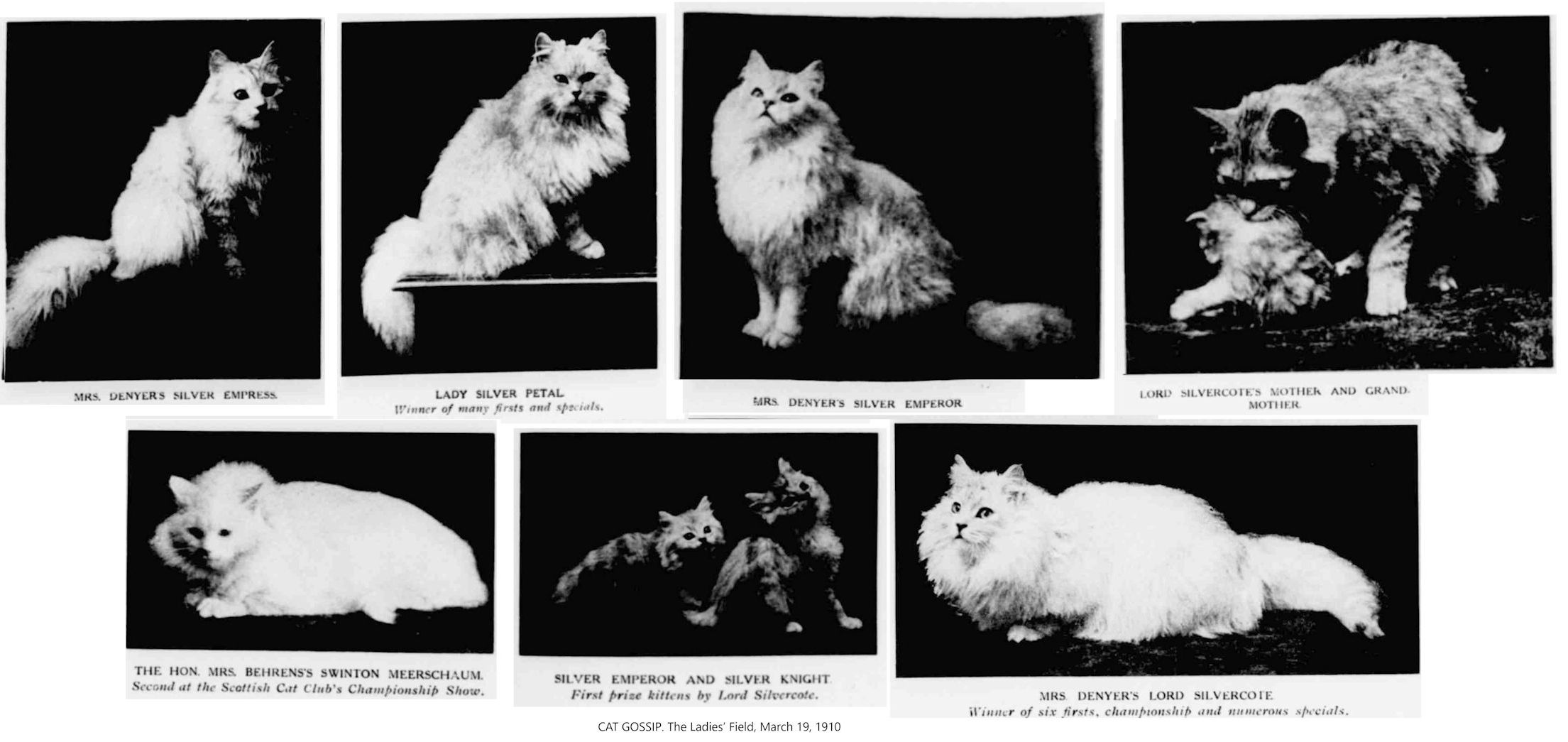
SCOTTISH CAT CLUB CHAMPIONSHIP SHOW.
THE twelfth annual show of the Scottish Cat Club was held on Thursday, March 3rd, in the City Hall, Candleriggs, Glasgow. The entries numbered some 320, the largest exhibitors being Mrs. Slingsby with forty-two, the Countess of Aberdeen with eighteen and the Hon. Mrs. Behrens with twelve exhibits. Mrs. Ransome was prevented from judging by illness, so the arduous duties of adjudicating were fulfilled by Mrs. Munsie-Leitch and Messrs. Bain Brown and James Money. Mr. Allan McDonald was the efficient show manager. Certainly much credit is due to Mr. John McNish, the hon. secretary and treasurer, to whose indefatigable energy the success of the show is attributable.
Long-haired section, blue (male): First, Mrs. Baldry's Blenkinsopp Prince, a splendid cat with a fine head and good markings; second and reserve went to Mrs. Slingsby's Blue Cap of Thorpe and Vanity of Thorpe; Mrs. Robert McCann took the third with her Sandford Boy, a really fine blue; v.h.c., the Countess of Aberdeen's Haddo Bluebeard and Mrs. Fosbery's Eastbury Cadillac, both in very good condition.
Blue (female): First, Mrs. Fosbery's Eastbury Dora, has good head and lovely eyes; second, Mrs. Slingsby's Narcissa of Thorpe; Mrs. Allan McDorald carried off the third with her Signoretta, a sweet blue with fine coat; reserve, Sweet Marie II., exhibited by Mrs. D. Swanson.
Kitten classes, blue (under nine months): Mrs. Slingsby carried off the second and fourth prizes in this class with her Narcissa of Thorpe and Jonquil of Thorpe; they also took first in Class 4 (pair of kittens under eight months). These are really a very promising pair, with good shapes and lovely eyes, and have a future before them. In this latter class Mrs. E. J. Fortune's kittens were second and Mrs. Graham Coltart's Toodles and Tibby third; this quartet were in splendid form.
Blue (novice, cat or kitten): This was a strong class, there being twenty-two exhibits. Mrs. Slingsby was again second with her Narcissa of Thorpe, while her Jonquil of Thorpe was reserve; v.h.c., Mrs. Cole's Dandy Boy, well marked, with good head; c., Mrs. G. P. Cochrane's Toby, a nice blue, but eyes too pale.
White (male): First, Mrs. W. Faulds's Knowe Boy; second and third, the Hon. Mrs. Clive Behrens's Swinton Rogue and Swinton Meerschaum; the latter's Swinton Merry Andrew was commended. but had he been less nervous higher honours would certainly have awaited him.
White (female): Second, Mrs. W. Fauld's Snowflake; third, Mrs. R. B. McLaren's Muscari; reserve, Mrs. Slingsby's White Rose of Thorpe, which was rather out of coat.
Black (male or female): First, Mrs. W, Walker Stevenson's Dabye: second, Mrs. Noble Wilson's Chloe; third, the Countess of Aberdeen's Avondale Black Mark, in fine coat, had lovely limbs; v.h.c., Miss S. K. Siles's The Cluricaux; c., Mrs. James Nicoll's Golden Eyes II.
Orange (male or female): First and second, Mrs. Slingsby's Aquila of Thorpe and Ch. Red Eagle of Thorpe; reserve, Miss H. M. Tawse's Carmen, a nice cat, with fine markings.
Cream (male or female): Mrs. Slingsby's Wilful of Thorpe headed this class, and the Hon. Mrs. Behrens's Swinton Daffodil, a lovely cat, was second; Mrs. Somerville took third with her Matty Dalziel, and was v.h.c. and h.c. for her Ronald Dalziel and Edwin Daiziel.
Chinchilla (male): There were only two entries in this class, and the winner, Silver Comet of Thorpe, is a perfect gem. He is another of Mrs. Slingsby's exhibits. Silver Elgin, which was second, has a good head and small ears. His owner, Miss Chamberlayne, may well be proud of him.
Shaded silver or silver tabby (male or female): Mrs. Slingsby's Ch. Don Pasquale of Thorpe was second in this list, the Countess of Aberdeen's Hadda Silver Foam being third.
In the tortoiseshell class (male or female) Mrs. Slingsby was the only exhibitor, and carried off the first and second with her beautiful Mayday of Thorp and Sunrose of Thorpe; while in the tortoiseshell and white class (male or female) her Ch. Rosette of Thorpe was first, the Countess of Aberdeen's Haddo Biscuit being a good second, but the latter was very savage, which spoiled his chances.
Cream kitten (under ten months): First, Mrs. Somerville's Edward Dalziel; third. Mrs. A. McCowatt's Blythswood Italo, a nice exhibit, and should have done better.
Any other variety kitten (under eight months): First, Mrs. A. Macgregor's Danny Maher, and second, the Countess of Aberdeen's Haddo Biscuit.
Mrs. W. Faulds's Knowe Boy and Knowe Lady were first for a pair of kittens, other than blue, under eight months. These are a promising pair. and should do well at future shows.
Novice, other than blue (cat or kitten): There was a fair entry for this class, Mrs. Somerville's Matty Dalziel heading the number, while the Hon. M Clive Behrens's Swinton Meerschaum was second and her fine Swinton Merry Andrew reserve; v.h.c., Miss Livingstone's Glencairn Brownie.
Class 24, limit, for cats having won not more than three firsts (long-haired or short-haired): Mrs. Slingsby was first, second and v.h.c. with her lovely trio, Aquila of Thorpe, Silver Comet of Thorpe and White Rose of Thorpe respectively.
Gelding (self-colour): First, Mrs. Breedie's Craigroy Major, a new face, in capital form, extra large blue, great coat, good head and eyes; second, the Countess of Aberdeen's Haddo Blue Lad, good head and markings; third, Mrs. Heggie's White Heather; reserve, Mrs. McLaren's Lord Percy Blakeney; v.h.c, Miss Christine Cassells's Ayrshire Fred; h.c., Mrs. Allan's Peter.
Gelding (other than self-colour): First, Miss Livingstone's Glencairn Silver Arne, a chinchilla, beautifully clear in colour and a grand all-round cat; her Glencairn Frederick took second, while reserve went to her Glencairn Brownie; Haddo Jake, exhibited by the Countess of Aberdeen, was third.
For stud cats Mrs. Slingsby was again first and second with her Silver Comet of Thorpe and Aquila of Thorpe, her Ch. Red Eagle and Aquila carrying off the first for brace.
In Class 30, team, of not less than three, this lady exhibitor was also first with her splendid cats, Vanity, White Rose, Ch. Red Eagle, Aquila, Aigrette, Wilful, Silver Comet, Ch. Don Pasquale, Sunrose, Mayday and Ch. Rosette.
Breeders (for cats bred by exhibitors): Second, Mrs. Slingsby's Ch. Don Pasquale of Thorpe; reserve, Mrs. Fosbery's Eastbury Dora; h.c., Mrs. R.B. McLaren's Lord Percy Blakeney; v.h.c., Miss H.M. Tawse's Carmen.
In Class 32 (for breeders, same conditions) Mrs. Somerville's Edward Dalziel was first; second, Mrs. W. Faulds's Lady; reserve, the Countess of Aberdeen's Haddo Silver Foam; v.h.c., Mrs. Baldry's and Mrs. A. Macgregor's exhibits; c., the Countess of Aberdeen's Haddo Plum.
Short-haired section (Siamese, Abyssinian or Manx, male or female): Platinum, a fine Abyssinian, exhibited by Mrs. Slingsby, headed the list, and Jupiter, a handsome Siamese, owned by Miss Kate Fraser, was second; third, Mrs. Allan McDonald's Swaye, a Siamese; reserve, Mrs. Chisholm's Siagon.
Mrs. Tom Fletcher was the principal winner in the Manx at or kitten class, The Deemster and Brunswick Biily Brown carrying off first and second respectively; nice cats, have good points and good eyes.
Self-coloured (male): Second, Cathcart Blue Lad, a splendid blue, has good markings. exhibited by Mrs. Campbell; fourth, the Hon. Mrs. Clive Behrens's Swinton White Heather; v.h.c., Mrs. Tom Fletcher's Brunswick Negro, a fine black.
Self-coloured (female): v.h.c., Mrs. Grieg's Blackie II.; c, Mrs. Graham Menzies's Orleans Blue Boy.
The red tabbies were a strong class, but the only lady exhibitors were Miss Mitchell, who took third for her fine Hero, and Mrs. Victor Bosanquet, whose Bowser was commended.
Silver tabby (male or female): First, Mrs. Fletcher's Brunswick Tabs; second, Mrs. J. E. Dougan's Falls Fairy; third, Mrs. Cunningham's Alfonso: v.h.c., Mrs. J. E. Dougan's Falls Beauty: c., Mrs. Fletcher's Brunswick Kuroki. This was quite a strong class, the quality being excellent.
Any other variety (male and female): Second, Mrs. Tom Fletcher's Brunswick Top, a nice cat but a little too white; third, Mrs. Slingsby's Ch. Cretonne of Thorpe; h.c., Mrs. Slingsby's Ladybird of Thorpe.
Novice classes: Second, Miss Kate Fraser's Jupiter; reserve, Mis. Cunningham's Esmeralda: v.h.c., Mrs. Victor Bosanquet's Redhill Domino; h.c., Mrs. Slingsby's Ladybird of Thorpe.
Gelding: First, Miss E. Richmond's Duke, in fine form; second, Miss Chamberlayne's Tibbo Tibbs; reserve and h.c., Miss Livingstone's Glencairn Baringa and Glencairn Patrick; v.h.c., Mrs. John Alexander's Tomey.
In the selling classes Mrs. Cunningham's Esmeralda was third; while in the ring class there was only one exhibitor, Miss Livingstone, who took first with her Glencairn Frederick.
Children's class: First, Master D. Blackwood's Coomy; second, Miss Nellie McPhee's Beauty, a lovely cat with good head and eyes; third, Miss Mary Bell's Billy; reserve. Miss Bessie Bell's Bab, a fine cat which should have done better.
FAST gaining in popularity among lovers of the aristocratic Persian cat is that fascinating variety the chinchilla breed. After years of patient striving this notable type is now, indeed, worthy of admiration. To the uninitiated it seems well-nigh impossible that the chinchilla of to-day, so pale and unmarked, originated from a smoke and a silver tabby. Bearing this fact in mind one can realise that many years of patient experiment were exercised before breeding out the tabby markings. Our illustrations of this beautiful breed are of some of the perfect specimens owned by Mrs. Edmund Denyer of Staines. Lord Silvercote, a winner of many firsts, championships and challenge prizes, is world-famous. His progeny, Silver Empress and Silver Emperor (owned by Mrs. Todd), among many others, have won many firsts, cups and specials; they inherit Lord Silvercote's exquisite colour and wealth of coat. In Lady Silver Petal we have an absolutely perfect specimen of a chinchilla, possessing a coat of exquisitely pale silver, quite unmarked and the much-coveted full, green eyes. As a hobby chinchilla breeding is a very engaging and interesting pursuit, while for perfect specimens there is always a demand.
ANSWERS TO CORRESPONDENTS.
C.L.P. You should brush and comb the cat well daily as this removes a great deal of the dead hair which is otherwise swallowed. Of course, some cats resent having their toilet thus performed, although they should have been taught, as kittens, to take it quietly. But a pair of thick gloves, and an assistant to hold puss by the front paws, enables the most refractory subject to be properly brushed and combed. The only thing you can give internally is a little pure olive oil, which many cats will take if mixed with some sardine oil, or the latter alone will answer this purpose. Remove the bones from the sardine and give it also to help down the dose. If the cat will not take the oil and you have to give it, warm it first, as it then leaves the spoon freely. About two teaspoonfuls is enough. Some people give an emetic, generally zinc, but I do not advise what I consider, personally, to be a very unwise proceeding, and one that is really unnecessary. If you cannot get the cat to take oil, and dislike dosing him, compromise by smearing his paws thickly with good fresh butter, which he must lick off, and which is useful by acting as an internal lubricant.
DORIS. - A book that would meet your requirements is "The Cat," by Mrs. Leslie Williams, published by Sidney Appleton. This is one the few books on the care of animals which can be recommended alike to the novice and the experienced fancier. Mrs. Williams's views on feeding cats and kittens are thoroughly sound and up to date, and she gives satisfactory reasons for holding the views she does.
MISS HARTR'S neuter is evidently suffering from small insects, which are often seen in cats, but which never leave the cats or get on to human beings. Remedy: Take a small piece of wadding dipped in spirits of wine, part the coat, and wherever dust is to be seen dab with spirit. It is a tedious operation. but effectual, Brush the cat well every morning with a long bristled brush, and take care it does not go near a light or the fire till the spirit has evaporated. Diet on raw meat, rabbit and plenty of nourishing foods, as the insects suck the blood of the cat and weaken the constitution. Do not turn the cat out of doors at night, but keep it in a warm dry place, with plenty of air but without draughts.
MASCOT. - The cat seems hardly remarkable enough to stand a very good chance at a show, but there is no reason why you should not send her as you have such a very great desire to see how she compares with others of her kind. As regards the "treatment" for cats when taking them to a new home, the best advice I can give is to take care that they are not frightened on their arrival, and let them have a good meal as soon as possible.
LEONIE. - 1. It is very improbable, I may almost say impossible, that your kittens are pure-bred. 2. You cannot do better than bathe the eyes frequently with hot boracic lotion, but I should not apply any greasy ointment. I consider that these cases of ophthalmia usually occur in connection with distemper, and under the circumstances satisfactory cures are rare. As the kittens are presumably mongrels, I should, if they do not very shortly show a marked improvement, have them destroyed,
CAT GOSSIP. The Ladies' Field, March 26, 1910, pg 171. - No Cat Gossip.
The second open dog and cat show was held in the Market, Carlisle. [No other mention of cat section.]
CAT GOSSIP. The Ladies' Field, April 2, 1910, pg . - No Cat Gossip
ANIMAL GOSSIP. The Ladies' Field, April 9, 1910, pg 255.
A CAT STORY. A CORRESPONDENT writes: "The old idea that a cat is a purely selfish animal, concerned only with the achievement of its own comfort and well-being, is exploded. May I tell one story of my Thomas to illustrate this? My Thomas was a pedigree orange Persian, and certainly master in his own house, which consisted of Grayling, a very handsome long-haired chinchilla, his little sister Trixie, and a one-eyed but most softly appealing little smoke we all called Chum. It was a sultry August afternoon. Everybody was abroad but myself, and that I might not have occasion to open the street door, the milk-jug had been placed outside it. I had a hazy recollection of hearing the milkman deliver our afternoon quantum of the fluid that is nectar to the feline world, and also of my Thomas getting softly from my lap. But it was not until I craved a cup of tea that I went to the door for some milk. This is what I saw: My Thomas, who had long had the bad habit of helping himself to milk from a deep jug by means of a front paw, was standing over the little pitcher and rapidly licking his paw, from which the milk dripped freely. Chum licked up the drips. For some time my Thomas dipped and licked his paw with regular monotony; Grayling and Trixie watched with eager eyes, unnoted by their lord. Presently Grayling uttered a little cry. Instantly Tom turned, paused to croon back an answer, then swiftly scooped up more milk from the jug and held his streaming paw for Grayling to lick. Was not this truest charity?"
CAT GOSSIP. The Ladies' Field, April 16, 1910, pg 279.
ANSWERS TO CORRESPONDENTS.
M. L. - He ought to manage this for himself, but many cats will not, and others never touch their own coats if any substance has once been put on them or if they have been washed. I advise you to use a good dry shampoo powder, such as the best hair specialists sell for human use. The "Guda" is a very good one. The basis of some of these, I believe, is carbonate of ammonia. They would be brushed in and out again, and are far more efficacious than flour, which is messy. Magnesia used to be recommended, but I never found it much good. Daily brushing and combing, preceded by a superficial rub over with a damp sponge and a towelling with a very fine thin face towel, would do a great deal towards keeping him clean.
MIRZA. - AII long-haired cats shed their coats periodically, as yours does, and nothing can be done to prevent it; it is their great drawback. For this reason cat shows are very unpopular if held in the summer months, and are usually timed to be in the long-hairs' best season. As a rule, however, neuters are much less shabby when changing coat than other cats, and he ought not to have sore places. Try the effect of a course of cod liver oil and iron. First see if he will take the former by giving a little ordinary cod-liver oil. and if he appears to like it administer a little (half a teaspoonful at first, gradually increasing to two teaspoonfuls) in a very little hot milk. Give him this every morning and put 5 grains of saccharated carbonate of iron on his meat daily. Continue for six or eight weeks. Feed very liberally on meat and give rabbit and other dainties, also try to get him to eat a raw egg every day or two.
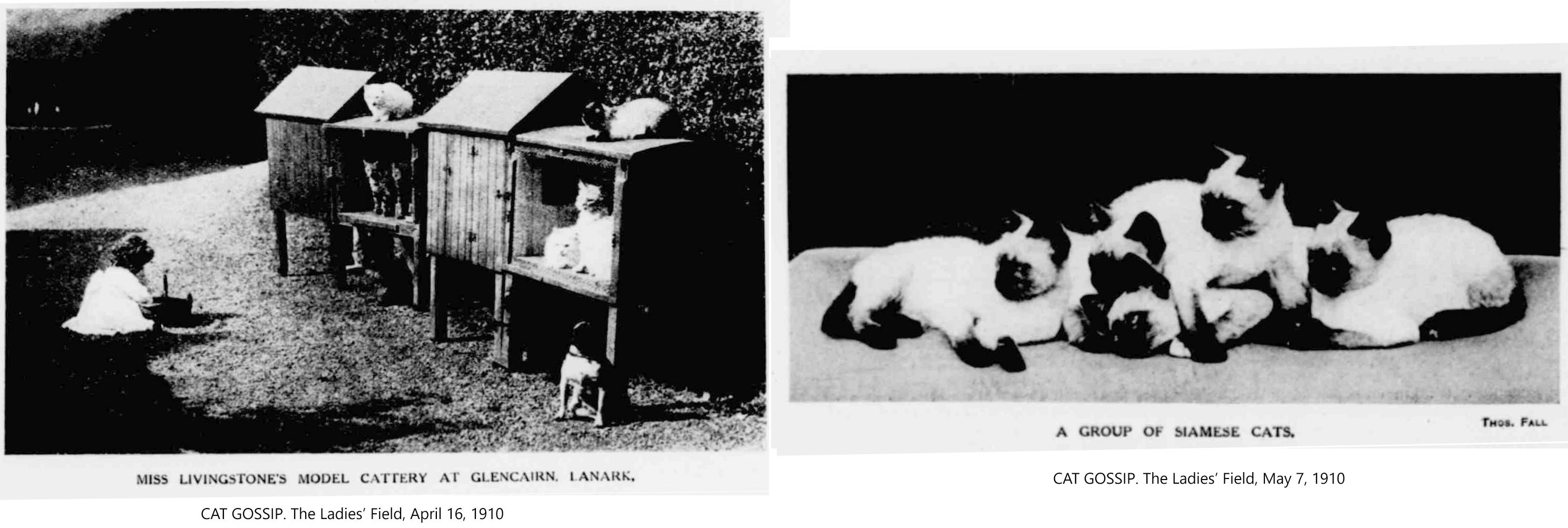
ANIMAL GOSSIP. The Ladies' Field, April 23, 1910.
THE Dundee Canine Club scored a big success with their seventeenth annual show of dogs and cats held in the Kinnaird Hall, an admirable venue for an exhibition of that description. The hon. secretary, Mr. Forbes Grant, deserves a special word of praise for the capital manner in which he piloted the show. His arrangements were most up-to-date, and all his efforts were nobly backed up by an efficient band of stewards. [No cat results given.]
CAT GOSSIP. The Ladies' Field, April 30, 1910. - No Cat Gossip
CAT GOSSIP. The Ladies' Field, May 7, 1910, pg 380.
DUNDEE CAT SHOW.
AT the Dundee Cat Show the cats were not as numerous as they might have been, and another year it might be as well to have the Show advertised more, as many people were enquiring where the schedules could be procured. Mr. D. Simpson was the judge, and his awards gave general satisfaction.
Long-haired blue male:
First and special, Mrs. Traill's blue, a fair head, nice eyes and in fine coat; second, Mrs. Grant's, a pale blue, eyes not so deep as the winner's; third, Mrs. Nicoll's, out of coat, and nose not so short as the previous winner's.
Long-haired blue female: First and special and second, Mrs. Morris's blues, the first prize winner a beauty, in fine condition, glorious eyes; the second prize cat also in fine coat, but not as good as her cattery companion's; third, Mrs.Traill's, out of coat and eyes too pale; reserve, the Countess of Aberdeen's blue; v.h.c. Mrs. Kidd's.
Any other colour male: First and special, Mrs. Walker's, a pale coloured silver with a brown tinge on the head and ears; second, Mr Reid's, a white, had a very bad cold in her eyes and coat looking harsh in texture; third, the Countess of Aberdeen's black, of a fine raven-coloured black and nice texture coat, but eyes too pale in colour.
Any other colour female: First Mrs. Reid's white, nice condition and nice-coated cat; second, Mrs. Boyd's silver, too dark in colour and out of coat; third, the Countess of Aberdeen's tortoiseshell and white.
Short-haired: Fi and special, Mrs. Reid's red tabby, beautiful in colour and markings; second, Mrs. Hanley's, also a red, not so deep in colour as the winner; third, Mrs. Thomson's brown tabby (this cat had a tiny kitten with her, hardly an advisable proceeding, we think); reserve, Mrs. Nelson's; v.h.c., Mrs. Donaldson's; c., Mrs. Anderson's.
Any variety: First, Mrs. Bruce's; second, Mrs. Hanley's (these two were absent from their pens at the time of reporting); third, ‘Mrs. Harper's cream Persian, in nice coat, good in eyes; reserve, Mrs. Thomson's; v.h.c, Mrs. McLean's; h.c., Mrs. Reid's.
Gelding: First and special, the Countess of Aberdeen's blue Persian, a fine, large cat, but eyes too pale in colour; second, Mrs. McInroy's, not in very good condition and out of coat; third, Mrs. Morrison's, a bad colour and also out of coat; reserve, Mrs. Scobie's; v.h.c., Mrs. Dick's; h.c., Mrs. Curtis's; c., Mrs. Inroy's.
Novice: First and special, Mrs. Morris's, the winning blue female; second, Mrs. Walker's, the winning any other coloured male; third, Mrs. Reid's, second prize-winner in the any other colour male class; reserve, Mrs. Hanley's; v.h.c., Mrs. Traill's; h.c., Mrs. Grant's; c., Mrs. Nicholl's.
CAT GOSSIP. The Ladies' Field, May 14, 1910. - No Cat Gossip
"THE CAT IN HISTORY, LEGEND AND ART" forms a descriptive phrase which will be very alluring to many people, and the book of which it forms the title will not disappoint them, for it is delightfully written and illustrated by the author, Miss Anne Marks. The cat since her appearance in the days of Noah has experienced fortunes as chequered as those of Humanity. Worshipped in ancient Egypt, as everyone knows, she had a very bad time in Europe in the Middle Ages, such games as "Cat in Barrel," "Cat in Bottel" and "Catte in a Basket" proving not at all to her taste. Also, she was the familiar of witches, the guise of Satan and a harbinger of Evil in every movement she made. To-day, in Europe, at all events, her position is rightly described by Miss Marks as "comfortable." For the most part she is "pampered and petted, exhibited, painted and caricatured; provided with her Burke and Debrett, her clubs, shows and hospitals." At the worst, she is Shakespeare's "harmless, necessary cat," except when someone, as has M. Maeterlinck in "The Blue Bird," recalls some of the bad impression she made on our forefathers. Then ee remember that even in Egypt the female cat was held spiritually akin to the moon and the powers of Night, that on some of the ancient monuments she represents false friendship (modern "feline amenities"), and that although she lives in our homes she has little affection for us. Miss Marks, however, in her pleasantly partial narrative suggests that this want of attachment may be due to the eating of mice, which are thought to induce forgetfulness.
"The Cat in History, Legend and Art." (Elliot Stock, 62, Paternoster Row.)
CAT GOSSIP. The Ladies' Field, May 21, 1910. - No Cat Gossip
CAT GOSSIP. The Ladies' Field, May 28, 1910, pg 496.
THE Bristol Fanciers' Society will hold their show on October 26th, and 27th. There is to be an extensive classification for cats, and Mr. and Mrs. Palmer have kindly promised to take charge of the cat section. Mrs. Palmer is presenting a lovely 5-guinea cup for the best cat in the show.
A GENERAL meeting of the National Cat Club was held recently at 2, New Court, Lincoln's Inn, by kind permission of Mr. Maurice Barnett. The meeting was well attended. Lady Decies, Mrs. Vallance, Mrs. Brooke and Mr. Little were elected delegates for the National Cat Club on the Governing Council. The National Cat Club contemplate holding a one-day show at the Botanic Gardens about June or July.
MRS. NORRIS has had the great misfortune to lose her fine blue, Ch. Kew Blue San Toy II. This loss has come as a great grief to Mr. and Mrs. Norris, as he was a great pet. He was quite well one night, and the next morning was found dead in his box. He died from fatty degeneration of the heart.
THE fine blue queen, Blue Heather, belonging to Mr. Hodgkinson, has lately been sold to Miss Gladys Cheetham of Oaklands, Brighouse. T
THE HON. MRS. CLIVE BEHRENS'S Swinton Princess of Siam has four kittens by Mrs. Robinson's Wankee III. These kittens were born on March 12th, and look most promising. Mrs. Behrens's Swinton Brownie has three kittens to her Swinton Usquebaugh, and her Swinton Stray has four kittens to her Swinton White Heather, which have all got blue eyes.
LADY DECIES has had the misfortune to lose, from jaundice, her lovely black short-hair, Fulmer Black Michael.
MRS. MARDON'S Beauty has four nice kittens by Miss Humfrey's Don Carlos.
THE second annual general meeting of the Northern Counties' Cat Club will take place on June 11th at three o'clock in the grounds at Ossett Show.
AT Cathcart Show, to be held on June 4th, Mrs. A. L. Cathcart will be the judge, and there will be eight classes for cats. - SPIDER.
CAT GOSSIP. The Ladies' Field, June 4, 1910, pg 31.
MRS. GEORGE LIVESAY'S ZUDI (third prize Crystal Palace, 1909) has six lovely blue Persian kittens by Mrs. Clarke's Bath Blue Blossom, five males, one female. Also her Mousme has three fine blue Russian kittens by her Ivanovich, a very promising trio.
CAT GOSSIP. The Ladies' Field, June 11, 1910, pg 76.
MRS. HOWE-WHEATLEY has just sold White Foxglove to Miss G. Kerswill; he is going to New Zealand. Mrs. Howe-Wheatley has also sold a beautiful daughter of Foxglove's to Miss Clifford of Cambridge.
THERE will be seventeen classes for cats at the Edinburgh Kennel Club Show on June 22nd. Mr. Archibald Knox is in charge of the fur section, assisted by Mr. James Blythe and Mrs. Grieg.
THERE were a nice number of cats entered at Otley Show on Moy 28th. The medal for the best cat in the show was awarded to the Hon. Mrs. Clive Behrens's cream, in nice coat and good colour. Mr. T. Ambrose was the judge.
Blue long-hairs: First, Mrs. Crowther's Tennyson Silky Queen, short of frill, good eyes and nice shape; second, Mrs. Pease Bennett's Newcastle Monarch, a nice-headed male, in lovely coat, third Miss Winifred Beal's Romaldkirk Captain. This cat would not be handled, has a good head. Pens 1 and 3 were empty.
Long-haired, any other colour: First, Northern Counties' Cat Club medal and special for best cat in show, the Hon. Mrs. Behrens's Swinton Daffodil, a cream male, lovely even colour, in fine coat and nice eyes; second, Mrs. Hall's Golden Eagle, a large-boned red tabby male, good head, colour and nice eyes; third, Mrs. Woodcroft's tortoiseshell and white, a nice shape and in good coat; fourth, Miss W. Beal's Romaldkirk Orange, a a lovely deep colour, out of coat; reserve, Mrs. Stephenson's; v.h.c., Mrs. Wood's.
Long-haired kitten: First, Mrs. Atkinson's blue male, has good eyes and nice bone, but out of coat and big in ears; second, Mrs. Laine's Sapphire Queen, a blue female, in fine coat, rather young and wants time to develop, eyes rather pale in colour; third, Miss Butler's cream, good eyes, but colour too uneven; fourth, Mrs. Wood's White Queen, a nice blue-eyed white, but weak in bone; reserve, Miss Dawsons; v.h.c., Mrs. Jefferson's; h.c, Mrs. Buck's.
Short-haired tabby: First and Northern Counties' Cat Club medal for best short-hair, Mrs. Hanley's Eclypse, a well-marked red, with a beautifully fine coat; second, Mrs. T. Fletcher's Brunswick Tabs, a well-marked silver tabby; third, Miss Burton's red tabby male, a nice cat, well marked and a good shape; fourth, Mrs. Odell's red tabby; reserve, Mrs. Charnley's.
Short-haired, any other colour: First, Mrs. Adam's, a Siamese, rather small in size, but has good eyes; second, Mrs. Cariss's tortoiseshell and white, a nicely patched cat not quite rich enough in colour; third, the Hon. Mrs. Behrens's white male, Swinton White Heather, rather pale in eyes, in nice coat; fourth, Miss Fitzwilliam's Siamese, pale eyes, and not dense enough in points; reserve. Miss McDowell's; v.h.c., Miss Burton's; c., Mrs. Fletcher's.
Short-haired kittens, eight months: First, Mrs. Hanley's Eclypse, the winning red tabby; second, Miss Burton's silver tabby, nicely marked, but not quite clear enough in ground colour; third, Mrs. Potter's tortoiseshell, very dark on the feet, and too dingy in colour; fourth, Miss Burton's brown tabby, white on chin, but a fine cat. - SPIDER.
CAT GOSSIP. The Ladies' Field, June 18, 1910.- No Cat Gossip.
CAT GOSSIP. The Ladies' Field, June 25, 1910, pg 175.
"SPIDER" will be glad to receive good photographs and any news concerning cats for insertion in this column. In the case of copyright photographs the owner should be mentioned, and every care will be taken to return them, although the Editor cannot accept responsibility.
BUTE AGRICULTURAL SOCIETY held their annual show the other day in the public park, Rothesay. The cat section was under the management of Councillor C. Hill, and to his able management may be attributed the expeditious way in which the cats were penned and despatched. Mrs. S. M. C. G. Henn of Bute made her first debut as judge and Mr. Millar was the steward. The awards were as follows:
Long-haired male, any colour: First, Mrs. A. Macdonald's red, a nice-coated cat, a trifle long in nose, good eyes; second, Mrs. W. R. Montgomerie's chinchilla, rather dark in colour, good eyes; third, Mr. John Holmes's, not in pen when reporting.
Long-haired female, any colour: First, Mrs. Macdonald's Purity, a fine white, too well known to need describing; second, Miss Janet McEuen's white, eyes too pale, in good coat; third, Mrs. Montgomerie's smoke, a nice little cat, eyes might be darker.
Short-haired males: Only one in the class, won by Mr. Robert Currie's red, too much white in its coat.
Short-haired females, any colour: First and special, Mrs. D. McC. Weir's blue, a very nice exhibit, with good ears, fine eyes, in nice coat; second, a tortoiseshell and white Manx, also a very fine specimen; third, a tortoiseshell, nursing a litter, which made her out of condition; fourth, a nice blue kitten, unfortunately entered in the wrong class.
Gelding, any variety, long or short haired: First, Miss Stevens's, a beautiful, black long-haired, an easy win; second, a medium short-haired ticked tabby; third, Mrs. A. Black's, a silver, in bad condition, wanted brushing badly.
Members' class, long or short haired: First, Mr. John Holmes's; second, Mrs. D. McC. Weir's blue short-haired, the first prize winning short-haired blue in the short-haired female class: third, Mrs. W. R. Montgomerie's chinchilla, second in male open; fourth, Mrs. J. H. Squair's.
MILNATHORT SHOW will take place on September 3rd. This will be the semi-jubilee of this fixture.
MRS. STUART ROGERS, Layton Villa, Hassocks, is asking all cat fanciers to help her in any way for Hassocks Cat Show. This show takes place on November 3rd, and has always been very popular. It is to be hoped that when it takes place there will be a record entry and that many classes will be guaranteed.
I HAVE lately seen a new invention, namely, a very nice travelling cat basket. They are made of the finest buff willows, well varnished; each compartment has a separate open-work inner lid, with large close-work outer lid. The baskets are lined throughout with flannelette; there are straps to fasten, and a pocket in the side of the basket to put cards in. They are made in three sizes, to hold one, two or three cats.
WE are sorry to hear that Miss Cope is not well, and has been obliged to part with her cat, Lord of the Manor, to Mrs. Sharland. This lady is very keen on silver tabbies, and this fine stud cat should be an addition to her cattery and benefit the breed. Mrs. Sharland has already got two very fine silver tabby females.
MISS HILL SHAW has some nice kittens by Mrs. Watson's Barry Peter. Miss A. Beatson's Bath Empress has five kittens by Mrs. Slingsby's Ch. Neila Billi.
WE are sorry to hear that Mr. Ballantyne has lost his fine blue stud Neidpath Gilpin. Gilpin was a son of the late Ch. Orange Blossom and has sired some beautiful kittens. This fine cat died from a chill owing to the changeable weather we have been having lately. Mr. McNish has also sustained a great loss in the death of Dusk Vale Velvet Paws, the pretty little short-haired blue female which did so well at Glasgow, winning first prizes in three classes, championship and silver medal for best female.
A SHOW will be held at Prestwich on July 9th. Mrs. Herbert Ransome has kindly consented to judge the cats. Sandy Show this year is on August 25th.
MANY fanciers will regret that Mrs. Livingstone has decided not to show her cats any more. Mrs. Livingstone has shown cats for the last seven years, and at the shows her neuters, long and short hairs, were always much admired. No fancier has been more popular than Miss Livingstone. The Scottish Cat Club have shown their appreciation of Miss Livingstone's services by electing her an honorary life member.
THE pretty picture published on this page shows Mrs. Gordon's famous prize-winner, Ladybird, with her attractive family. At the Crystal Palace in 1909 Ladybird carried off a championship, two firsts and two specials. The kittens were sired by Rob Roy, a famous stud cat, whose son, Rob Roy II., was sold for £100.
ANSWERS TO CORRESPONDENTS.
TADDLES. - There must be some amount of constitutional weakness for the cat to suffer as described. Upon the extent of this weakness the possibility of cure hangs. Such cases have been completely cured by treatment, which consists of surgical attention to the abscess and general building up by means of every possible nourishment with tonics and change of air. Of course, it is very troublesome to dose cats; and as you give no address I cannot tell whether you are near a good veterinary surgeon. But if you live in London, take the cat to the Royal Veterinary College, Camden Town, where they would treat the abscess. You see, unless it is properly evacuated, drained and aseptically dressed, it is likely to go on forming again and again, and such a continual strain on the system cannot be much longer borne. You could not manage all this yourself unless you thoroughly understand nursing and simple operations. The opening of the abscess should be done just as it is about to break, and the surgeon would do it under a local anaesthetic, probably ether spray, so that it would not hurt. The cat should be liberally fed twice a day on scraped raw beef, and have besides pure raw cream or a fresh raw egg stirred into a little new milk in which some Plasmon powder has been gently cooked for a few minutes. She should have 5 grains of saccharated carbonate of iron on one of the meat meals, and if she will take cod-liver oil and malt, give her that also in regular small daily doses, beginning with half a teaspoonful. She should be allowed to have fresh air and sunshine, but be kept indoors in a warm place at night. It is probable that the trouble is what is known as a cold abscess, and this is not acutely painful, but no doubt the patient feels very weak.
Re. CAT WITH SWELLING ON NECK. - ln reply to "Buffie," I should advise taking the cat to A. Sewell and Cousins, 55, Elizabeth Street, S.W., for advice. It may be an abscess, and, if so, fomenting is the best thing to do. I should let the kitten be out of doors as much as possible, as an out-of-door life seems to suit her best. Iodine is not safe to use in large quantities on cats, as if they lick it, it is bad for them. A small dose of Epsom salts in a saucer of milk is a good thing. Plenty of fresh water is a necessity, and a bowl should always be at hand. When the cat begins to roll about and to mew a good deal, then it is generally the time to lock her in. - SPIDER.

CAT GOSSIP. The Ladies' Field, July 2, 1910, pg 195.
"SPIDER" will be glad to receive good photographs and any news concerning cats for insertion in this column. In the case of copyright photographs the owner should be mentioned, and every care will be taken to return them, although the Editor cannot accept responsibility.
AT the Ossett Agricultural Society's show the Hon. Mrs. Clive Behrens's Swinton Day Dream took the special for the best cat in the show. Miss Chectham won the special for best long-haired blue cat in the show; and Miss Burton won the special for best short-hair in the show with her orange tabby.
Long-haired blues: First and special, Miss Cheetham's, a fine blue; second, Mrs. Walker's, not quite so sound in colour as winner and eyes not so deep, but a very nice cat; third, Mrs. Crowther's.
Tabby, any colour: First and special, Mrs. Kitching's brown tabby, a fine-headed cat, with good markings and in nice coat; second, Mrs. Hall's orange tabby, a fine, red colour and nice head, a little out of coat; third, the Hon. Mrs. Behrens's orange tabby, has a long face and is out of coat; v.h.c., Mrs. Moore.
Any other coloured male: First, Mrs. Behrens's cream, had lost its frill, but is a lovely cat, with a beautiful head and eyes; second, Miss Wharton's black, not quite in full coat, has a fine head; third, Miss Burton's cream.
Any other coloured female: First and four specials, Mrs. Behrens's Day Dream, a white well known and in fine condition, eyes too pale or would be unbeatable; second, Mrs. N. Wilson's black, a good colour, nice head and eyes, also very cross and objected to being handled; only two in this class.
Kitten any colour, eight months: First and special, Miss Atkinson's blue, a lovely blue the correct shade, with nice orange eyes, but short in frill; second, Mrs. Laine's, a blue with a good head, eyes a little too pale, neat ears; third, Mrs. White's, rather young with a sweet little face and expression and a good colour; fourth, Mrs. Morris's orange tabby.
Short-haired orange tabby: First and three specials, Miss Burton's, a finely marked cat with a nice head; second, also Miss Burton's; third, Miss Mitchell's, also a nice-coloured orange tabby, but not such good markings as the previous winners; v.h.c., Messrs. Odell and Son.
Any other coloured tabby: First and special, Mrs. Fletcher's silver female, not quite in coat, which caused the markings to be a little blurred. I preferred the second prize-winner, which belonged to the same owner, only he had a little cold in his eye which evidently put him back; third, Miss Burton's brown tabby, has a fine head, but markings not distinct enough, probably owing to not being in full coat; v.h.c.. Mrs. Butterfield and Mrs. Walker's.
Whites: First and special, Miss Burton's, a pretty deep blue-eyed cat, shown beautifully white and clean; second, Mrs. Behrens's, too long in coat for a short-hair and a trifle long in face, but lovely eyes; third, Mrs. Williamson's, nice coat, but pale in eyes; v.h.c., Miss Burton's.
Blacks: First, Mrs. Haslam's, a raven in colour, eyes a trifle too pale; second, Miss Pye's, also a nice black; third, Mrs. Hargreaves's. This cat would not be handled; v.h.c., Miss Burton's; h.c., Mrs. Fletcher's.
Blue: First and second, Miss Burton's pair, both a good blue but eyes too pale; third and special, Mrs. Towlerton's, too pale in undercoat but a good shape; v.h.c., Mrs. Marsden's.
Any other colour: First, Mrs. Adams's, a Siamese, of a nice pale colour, the only one in this class.
Kittens, any colour: First, Mrs. Pickles's orange, rather a long face, but good eyes and a lovely colour; second, Messrs. Odell and Son's orange, eyes a little pale and a trifle long in face, but a fine colour and markings; third, Mrs. Ashton's tortoiseshell, nice head and good body colour; v.h.c., Mrs. Marsden's.
Neuter, any variety: First and special, Miss Burton's short-haired white; second and special, Miss Atkinson's blue long-hair, a little out of coat, but has a nice head and is of a sound, blue colour: third, Mrs. Hibbitt's white, very much out of coat.
Selling class, price 30s.: First, Mrs. Ambrosc's; second, Mrs. Durham's; third, Mrs. Crowther's.
Local, any variety: First and special, Miss Wharton's, a lovely long-haired black, with a nice head and in good coat; second and special, Miss Ashton's; third, Mrs. Durham's; v.h.c., Mrs. Butterfield and Mrs. Walker's; h.c., Mrs. Pollard's. - SPIDER.
CAT GOSSIP. The Ladies' Field, July 9, 1910, pg 238.
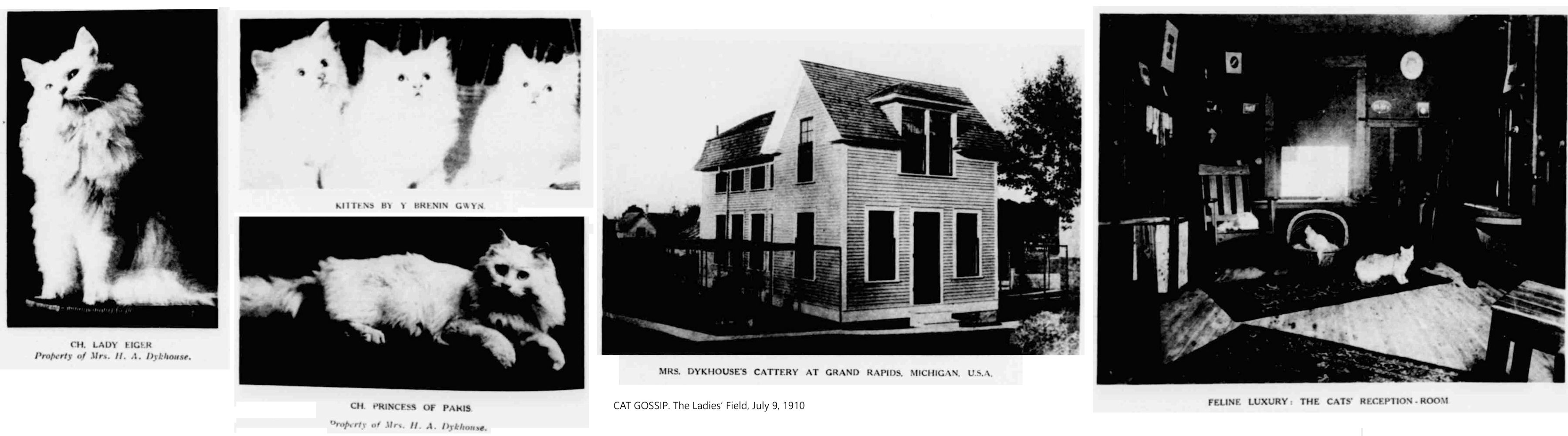
AN AMERICAN CATTERY.
REPUBLICAN though the United States is in its Government and in its sentiments of equality in the birth of all the eighty millions of people who go to make up the stately roll of its inhabitants, its men and women tacitly acknowledge, under certain conditions, the truth of the old proverb, "Blood will tell," which underlies the principle of the caste and sway of sovereignty. This recognition prevails in the animal world, notably among the creatures which are bred for sport, and more particularly for the show bench. Especially is this the case with cats. Although it is only of recent years that the cat fancier has been able, or, perhaps it would be more correct to say, has tried, to impress the value and fascination of his - or rather her - hobby on the consideration of a large public, it has already attained such dimensions that it is no unusual thing for the cat shows of a single club to bring together animals valued in the aggregate at from £40,000 to £50,000, or even larger sums.
Among the most celebrated cat breeders of the country is Mrs. H. A. Dykhouse whose Romeo Kennels, Grand Rapids, Michigan, are among the most complete and delightful catteries to be found in the length and breadth of the United States. These kennels are noteworthy for the fact that they contain what has been described as a palace for the animals. It consists of a two-storey frame house erected on the lawn attached to Mrs. Dykhouse's home, and cost about £600 to build and furnish. It is equipped with a complete heating and electric lighting plant, and is perfect in every detail. On the ground floor is a reception room which forms one of our illustrations. It is decorated with photographs of its present and former distinguished inhabitants and the trophies they have won in the various shows of the country, and handsome rugs are, as will be seen, provided for the white Persian cats to the breeding of which Mrs. Dykhouse largely devotes herself.
Beyond the reception-room, on each side of an aisle, are fourteen cages, which, opening out into a small private caged yard, seen in another of the illustrations, give plenty of space for exercise, although in the summer the kittens are allowed still greater freedom. On the first floor are a creche and maternity room, a small nursery and hospital, and in the nursery are many toys for the amusement, if not the edification, of the young kittens. The house is also furnished with a dietary kitchen, so that everything necessary for the comfort of its inmates is always ready to hand.
Many of the famous cats owned by Mrs. Dykhouse have family trees superior to those of most American citizens, for their lineage goes straight back to their native Persia. These Persian cats are, as all fanciers know, distinguished for their dry, shiny fur as well as for the possession of certain traits which make them seem, at once, over-refined and aristocratic. This is evidenced in the almost humorous way with which a real Persian will carefully avoid the dusty places in a room - should such exist - and will, invariably, select the softest silken cushion for the purpose of stretching its dainty limbs, while the ordinary house cat will content itself with a by no means spotless rug, provided it offers a convenient resting place near the alluring charm of a fire. In Mrs. Dykhouse's kennels are some of the most famous prize-winners in the American continent in addition to several champions. To gain a championship a cat must win ten points under the rules of the American Cat Association. The famous cats include Lady Eiger, The Princess of Paris, Lady Thelma and Al Tarem among others.
Lady Eiger is a blue-eyed white Persian which was born in May, 1906. Her record is a very fine one, for, at Syracuse a year or so ago, she obtained twenty-three specials and eleven challenge cup wins, being the best cat in the show, the best novice, the best female and the best American-bred cat and took precedence over twenty famous imported prize-winners. In Chicago, about the same time, she was also first in the open classes, winning a championship, and the prize for the best cat in the show, in addition to fifteen specials and nine challenge cups. She maintained her record in the Cat Show at Grand Rapids last year, being first in the open class, the best female in the show, taking twelve specials and five challenge cup wins, and winning outright two cups which have to be taken three times running before becoming the property of the owner.
The Princess of Paris is another blue-eyed white Persian which is a famous prize-winner. Her record began as a kitten in 1907, when she was first in the open classes in Chicago and also took the prize for the best American-bred female in the show. This record she subsequently repeated in that city as a full grown cat. In addition to these, she has had a remarkable series of wins in such important shows as those of Toronto, Springfield, Buffalo, Cleveland and Columbus, while at Grand Rapids last year, she was beaten only by Lady Eiger. She has also to her credit four silver cups and two gold medals; among them being a famous challenge cup for the best blue-eyed white female cat.
Lady Thelma, a silver Persian, is one of Mrs. Dykhouse's best born cats, her sire being Rob Roy, the famous chinchilla from one of our own best known kennels - the Arrandale. Lady Thelma took the first prize in the novice class in Chicago three years ago, and since then has won first prizes in the open classes in Buffalo, Chicago, Cleveland, Detroit. Milwaukee and Toronto.
Gavatta, a tortoiseshell Persian, besides being champion is also a winner of the challenge cup awarded by the American Cat Association. Al Tarem, a shaded silver male Persian, and Lady Thelma won two awards in the challenge cup contest at Chicago, and each has held the challenge cup for two years running. Another famous member of the household is Y Brenin Gwyn, an imported English cat with a Welsh name and a high Persian ancestry. He went to America with a record of three prizes, and within one year after his arrival he won over thirty-five prizes and a challenge cup. He has also taken cups at the Royal Cat Show, the Washington and Beresford (Chicago) Cat Clubs, a bronze medal at the Atlantic Cat Club of New York as the best white cat in the show, while he carried off the gold medal at the Washington Cat Club as t he best white. He as undoubtedly a brilliant future before him.
Mrs. Dykhouse's latest possessions are two Royal Siamese cats of which there are only a very few specimens at present in America. These cats which were imported from England are almost the colour of a black and tan terrier. Their bodies are of a pure tan, while their head, feet and tail are very dark brown. Fanciers describe them as "Tan colour and chocolate points," and their blue eyes set in a dark brown face give them a curious if not uncanny appearance. It is a point of interest that Mrs. Dykhouse who is a member of most of the important American cat clubs, is constantly represented at the chief shows in England by an agent, so that her kennels may be replenished by the best stock.
In her home she has a large China cabinet filled with the prizes and trophies won by her pets. There are fold and silver medals, challenge cups and silver cups of various kinds and sizes; pieces of silver and cut glass, badges and ribands by the dozen, in all of which she takes great pride. Las year her cats won no fewer than 107 prizes, all of which were specials and firsts. That she has the real unadulterated spirit of the fancier is evident from a remark she once made to the inevitable interviewer. "I would rather," she said, "have my cats than a steam launch or a dozen automobiles." She regards cat breeding as a fascinating and expensive sport, and "she loves her pets almost as if they were children." In short, she is a fancier whose enthusiasm would make her persona grata with al English fanciers, who never fail to stretch out the hand of comradeship to the foreign follower of the same hobby who breeds with skill, and whose delight is to see the blue riband awarded without favour to the admittedly best specimen of its class.
CAT GOSSIP
"SPIDER" will be glad to receive good photographs and any news concerning cats for insertion in this column. In the case of copyright photographs the owner should be mentioned, and every care will be taken to return them, although the Editor cannot accept responsibility.
RICHMOND CAT SHOW took place in the Old Deer Park on Tuesday, June 21st. The weather was perfect and a great many people visited the cats, which, in many pens, reclined on silken cushions and had balls and toys to play with. Among those who visited the show were H.H. Princess Toussoun, Baroness Campbell, Lady Binning, Lord and Lady Decies, Lady Kathleen Pilkington, Mrs. Vallance, Mrs. Philip Hunloke and Mr. Henry Peter. Mrs. Millar made her debut as judge owing to the regrettable absence of Mrs. Ransome, who, we regret to hear, is suffering from acute trouble with her eyes. Mr. T. B. Mason undertook to judge her classes.
The prize for best cat in the show went to the Hon. Mrs. Behrens's Day Dream, who was looking well and in fair coat for this time of year, Miss Bartlett won for best Chinchilla kitten with a very young kitten with a sweet face; and Mrs. George Wilson must have been very pleased to see that her Sir Archie II.'s kittens carried all before them. There were 241 entries and the quality of the cats was good.
Blue, male or female: First, Mrs. Fisher White's, a fine-headed young male, a nice colour and good short face, only fault eyes might be deeper in colour; second, Mrs. Wynn's (this queen was nursing a litter of kittens) - she was much out of coat, but is a fine large cat; third, Mrs. George Wilson's blue, a trifle shaded about the ruff owing to changing its coat, has a nice head and eyes.
Blue novice: First and third, Mrs. George Wilson's Sir Archie III,, of Arrandale and Dame Archie of Arrandale, both good-headed blues; second, Dr. Woodcock's Winchmore Blue Belle, has lovely eyes and a nice colour; v.h.c., Mr. P. J. Lawrence's Nada.
White or black, male or female: First, the Hon. Mrs. Behrens's Swinton Day Dream, rather weak in head and pale in eyes, but looking well; second, Mr. P. J. Lawrence's Teresa, a grand-coated cat, but pale in eyes; third, Mrs. Behrens's Swinton Rogue (we saw this cat last year as a kitten, and he has not fulfilled the promise he gave then of being a very large cat) - he has a pretty face and good head, but is small and has pale eyes; reserve, Master B. Currie's Puff Ball, a lovely cat with deep blue eyes; v.h.c., Mrs. H. Cook's Blue-Black; h.c., Mrs. R. Fisher White's Persephone of Highgate; c., Master B. Currie's Pearl Sea Queen.
Chinchilla or silver, male or female: First, Mrs. George Wilson's Rob Roy III. of Arrandale, a beauty, only fault a little cream on the face, splendid bone, size, colour and eyes; second, Mrs. Labron's Chiswick Tiger, a fine silver tabby with a nice head and well marked; third, Mrs. Burt's Silver Junita, long in nose, good eyes and lovely body colour; reserve, Miss Chamberlayne's Crown Diamond; v.h.c., Miss D. Piersenne's.
Brown tabby, male or female: First, Miss Chamberlayne's The Sable Boy, nice colour and markings and a good head, but pale on the chin; second, Mrs. Fleming's Strathclyde Sir Galahad, not so good in colour as the winner; third, Mrs. Ambrose's Maid of Kent, also not good in colour and too much blurred on the back.
Orange or cream, male or female: First and special, M s. Norris's Ch. Kew Red Comyn, a very deep red, shown in fine form; second, the Hon. Mrs. Behrens's Swinton Daffodil, a nice cream, ears might be shorter, but a nice colour; third, Mrs. Norris's Ch. Kew Ronald, a grand old cat, but showing age; reserve, Miss H. Lea's Ruckholt Noel; v.h.c., Mrs. Kennaway's Garboldisham Junker; h.c, Mrs. L. Maxwell's Tibert.
Any other colour, male or female: First, Miss Milier's Chloe, a well-patched tortoiseshell with a nice head; no second awarded; third, Mrs. Norris's Kew Pansy, also has a nice head, but fails in patchings.
Any colour, except blue, novice, male or female: First, Mrs. George Wilson's Rob Roy III. of Arrandale (the winning Chinchilla); second, Mr. Lawrence's Teresa (the second prize winner in Class III., white or black, male or female): third, Mrs. Labron's Chiswick Tiger; reserve, Mrs. Burt's Silver Jimeta; v.h.c., Mrs. Maxwell's Tibert.
Brace: First, Mrs. Norris's; second, Mrs. G. Wilson's; third, the Hon. Mrs. Behrens's; v.h.c., Miss Chamberlayne's: h.c., Master B. Currie's.
Short-haired cats, red tabby, male or female: First, Mr. E. Oliver's Gainsborough Red Jacket, a lovely red cat, with good markings of a deep red, looking well; second, Mr. Reid's Everbright, another rich-coloured cat, but markings too heavy on back.
Silver tabby, male or female: First, Mr. J. Woodward's Tiger; absent, Lady Alexander's Ballochmyle Simple Simon.
Brown tabby, male or female: First, Miss Beardsley's Kitty Brown, a nice cat of a good colour and markings; absent, Lady Alexander's.
Black, male or female: Second, Mr. J. Haslam's Romney, a fair colour, but eyes too pale; absent, Lady Alexander's.
Manx, male or female: Second, Miss D. Shaw's Diamanta, a pretty tabby; absent, Sir Claude Alexander's and Miss Samuels's.
Siamese, male or female: First, Mrs. de Vere Brooke's Ch. Sancho, the well-known cat, looking well; second, Mrs. Maturin's Light of Asia, not so dense in points, has nice eyes; third, Mrs. Kennaway's Rachel, not in condition, but a nice cat; reserve, Mrs. Robipson's Babs.
Any other variety, English or foreign, male or female: First, the Hon, Mrs. Behrens's White Heather, a short-haired white, in good condition, but eyes pale; second, Mrs. Patman's brown Abyssinian, a well-ticked cat, a little light in colour; third, Mrs. Carew Cox's Onizero Taiton, a nice silver Abyssinian.
Novice, any variety, male or female: First, Mrs. Carew Cox's Onizero Taiton; second, Mr. Reid's Red Rose, a beautiful tortoiseshell and white, well patched: third, Mrs. Mason's Royal Butterfly, also a nice tortoiseshell.
Brace: First, Mr. Oliver's; second, Mrs. Robinson's.
Kitten classes, long-haired, blue, male or female, under nine months: First, Mrs. George Wilson's Kyra of Arrandale, a beauty, a large cat and in fine coat, nice eyes; second, Mrs. Wilson's Thyra of Arrandale, also a nice cat, but not in such good coat or so big as the winner; third, Miss Lea's, not such a good colour or such good eyes as the other two.
Blue, male or female, under six months: First, Miss M. Whyte's blue female, a pretty kitten, with fine eyes, rather young; second, Miss Hine's Winchmore Lightfoot, very pale in colour, a trifle long in nose; third, Mrs. Sharland's Gemini.
Chinchilla or silver tabby, male or female, under six months: First, Miss Bartlett's Moon Ray; second, Miss Bartlett's Star Ray, both pretty kittens in nice coat, third, Mrs. Judge's Silver King, also a pretty baby kitten.
White, male or female, under nine months: First, Master B. Currie's Rex of Minley, in fine coat, but very pale in eyes, and might be shorter in face; second and third also went to Master B. Currie's Rose and Bobbie: these were out of coat, but had better heads and eyes.
Orange or cream, male or female, under nine months: First, Miss Lea's Daphne, a nice-coloured red, with a nice expression; second, Miss Bowtill's - this kitten has rather a long nose, but has a fine coat; third, Miss Fawcett's Rosy Dawn, a very nice orange, with a good head and eyes.
Any colour, except blue, white, orange or cream, under nine months: First and second, Miss Bartlett's (the winning Chinchillas); third, Mrs. Denyer's The Silver Knight, a lovely coloured Chinchilla.
Any colour, except blue, Chinchilla or silver tabby, under six months: First, Miss Fawcett's Rosy Dawn, third in orange or cream class; second and third, Mrs. Maxwell's Brasso and Cherry Ripe, a good orange and black, in the order named.
Novice, any colour, under nine months: First, Mrs. G. Wilson's Kyra of Arrandale, the winning blue kitten; second, Miss Lea's Ruckholt Bijou; third, Miss Dean's Hasan al Saltah, a medium blue.
Pair class, under nine months: First, Miss Bartlett's; second, Miss H. Lea's; third, Miss L. Denyer's.
Pair class, blues, under nine months: First, Mrs. George Wilson's; second, Miss Hine's; third, Miss Whyte's.
Litter class, under three months: First, Mrs. Todd's, a pretty litter of Chinchillas; second, Master B. Currie's litter of whites; extra second, Mrs. Bevan's silver tabby litter; third, Mr. Lawrence's, a litter of blues and blacks; extra third, Mrs. Judge's Chinchilla litter.
Litter blues, under three months: First and third, Miss M. Grindley's, two lovely litters, very even in colour and nice heads; second, Miss Clements's litter.
Kitten classes, short-hair (English or foreign), any colour, under nine months: First, Mrs. Bevan's, a nice Siamese; second, Mrs. Westworth's, a lovely white with deep blue eyes; third, Mrs. Carew Cox's, a fair blue.
Manx, under nine months: First, Mr. J. Millar's Mona, a good white; second, Mr. Anderson's Polar Bear.
Pair class, under nine months: No entry.
Litter class, under three months: First, Mrs. Patman's, a fine litter of three Abyssinians; no second awarded; third, Mrs. Clark's four blues.
Any colour, neuter, long or short haired: First, Mrs. Brockett's Chiswick Chummie, a very large shaded silver, with good eyes and a fair head; second, Mrs. Thomas's Chululung II., a nice Siamese; third, Mrs. Carew Cox's Bruno, a large sable,
Miscellaneous, long or short hair: First, Mrs. Norris's Ch. Kew Red Comyn; second, Mrs. Wilson's Sir Archie III. of Arrandale; third, Miss Chamberlayne's Crown Diamond.
Members, long hair: First, the Hon. Mrs. Behrens's Swinton Day Dream; second, Mrs. Wilson's Rob Roy III. of Arrandale; third, the Hon. Mrs. Behrens's Swinton Daffodil.
Members, short hair: First, the Hon. Mirs. Behrens's Swinton White Heather; second, Mrs. Carew Cox's Onizero Taiton; third, Mrs. Mason's Royal Butterfly.
These last two classes were confined to members of the Richmond Cat Club. - SPIDER.
CAT GOSSIP. The Ladies' Field, July 16, 1910, pg 293.
"SPIDER" will be glad to receive good photographs and any news concerning cats for insertion in this column. In the case of copyright photographs the owner should be mentioned, and every care will be taken to return them, although the Editor cannot accept responsibility.
A VERY nice show was held in the Waverley Market, Edinburgh, at the end of last month. Unfortunately, the entries were not as plentiful as they might have been, and several of the handsome specials were not awarded. Among those present were Mrs. Sommerfield, Mr. and Mrs. Allan McDonald, Mrs. Mackintosh, Mr. Colin Campbell, Mr. Morris, Mr. McInroy, Mr. Dundee, Mrs. and Miss Greig and Mr. Knox, and Mr. James Money, who is president of the Scottish Cat Club, was the judge. I hear that this is Mr Money's last appearance as judge in England owing to his departure for the Colonies. The awards went as follows -
Blue male: First, Mrs. Swanson's Lord Clyde, not a good colour, but a fine head, good eyes; second, Mr. Traill's, a lovely colour, eyes too pale, has a nice head; third, Miss Cochranc's, weak in bone and face too long, a fair colour; reserve, Mr. Morris's, a small cat, good colour, head might be better; v.h.c., Mrs. Mulcaster's, has a shaded tail and weak in bone and face.
Blue female: First, Mrs. Booth's, a good head and nice bone, might be sounder in colour; second, Mrs. McDonald's, also a nice cat with plenty of bone and a good round face; only two prizes awarded in this class; pen 2, a bad smoke; and pen 3 empty when reporting.
Self male, any other colour: First, Mr. Colin Campbell's Oakdene White Heather, a fine white, with nice blue eyes, and might easily have taken the special for best cat in the show; second, Mrs. Sommerville's cream, of a nice level colour, with a good head and nice bone; third, Mrs. Boyd's white, eyes rather pale and too long in body; fourth, Mr. Dryson's, also a white, a good shape, but spoilt by a black patch under the eye.
Any other colour, male or female: First, Mrs. Greig's Scarlet Runner, not in pen; second, Mrs. Hall's Golden Eagle, a deep red tabby, markings too indistinct and eves too pale; third, Mrs. Johnstone's tortoiseshell, not enough red in the patching, a fair head.
Chinchilla, shaded silver and tabby: First, Mrs. Greig's, a pale cat, with nice green eyes, will improve as she gets older; second, Mrs. Greig's, a shaded silver, a good head, colour not clear enough in the undercoat; third, Mrs. Greig's, a nice coloured chinchilla, with kittens and so out of condition: fourth, Mrs. King's, out of coat and very small.
Novice, not having won a first prize: First, Mrs. Swanson's, reported in blue male class; second, Miss Cochrane's blue male, winner in Class 1; third, Mrs. Greig's; fourth, Mrs. Johnstone's self orange, not dark enough; v.h.c., Mrs. Wright's; h.c., Mrs. Greig's.
Pair of kittens under six months: First, Mrs. Wright's, a nice pair of blues with sweet little faces, eyes turning colour; second, Mrs. Blyth's whites, a level pair, eyes still pale, may deepen as they get older; third, Mrs. Greig's chinchillas, a nice pair; v.h.c., also Mrs. Greig's; h.c., Mrs. Sawyer's.
Any other colour kitten: First, Mrs. Wright's; second, Mrs. Blyth's, a nice seif red; third and h.c., Mrs. Greig's.
Litter of kittens under three months: First, a nice litter by Monarch, a nice shade and will be heard of later; second, Mrs. Blyth's five nice whites, two much better than the other three; third, not in pen; fourth, Mrs. Bruce's blues; v.h.c., Mrs. Donald's; h.c., Mrs. Wright's; c., Mrs. Booth's.
Gelding, long or short haired: First, Mrs. Swanson's blue, of a nice colour, good head and in good coat; second, Mrs. Smith's, a large shorthaired brown tabby, has a light chin but well marked on the back; third, Mrs. Weir's red tabby, too pale in colour; fourth, Mrs. Morgan's blue, an uneven colour and out of coat; v.h.c., Miss Cochrane's; h.c. Mrs. M'lnroy's, a fine red tabby; c., Mrs. Lindsay's.
A SHOW took place at Halifax on Saturday, June 25th; there were eight classes for cats and Mr. J. H. Roberts was the judge.
Long-haired kittens under eight months: First, Mrs. Hardman's red tabby, has a lovely head and fine eyes, in good coat and is of a deep red colour; second, Mrs. Mason's red tabby - this cat is nicely marked, but not such a deep colour as the winner; third, Mrs. Wright's blue, rather small, with a pretty little head, a nice colour.
Short-haired kittens under eight months: First and special for the best cat in the show, Messrs. Rhodes Brothers' tabby, in splendid condition, well marked and a good shape; second, Miss Burton's silver tabby, nice in colour and markings, face too pinched and not enough markings on the chest; third, Mrs. Hind's Siamese, very dark in colour and eyes too pale: v.h.c. and h.c., Mrs. Simpson's, the former an orange and the latter a tortoiseshell.
Long-haired blues, male or female: First, Mrs. Hardman's, a well-coated cat with a massive head and a fine shape, rightly placed; second, Miss Lumley's, also has a good head and nice eyes, but of a rather shaded coat; third, Mrs. Walker's, a nice even colour, but pale in eyes and out of coat; v.h.c., Mrs. Atkinson's, a good-headed blue, with nice eyes; h.c., Mrs. Binns's; c., Mrs. Laine's.
The long-haired tabby and short-haired white classes were cancelled.
Long-hair, any other colour, male or female: First, Miss Burton's cream, out of coat, but of a nice even colour, with a fine head and good eyes; second, Mrs. Shaw's black, a beautiful jet black colour, good round head and in fine coat; third, Mrs. Wharton's black, also a good colour and has nice eyes, but out of coat.
Selling class, 10s.: First, Mrs. Kittlewell's short-haired silver tabby, a good pale ground colour, good green eyes, but has a long face; second, Mrs. Holdsworth's black long-hair, in nice coat and a fine head, eyes too green; third, Mrs. Wright's black, in fair coat, but also eyes too pale; Mrs. Simpson's pen was empty when reporting.
Local Classes: First, Mrs. Holdsworth's; second, Mrs. C. Waghorn's; third, Mrs. G. Holdsworth's.
I AM very sorry to say that the Bath Cats' Home, which has been carried on in Bath for years by Mrs. Graham, has to be closed owing to lack of funds to carry it on. It is a great pity the home must come to an end, as the lot of the stray cat is very sad. The poor stray cats are hunted from pillar to post by boys who throw stones at them and by dogs that torment them; they are in most cases half-starved and homeless, and Mrs. Graham, who is an ardent animal-lover, has relieved a lot of suffering by finding kind homes for many cats and painlessly destroying those which were il or maimed. It is to be hoped some Good Samaritan will come forward and provide the necessary funds to prevent the necessity of closing the Bath Cats' Home.
OUR CATS publishes the following: "Miss Evelyn M. F. Van Wart of 32, Curzon Street, London, who died recently, leaving property in the United Kingdom worth £16,565, made provision in her will for the care of her cats and horses. She authorised her trustees to pay £20 a year for the care and keep of each cat, begging her executors to see that her pets are properly and kindly cared for. She directed that her horses should be provided for or mercifully destroyed, stating that she did not wish them sold for any harder work than that to which they had been accustomed."
THE Northern Counties' Cat Club have granted two medals to Hall and Eccleshall Show, and the next club show will be held at Wakefield on November 24th.,
MISS HILL SHAW has accepted the post of hon. treasurer and secretary of the Short-haired Cat Society of Great Britain.
THE LADY DECIES has just purchased an exceptionally pale chinchilla from Miss Marriott; it is of a pale silver, and is quite unmarked; it is of her late celebrated Ch. Zaida strain, and Lady Decies says it is the palest she has seen since the sad death of Zaida. - SPIDER.
CAT GOSSIP. The Ladies' Field, July 23, 1910, pg 340.
"SPIDER" will be glad to receive good photographs and any news concerning cats for insertion in this column. In the case of copyright photographs the owner should be mentioned, and every care will be taken to return them, although the Editor cannot accept responsibility.
CARLISLE CAT SHOW takes place on July 23rd. This show is combined with the Cumberland Agricultural Society's show, and splendid classification is provided, including nine classes for cats, with a number of valuable specials, comprising three cups from the Scottish Cat Club and a silver medal from the Neuter Cat Society. There are also three valuable silver cups, open to all, and two are to be won outright. The judge is to be Miss C. McNish and all the cats will be penned in a large marquee.
CAMBRIDGE MAMMOTH SHOW takes place on Bank Holiday, August 1st. There is a fine classification for cats. Mr. T. B. Mason is the judge. Exhibits can be received on the day of the show up to 1 p.m, and can be taken away at 6 p.m. There are a silver cup, value £7 7s., to be won outright, and several money prizes. The schedules can be had from the hon. secretary, Mr. W. Driver, Cambridge.
THE Governing Council of the Cat Council of the Cat Fancy now keeps the official register at the offices at 65, Chancery Lane, London. The registers of the National Cat Club and I.C.F.A. are being amalgamated, and all registrations in future must be sent to the secretary of the Governing Council, 65, Chancery Lane, London. Rules for shows will be ready, I hear, early in the autumn.
I AM very sorry to hear that Miss Florence Frowd is retiring from the cat fancy owing to Mrs. Frowd having let Overcoats for a period of five years. Miss Florence Frowd is going abroad on July 25th for three or four weeks.
LADY DECIES has secured a very valuable addition to her cattery, having just bought for a high figure a fettered cat (Felis maniculata). This species is the progenitor of the domestic cat. It was tamed by the ancient Egyptians and was embalmed by them after death. It is a long-bodied cat with gorgeous green eyes. The colour is very much like that of a rabbit and it has two rings on its tail and three narrow bars on the sides of its face. It is a female, and Lady Decies is trying to procure a male. It is supposed that there has never been a specimen of this cat in England before, so it will be a great addition to the cat fancy. Lady Decies hopes shortly to put it on the show bench.
MISS GRUNDY'S Diamond Queen has five kittens by her Moonstone II. Mrs. Owen's Minna has six kittens by Mr. Walker's Kew Blue Peter. Mrs. Hall's Geisha has four blue kittens by owner's Tower Wood Pharaoh.
AT Wembley Show, on July 23rd, there are to be six classes for kittens'; Mr. T. Mason will be the judge. The show is held in conjunction with the annual show of the Wembley Horticultural Society, and Mr. G. Titus Barham has kindly lent the grounds of Sudbury Park for this show, and the beautiful gardens, rockery and museum will be open to visitors. There are to be demonstrations on bee-keeping, tugs of war and many other attractions. Mr. J. Lindsay Deas, Merok, Barrow Point Avenue, Pinner, Middlesex, is the hon. secretary.
ROCHDALE AGRICULTURAL SHOW takes place on Saturday, July 23rd. There are two classes for cats. Shows are to be held also at Castleford on August 1st and 2nd, at Downend on August 2nd, at Hexham on August 1st, and at Padiham on August 11th.
LADY DECIES'S Fulmer Spider has three lovely pale blue kittens by her Fulmer Tune.
MRS. BURT is offering for sale some beautiful kittens by Ch. Brayfort Victory, the celebrated sable tabby. Mrs. Burt has so many cats and kittens that she is obliged to part with some of her pets.
MRS. FILE has five cream kittens from an orange daughter of Kew Spider and her blue stud cat Folkestone Blue Bobs, who is a son of Inniskilling II. - SPIDER.
CAT GOSSIP. The Ladies' Field, July 30, 1910, pg 362.
MR. T. B. MASON will judge the cat section at Cambridge Show on the August Bank Holiday. There will be six classes for cats and three classes confined to members. This show is in aid of the County Hospital. There is a very handsome Challenge Cup offered, and also six other valuable specials given. Exhibitors are allowed to bring their cats as late as one o'clock on the day of the show, and to remove them at 6 p.m. the same day.
THE Prestwich Show was held in glorious weather, and there were a great many visitiors present. Mrs. Herbert Ransome judged the cat section. There were only three classes.
Long-haired: First, Miss N. Bamford's silver, in fine coat with a good head and neat ears; second, Mirs. Hardman's orange, also has a good head, and is a good rich colour, but much out of coat; third, Mrs. N. Wilson's, a very fine black, of good even colour, with superb coloured eyes; fourth, a blue, owner's name not in catalogue, fine eyes, but too long in body; v.h.c., Mrs. Artingstall's and Mrs. Hardman's; h.c., Mrs. Barnes's orange.
Short-haired: First and two specials, Mrs. Pollard's, a beautifully-marked silver tabby with a nice clear undercoat; second, a red tabby, of a good colour, but markings not distinct enough; third, a Siamese, fine blue eyes and good dense markings, body colour too dark, the owner's name not printed in catalogue; fourth, Mr. A. Simpson's, a pretty little tortoiseshell; v.h.c., Mrs. Pratt's; h.c., Mrs. Hargreave's.
Any variety, kitten: First, Mrs. E. Cliff's, a lovely blue, with a wealth of coat, fine orange eyes, good in head and a good shape; second, Mrs. Seddon Hughes's blue, also a nice one, but not quite so good in coat; third and special, Mr. F. Pratt's red tabby, rich in colour and good in markings, but very young; v.h.c., Mrs. Hughes's; h.c., Mrs. Hardman's; c., Mrs. Rhodes's.
THE Dewsbury and District second annual Agricultural Show was held on Saturday, July 9th, in beautiful weather, in a field adjoining the park. There were four classes provided for cats, and there were a great many visitors during the afternoon. Mr. Frank Crawshaw was the judge and gave universal satisfaction.
Long-haired, male or female: First and special for the best longhaired cat in the show was taken by Dr. Prior's blue, very large, though out of coat - it won well, has fine eyes, and was in nice condition; second, Mrs. Walker's, another blue, eyes too pale in colour and out of coat; third, Mrs. Shaw's, a fine black with the best head in the class, and good yellow eyes, but out of coat, or would have won.
Long-haired, male or female, under eight months: First and special, Mr. Mann's, a very promising blue, with a fine head and good orange eyes; second, Mrs. White's, another blue, out of coat, and has some markings on its head, a good shape: third, Dr. Prior's, also a blue, with good head and nice eyes.
Short-haired, male or female: First and special, Messrs. Rhodes Brothers' red tabby male, in fine condition and of a deep red colour; second, Dr. Prior's tortoiseshell, not patched enough with black, but looking well, a well- known winner; third, Mrs. Mitchell's red tabby, small, and out of condition, not the same class as the two previous winners; v.h.c., Mrs. Grant's.
Short-haired. male or female, under eight months: First and special, Messrs. Rhodes Brothers' red tabby, a fine colour and good markings; second, Mrs. Ashton's silver tabby, not very good in markings, and has a poor head; absent, Dr. Prior's.
THE date of the Southern Counties' Cat Club Show is fixed for January 19th, 1911 at Westminster.
MRS. SINKINS has just sold to New Zealand a lovely son of Shaitan, who is out of Queenie, a daughter of Ch. Teufel, and grand-daughter of Ch. Backwell Jogram. Mrs. Sinkins has had the misfortune to lose her old favourite, Mi Minouche. The poor cat died in giving birth to a iitter of kittens, and Mrs. Sinkins has only succeeded in saving one out of the litter.
MRS. GIBSON FLEMING is obliged to part with all her cats, as she finds her Scottish terriers take up too much of her time, and she cannot devote enough time to the cats. Mrs. Gibson Fleming has some fine sable tabbies. A male, by Russet Boy ex Strathclyde Fluff, is for sale, and her son, Strathclyde Sir Galahad, sire Brown Billy, which has been a winner every time shown, and three kittens by Brown Duke are all for sale. Mrs. Gibson Fieming's address is Hawthorn Cottage. Christchurch, Hants. - SPIDER.
CAT GOSSIP. The Ladies' Field, August 6, 1910, pg. 422
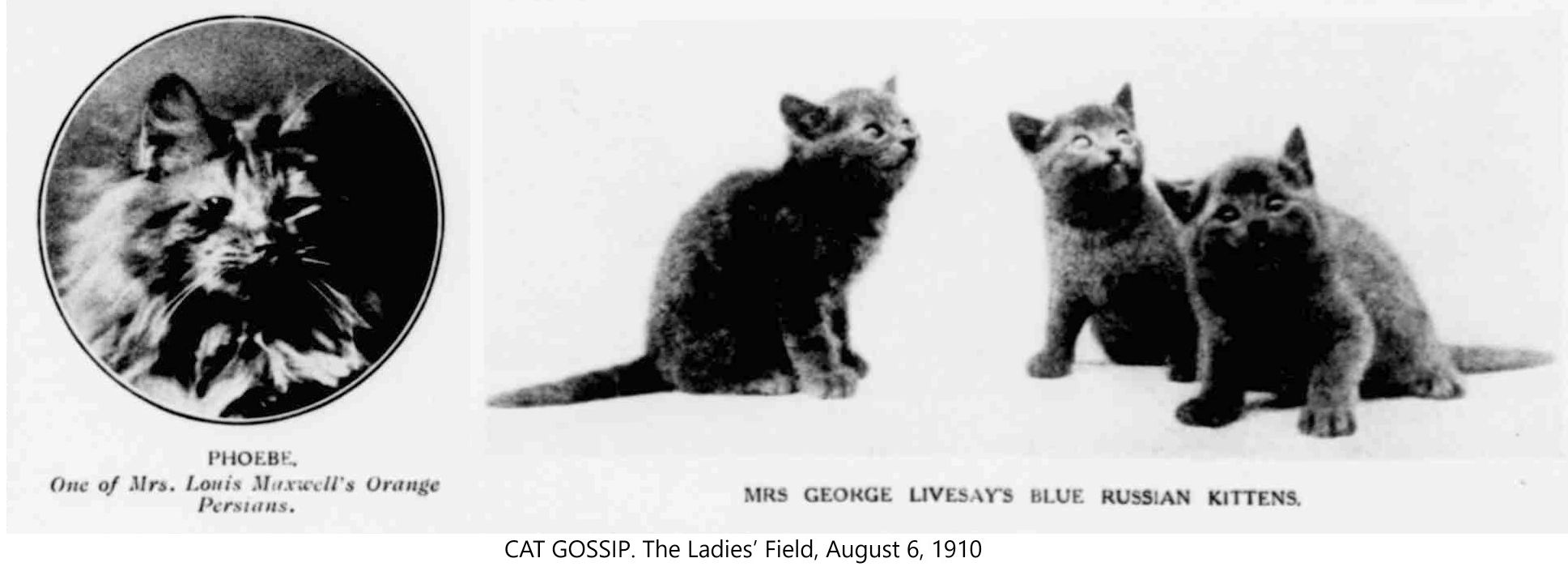
"SPIDER" will be glad to receive good photographs and any news concerning cats for insertion in this column. In the case of copyright photographs the owner should be mentioned, and every care will be taken to return them, although the Editor cannot accept responsibility.
LADY DECIES writes from Sefton Park, Slough: "Allow me to take up a little of your space on a subject which must awaken our sympathy. At this time of the year everybody who can is going for a holiday. Our houses will be shut up, our portable necessaries will be taken away with us; but, alas! in many cases, our cat are left at home, and frequently get lost or die of starvation. As we go away to enjoy ourselves, let our motto be, ‘Lest we forget,' and there is something that all humane people may remember and may do - we may remember to place our domestic pets in security for a very small sum; we can hand the cats over to the Gordon Cottage, Argyll Place, Hammersmith for the small charge of 2s. 6d. per week, who provide the necessary shelter - and have the satisfaction of knowing that while we are enjoying ourselves we have not left the ‘harmless necessary cat' to be ill-treated and starved."
MRS. LOUIS MAXWELL, one of the vice-presidents of the Neuter Cat Society, has kindly promised a silver medal, to be called the Villikins Silver Medal, for the best orange neuter, either long or short haired, for the members of the Neuter Cat Society only, to be won three times, not necessarily by the same exhibit.
FOUR classes were provided for cats at Bolton, and Mr. Ambrose was the judge.
Long-haired: First and second, Mrs. Hardman's orange, good head and nice eyes, and the other a fine blue of a nice colour, but slightly out of coat; third, Mrs. Bamford's chinchilla, a neuter, a fine large cat in good coat; reserve, Mrs. Broad's; h.c., Mrs. Barnes's; c., Mrs. O'Connor's.
Long-haired kittens: No first awarded in this class; second, Mrs. Hatch's black, a nice coat and good eyes, but head too pointed; third, Mrs. Knowles's smoke, a pretty cat, eyes green.
Short-haired: First, Messrs. Rhodes Brothers red tabby, well known, looking well; second, Messrs. Rhodes Brothers' Abyssinian, a nice exhibit but spiteful; third, Mrs. Summerhill's tortoiseshell, a nicely patched little cat of a good shape; reserve, Mrs. Pratt's.
Short-haired kittens: First, Messrs. Rhodes Brothers' red tabby; second, Mrs. Pratt's red tabby, nicely marked and a fine colour; third, Mrs. Toinnson's silver tabby, markings not defined enough and groundwork too smudgy; reserve, Mrs. Pratt's; v.h.c., Mrs. Summerhill's.
AT SANDY, on August 25th, there are 10 be sixteen classes for long-hairs and nine classes for kittens, six classes for short-hairs and two for kittens. The judges are to be Mr. T. B. Mason and Mr. F. Norris. Mr. F. W. Western is the secretary, from whom the schedules can shortly be procured.
MR. T. HARTLEY judged the cat section at Upholland, and some nice cats were exhibited.
English any colour: First, Mrs. Pratt's noted red, in fine condition; second, Mrs. Sugden's silver, nicely marked with a good, clear ground colour, but a little yellow on face; third, Miss Pye's black, with nice eyes and a good sound colour; reserve and special for best cat shown by a member of Knifton; v.h.c., Mrs. Pratt's; c., Mrs. Baxter's.
Foreign, any colour: First and society's medal for best cat, Mrs. Hardman's red, in fine coat and condition, good head and shape; second, Mrs. Connor's silver, a very savage cat and would not be handled; third, Mrs. Hardman's blue, out of coat; reserve, Mrs. Hurst's; v.h.c., Mrs. Howard's and Miss Pye's; c., Mrs. Tickle's.
Kitten any variety. under six months: First, Mrs. Hurst's blue, a fine-headed kitten, with nice round eyes and a good head; second, Mrs. Hepworth's silver tabby, well marked, but had a sore face; third Mrs. Pratt's red tabby, very young for the show pen; v.h.c., Mrs. Hurst's; h.c., we could not discover to whom it belonged. Pen 445 was disqualified, as it was over age.
MRS. GEORGE LIVESAY writes that she has three lovely male blue Russian kittens to sell - dam, Mousme; sire, her grand stud cat Ivanovitch - as shown in the accompanying photograph. She has also four perfect males, three months old, with Iovely eyes and coats, blue Persian - dam, her third prize Crystal Palace cat Zudi; sire, Bath Blue Blossom - which should make show cats. - SPIDER.
CAT GOSSIP. The Ladies' Field, August 13, 1910, pg. 466
CARLISLE SHOW
THE seventy-eighth exhibition of the Cumberland Agricultural Society was held at Carlisle, and was one of the most successful in every way that has been held under the auspices of the society. The dog and cat section formed one of the most attractive features; compared with previous shows, it more than upheld the reputation for quality which has been built up.
AT Malton Show, held recently, seven classes were provided for cats. There were, unfortunately, only thirty-three entries. Mr. Trickett judged the long-hairs and Mr. Lumb the short-hairs. The prize-money was 10s., 5s. and 2s. 6d. The Hon. Mrs. Behrens penned a nice team, but they were not for competition.
Long-haired, blue, male or female: First, Miss M. Metcalfe's, in fine coat and good eyes, but a little snipy in the face; absent, Mrs. C. Lane's.
Long-haired, any colour, male: First, Mrs. Kitching's, a brown tabby, nice colour and fine markings - unfortunately, has a white chin and is short of coat; second, Miss Burton's cream, not sound enough in colour, but has a fine head and nice eyes; third, Mrs. Beadnell's brown tabby, a fine large cat, but fails in markings to the winner.
Long-haired, any other colour, female: First and special for the best long-haired tabby, Mrs. Kitching's well-known brown tabby; second also went to Mrs. Kitching's, good colour and markings, but not so good in chest as the winner.
Long-haired kittens, under eight months: First and special for the best cat in the show, Mrs. Atkinson's blue, a little gem, in full coat, good head, eyes and shape; second, Mrs. Ripley's brown tabby, fine eyes and nice markings; third, Mrs. Herring's blue, a nice cat, but colour a little rusty from exposure to the sun, and head might be a little more round; fourth, Mrs. Ripley's brown tabby, weak in markings and in colour; v.h.c., Mrs. Kitching's; h.c., Miss Metcalfe's.
Short-haired tabby, male or female: First and special for the best short-haired tabby, Messrs. Rhodes Brothers' red tabby - the noted red tabby - looking very well, a lovely colour and fine markings; second, Miss: Burton's red tabby, has a nice head, but not so good in colour as the winner; third, Mrs. Wardell's red tabby, too long in coat for a short-hair and pale in colour.
Short-haired, any other colour: First, Miss Metcalfe's black, a good black colour, with a good round head, but too pale in eyes; second, Miss Burton's white, in good condition, but weak in head, beautiful eyes; third, Miss Fitzwilliam's Siamese, rather dark in body, but has a good mask and dark legs; fourth, Miss M. McDowell's tortoiseshell, has a good head, but too pale in eyes and not patched enough; absent, Pens 4 and 5.
Short-haired kitten, under eight months First, Messrs. Rhodes Brothers', a very nice red kitten, good colour and lovely markings; second, Mrs. Pickering's silver tabby, a clear silver ground colour with fine markings, but badly wanted grooming; third, Mrs. Richardson's brown tabby, too much spotted, should be more barred; fourth Mrs. Richardson's brown tabby, too pale in colour, not a good exhibit.
CAT GOSSIP. The Ladies' Field, August 20, 1910, pg. - No Cat Gossip
CAT GOSSIP. The Ladies' Field, September 10, 1910
MISS SAVAGE WRITES: "I am sure you will be pleased to hear of my success at Cambridge. My Queen Torfrida took two seconds and a third, and one of my kittens, Edith Swan Neck, a special for best kitten in show. Hereward the Wake, a son of Bonnie Marcello, and my pet stud, gained his first card - a special. He is such a gentle boy, and has the run of the place even now, in spite of the fact that I have placed him ‘at stud' and have two little sons of his. The kittens are Torfrida's, who had seven in her first litter and has brought them all up herself. Their sire is Ulster Blue Paddy Paws - also a winner."

CAT GOSSIP. The Ladies' Field, September 17, 1910. Pg. 110
MISS TOOTS OF EVERSLEY, by Persimmon II. ex Misdee, is litter sister to Miss Whitney's Tip Topper. Miss Toots has won important prizes at Birmingham and at Westminster. She has only been shown four times in her life. She has been the mother of many good kittens. Her present litter consists of two females and one male, by Ch. Brayfort Victory. One very bonny kitten is to be registered as Miss Toots II. An enlarged copy of the photograph of Midge of Eversley, by Brown Duke ex Miss Toots of Eversley, has been accepted for the Royal Photographic Exhibition now taking place in London, and has also had the honour of being selected as one of the twenty-three chosen to illustrate the catalogue of the Royal Photographic Exhibition. The title of the picture in the exhibition is "Kitten at Play." Midge was such a restless kitten: she would not stay still for the tenth of a second, which was the time required to photograph her, so this was a lucky snapshot taken while she was playing. She is now almost a year old, and is the owner of a huge coat. Zia of Eversley. by Ch. Kew Red Comyn ex Afterglow of Eversley, was awarded ten prizes at her first show at Westminster, January, 1909, the judges being Mr. Mason and Mr. Billett. She was first in orange kittens, first in any other colour novice, and second in any Colour breeders'. She was also awarded three challenge cups and the Midland Club badge for the best orange, cream or tortoiseshell kitten. The cups were the Beresford Cup for the best orange kitten, the Wilson Cup for the second best tabby kitten and the Maxwell Cup for the best orange under two years old. The Maxwell Cup was given through the O. and T.S., and as her owner was not then a member, it was withheld. Zia was awarded first in the any colour female class at Bournemouth, July, 1909 (a Southern Club Show), and second in the female orange class at Westminster, 1910, the judges being Mr. Mason and Miss Simpson respectively. Zia is a very large cat, rich in colour, with lovely head and eyes.
ANSWERS TO CAT CORRESPONDENTS.
GONNEBELLE. - Many thanks for the interesting cutting. It seems as though there must be more than coincidence in the passing by of the plague when it raged on either side yet left your house, where were cats to catch the plague-carrying rats, quite immune. It is fortunate we have no such deadly disease for rats to bring in England, although, of course, there is plenty of dangerous contagion that they do carry about. With regard to the cat who is often salivated, it is not likely to be due to toothache, as suggested, but is more probably caused by some digestive disorder. However, the mouth and tongue should be examined, as there may be some trouble there. Possibly he has inherited from the similarly affected parent a tendency to ranula, a swelling that looks rather like a blister and comes under the tongue. The trouble might be due to faulty diet, but you do not say how you feed him. Give him scraped raw beef next time you see an attack impending, and on each meal (feed twice a day) put 5 grains of bicarbonate of soda and 2 grains of chlorate of potash, or shake them on the back of the tongue, or give in tabloid form if he will not take the powder in food. Be sure that any milk he gets is free from preservatives. The mouth should be washed out with alum, 5 grains in 1 oz. distilled water. This is best done by using a small all-indiarubber nasal syringe, and inserting the point at the side of the mouth where there is a natural gap in the teeth. Between attacks it would do him good to take Kanofelin Digestive Tonic Pills, which you can get from Messrs. Appleby, Argyle Street, Bath, and he should be fed liberally on fresh meat, underdone, with occasional tripe or rabbit. No fish or twice-cooked food should be given.
DELIA. - I am afraid I know no breeder of half-bred kittens. It really is not necessary to buy a mongrel in order to have a strong kitten, for many cat-owners have strains of pure-bred long-hairs as strong and healthy as cats can possibly be. At the same time, if you go where the cats are badly fed and crowded you may, of course, find you have bought a miserable weakling, for there are plenty of them about. I fear you have had an experience of this kind. The only places I can suggest where you might possibly hear of what you want - that is, they might obtain it for you - are the Live Stock Agency, Westminster Chambers, 3, Victoria Street, S.W., or Mrs. Brown, 146, High Street. Kensington. The latter lady would certainly be able to find you an absolutely healthy and robust pure-bred kitten if, after all, you decide to have one. Blues. blacks and sable tabbies are generally strong, silvers and silver tabbies less so.
CAT GOSSIP. The Ladies' Field, September 24, 1910 - No Cat Gossip
CAT GOSSIP. The Ladies' Field, October 1, 1910, pg. 144
By an oversight, the three cats, Miss Toots of Eversley, Midge of Eversley and Zia of Eversley, were stated in our issue of September 17th to be the property of Miss Whitney. Their owner is Mrs. A, E. Corner, Eversley, Branksome Park, Bournemouth,
CAT GOSSIP. The Ladies' Field, October 8, 1910, pg. 188
CAT CORRESPONDENCE.
DELIA. Two of our readers having seen reply to your query about a half-bred Persian kitten in our issue of September 17th, would like to correspond with you if you will kindly send your name and address to the office of THE LADIES FIELD.
MOLLY. - Please send the cats' names, and doubtless it will be possible to let you have paper in which the photos appeared.
CAT GOSSIP. The Ladies' Field, October , 1910, pg. - No Cat Gossip
CAT GOSSIP. The Ladies' Field, October 29, 1910, pg. 352
ANSWER TO CAT CORRESPONDENT.
DAISIE. - This black, gritty substance is, as you surmise, the trace left by fleas on the cat's skin. They may be in her sleeping place and remain there by day, or they may all collect about her ears and neck and so escape your observations. It is very difficult to comb long-haired cats effectually if they have very thick coats, but daily combing with a small toothcomb is really the only way to get rid of insects. On some sandy soils cats always harbour fleas more or less. Give her a basket with a linen covered pillow in it as a bed, and before you comb her rub in a little pyrethrum powder round her neck and the roots of her ears, also along the spine. This must be subsequently brushed out, as it would not be good for her to lick it. In some cases cats get fleas by going into chicken-houses, as these pests always haunt the poultry yard, which sometimes also has an attraction for puss.
CAT GOSSIP. The Ladies' Field, November 5, 1910. - No Cat Gossip
CAT GOSSIP. The Ladies' Field, November 19, 1910. - No Cat Gossip
[Article about Mrs. Lytton of Crabbet Park, Sussex.]
On entering the sitting-room a fine Persian cat - Mist - was found sharing the fireside with Equinox, an exquisite little tricolour [Spaniel] puppy . . . it is remarkable to notice how well the dogs and cats agree, for Mrs. Lytton believes in having cats everywhere in the kennels, as a preventative against rats and mice.
[Camera Club]
The first prize of £1 10s. is awarded to MISS PENRICE, Fitzhall, Wellington Road, Bournemouth, for an excellent study of a cat's head in bromoil. The pigmenting is beautifully fine and even, and the light and shade in the fur exquisitely rendered. [The bromoil photo printing process replaces the silver bromide from a black and white print with a hand-applied oil-based ink, giving a soft image.]
CAT GOSSIP. The Ladies' Field, November 26, 1910. - No Cat Gossip
CAT GOSSIP. The Ladies' Field, December 17, 1910, pg. 133.
Owing to the increasing pressure on space in our "Animal Gossip" columns the report of the National Cat Club Show at the Crystal Palace is unavoidably held over until next week when a fully illustrated account will appear.
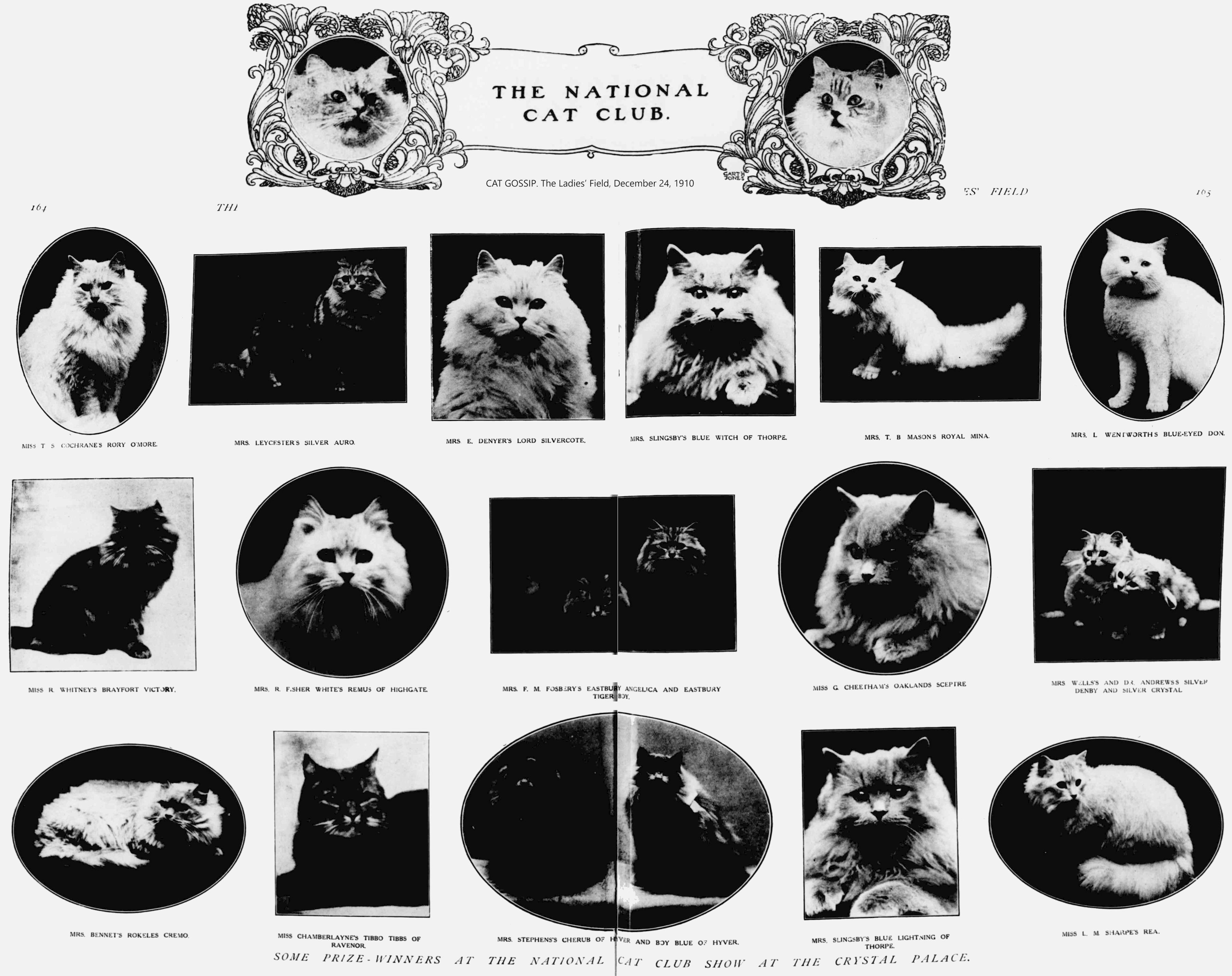
CAT GOSSIP. The Ladies' Field, December 24, 1910, pg. 166
THE twenty-third Championship Show of the above club was held at the Crystal Palace on Tuesday and Wednesday, December 6th and 7th. The entries were very strong both in quantity and quality, and in many classes the competition was keen. The catalogue contained special prizes and challenge trophies, of which twelve were N.C.C. challenge trophies confined to N.C.C. members. In addition, the Scottish Cat Club, the Southern Counties' Cat Club, the Midland Counties' Cat Club, the Richmond Cat Club, the Newbury Cat Society, the Wilson's (Limited) Cat Club, the Short-haired Cat Society of Great Britain, the Blue Persian Cat Society, the Orange and Tortoiseshell Society, the Chinchilla and Silver Specialist Society, the Black and White Club, the Brown Tabby Persian Society, the Siamese Club, the Manx Club and the Neuter Cat Society were all donors of many prizes, in every case confined to members of their respective clubs.
The different classes numbered no fewer than 106, and as it is impossible to deal with the whole of these, the principal winners alone can claim attention. The specials given below were open to all long-haired and short-haired tabbies, whites, blacks, blues, chinchillas, smoke, red or orange, creams, tortoiseshell, tortoiseshell and white, Siamese, Abyssinian and Manx. Naturally the best cats were found here, and many of them also proved to be prolific prize-takers in their various classes. The judges were Miss White Atkins, Mrs. Collingwood, Miss Cope, Mrs. Hardy, Mrs. Higgens, Mrs. James, Miss Lea, Miss Forestier Walker and Mr. Louis Wain. Of the exhibitors, from a numerical point of view, the most important were Miss A. K. Clifton with twenty-eight exhibits, Sir Claude and Lady Alexander with twenty-six, the Hon. Mrs. Behrens with fourteen, and Mrs. Slingsby with twenty.
The champion cat of the show was adjudged to be Miss R. Whitney's Ch. Brayfort Victory, a very lovely long-haired brown tabby, perfect in all points. It won the ten-guinea challenge cup given by the N.C.C., the Stisted Bowl (for the best cat in the show), the Champion Persimmon challenge cup, and many other specials. Many excellent feline varieties in other classes were to be seen, the winners in which are the best specimens in the cat world.
The Rotherham challenge bowl went to Mrs. Wentworth's Blue-eyed Don, for the best English short-haired.
The N.C.C. silver challenge cups for the best long-haired and short-haired kittens were won by Mrs. T. B. Mason's Royal Mina and Mrs. Aubertin's The Man in Khaki.
The Wrotham Park silver challenge cup for the best blue novice cat was won by Mrs. R. Fisher White's Remus of Highgate.
The Hughes challenge cup for the best short-haired blue female went to Mrs. F. W. Western's Wynnstay Bluebell.
The Southern Counties medals were awarded to Miss M. L. Sharpe's Rea, and Miss R, Whitney's Brayfort Victory (gold); while Messrs. Rhodes Brothers with Dashing Little Duke, and Mrs. C. T. Meller Bonny with Ixon carried off the silver medals.
The Midland Counties specials went to Mrs. A. H. Dee's Sweet Jetta (long-haired black), the Hon. Mrs. C. Behrens's Swinton Pansy (long-haired white), Mrs. F. W, Western's Wynnstay Daffodil (longhaired cream), and to Lady Alexander's Ballochmyle Crimson Rambler (short-haired red).
The Richmond Cat Club winners were found in Swinton Pansy (best black or white cat) Mrs. W. Singleton's Satanella of the Cottage (best black or white kitten), Ch. Brayfort Victory and Royal Nina.
The Newbury Cat Society's prizes were awarded to Ch. Brayfort Victory (silver medal), Dr. Prior's The Verger (silver medal), Miss R. Whitney's Brayfort Victory (best kitten bred by exhibitor), and again to this lady's Ch. Brayfort Victory (for best cat bred by exhibitor).
The Wilson's (Limited) bronze medals were taken by Miss G. Cheetham's Oaklands Sceptre and Mrs. L. Wentworth's Blue-eyed Don.
The Short-haired Cat Society's challenge cups and medals fell to Mrs. F. Pratt's Rochdale Perfection (for the best red tabby, winning first prize at this show), to Mrs. Mellor Bonny's Ixon (silver tabby, winning first prize), Mrs. Slingsby's Ch. Cretonne of Thorpe (medal for the best tortoiseshell), Miss A. M. Burton's Gipsy Jack (medal for best brown tabby), Miss T. S. Cochrane's The Blue Peter (medal for the best blue cat), and Ixon again won two prizes here.
The Blue Persian Cat Society's challenge cups went to Mrs. R. Fisher White's Remus of Highgate (best long-haired blue male), Miss E. Bartholomew's Lady Peary (best long-haired blue female), Mrs. Slingsby's Blue Lightning of Thorpe (kitten).
Fifteen other prizes were awarded by this society, The Orange and Tortoiseshell Society's prizes were as follows: The Lingmoor cup went to Mrs. Slingsby's Wilful of Thorpe (best cream tortoiseshell), the Louis Maxwell memorial cup to the Hon. Mrs. C. Behrens's Swinton Tally Ho! (best orange), and five challenge prizes to Wilful of Thorpe, Wynnstay Dafiodil, Red Eagle of Thorpe, Mrs. A. K. Corner's Zia of Eversley, and Ch. Rosette of Thorpe respectively.
The Chinchilla and Silver Specialist Society's challenge cups, silver medals or buttons were won by Mrs. E. Denyer's Lord Silvercote (best male cat), Royal Mina (kitten), Mrs. E. Denyer's Lady Silver Petal (medal for best male or female), Mrs. Chilcott's Smoke Pearl (best smoke male or female), and Royal Mina.
The Black and White Club's specials for three long-haired and one short-haired were won by Master B. Currie's Minley Rambler (white), Sweet Jetta (black), Mrs. W. Singleton's Satanella of the Cottage (kitten) and The Verger.
There was only one entry for the Brown Tabby Persian Society, which, naturally, fell to Ch. Brayfort Victory, the champion.
The Siamese Club's cups and medals were allotted to Mrs. de Vere Brooke's Ch. Sancho (a beautiful animal which carried off the President's cup), Mrs. Aubertin's The Man in Khaki (breeders' cup), Mrs. T. M. Coupland-Smith's Tis-Tis (novice cup). Three club medals went to Ch. Sancho (best cat over two years), Tis-Tis (under two) and The Man in Khaki (kitten). Mrs. Spencer, Mrs. Chilcott and Mrs. Robinson also were donors of prizes here.
The Manx Club specials were taken by Sir C. Alexander's Ch. Lord James Dumps, Miss A. K. Clifton's Weybourne Daniel, and also by the same lady's Weybourne Benjamin (kitten).
Miscellaneous specials (open to all) were carried off by Blue-eyed Don (two), Ch. Brayfort Victory and Ixon. Whites (long-haired and short-haired) by Swinton Pansy (two), Ixon (two), and Lady Alexander's Ballochmyle White Violet. Blacks (long-haired and short-haired) by Sweet Jetta (three), The Verger (two), and Wynnstay Thora (two). Blues (long-haired and short-haired), Mrs. Fisher White's Remus of Highgate and Miss G. Cheetham's Oaklands Sceptre.
Chinchillas: Mrs. E. Denyer's Lord Silvercote (best male), and the same lady's Lady Silver Petal (best female) also took the prize for the best chinchilla. Miss E. Watson's Barry Miss Archie (best kitten bred by exhibitor).
Smoke: Mrs. Chilcott's Smoke Pearl and Mrs. L. Sinkins's Shaitan were adjudicated the winners.
Tabbies (long-haired and short-haired) were a very strong class. The championships went to Mrs. Fosbery's Eastbury Peter, Mrs. Leycester's Silver Auro, Miss Whitney's Ch. Brayfort Victory and Ch. Brayfort Tip-Topper, Swinton Tally Ho, Mrs. A. K. Corner's Zia of Eversley, Miss A. M. Burton's Gipsy Jack, Mrs. F. Pratt's Rochdale Perfection and Lady Alexander's Ballochmyle South Wind, in addition to many specials.
Red or orange (long-haired) championship: Miss E. Bell-Irving's Rokeby Selfish One, Zia of Eversley and Mrs. Slingsby's Redwing of Thorpe.
Creams (long-haired and short-haired): Wilful of Thorpe (two), Mrs. H. Maden's Rockcliffe Buttermilk (championships and several specials).
Tortoiseshell (long-haired and short-haired) championship: Mrs., A. E. Hersey's Vectis Gwen and Mrs. Slingsby's Ch. Rosette of Thorpe.
Tortoiseshell and white (long-haired and short-haired) also to Ch. Rosette of Thorpe.
Siamese (championship): Mrs. de Vere Brooks's Ch. Sancho (two), and special to the Hon. Mrs. C. Behrens's Swinton Princess of Siam.
Manx (championship best male): Sir C. Alexander's Ch. Lord James Dumps (two), and Miss A. K. Clifton's Witchampton Heads or Tails (best female).
It must be stated again that this is not a full and comprehensive list of all the winners, nor of all the classes, many of which were not procurable at the time of going to press. If any disappointment, therefore, is felt by the omission of the names of well-known exhibitors and prize-takers, it is due to the exigencies of space and late-tabulated returns. Mention should be made of a veritable spit-fire yclept Ju- Jitsu. This ungracious animal kept up a savage growl throughout the day, resenting the appearance of anyone in sight of it and continuously attempting savage attacks on the unguarded. There were many amusing episodes, such as exhibitors hurriedly departing with their favourites because their cats resented any other musical noises, such as piano and organ playing! I heard one owner remark to the secretary: "Please let me take my cat away, for if that organ continues my cat will die!" This was an odd coincidence, for the writer not long ago was listening to a young lady playing a Beethoven sonata exceedingly well, when she was interrupted and stopped by an uncle, who said: "Please don't play that, the cat doesn't like it
CAT GOSSIP. The Ladies' Field, December 31, 1910, pg. - No Cat Gossip.