DITCHFIELD'S LITTLE WONDER BOOK No. 9
THE CAT, IN THE HOME AND FOR EXHIBITION.
CONTENTS
Introduction
Longhaired and Shorthaired Cats
The Varieties and Colours of Cats
How to care for your First Kitten
Feeding Kittens
Food for the Cat
Breeding, Weaning, Sexing and Neutering
Some hints on the General Management and Care of the Cat
The Cat in Health and Ailment
INTRODUCTION
When the tea is brought in at five o'clock
And all the neat curtains are drawn with care
The little black cat with bright green eyes
Is suddenly purring there.
In these lines of poetry there is not only a portrait of a cat, but a picture of a home - that lovely place where the worries of the world are left outside the garden gate, that happy place of love and family affection. It is as if to make this picture of home complete that the poet introduces - a cat. There is no animal which in these days belongs so much to the home as the cat. Of all creatures there is something about him which is particularly homely. That more boisterous companion of the home, the dog, has quite a separate character. He loves to wait upon his master, is by nature an adoring slave. No so the cat. He is a supreme individual, as much a "person" in the home as any member of the family. He takes things as a right, chooses his own corner by the fireside and expresses in the clearest way his likes and his dislikes.
And yet withal the cat is never fussy. He stakes his claim to a share in the family life and then settles down, so that sometimes you almost fail to notice he is there - almost, but not quite. For when, in the quiet evening when the stillness of the house is stirred only by the ticking clock and the falling fire, and you are half asleep in your armchair, or absorbed there in your newspaper or with your evening's work, he will rise noiselessly from the rug, arch his back, stretch himself, and then gently rub his cheek against your leg, or attract your attention by the touch of his very soft paw. You have the feeling in that moment as when some human member of the family, suddenly but naturally, utters a small endearing word.
Don't think, however, that the cat is always this quiet creature of the fireside. In his young days especially he is the friskiest and comicalist little fellow in the world. Watch him stretch a furry foot towards your wayward ball of wool. Artful little puss! He knows all right that it is only wool, yet the moment it moves he springs in the air, back arched as though he had trodden on the tail of a lion. Then cautiously he advances, nose between his paws, tail twitching, until with a mighty pounce the ball of wool is firmly caught. What happens next is too quick for the eye, but generally it ends with the frolicsome kitten on his back, legs in the air, and the ball of wool held tightly to his tummy. No, you can't be dull in the home which has its kitten.
Cats are usually delightful pets for children provided they are brought up with them (though children should not play with very tiny kittens which are liable to get hurt). That is why, among other reasons, we shall recommend later in this book that the new cat owner should begin by getting a fairly small, but not too small, kitten. The cat which is properly cared for, and which has been used to children from its early days, will be the essence of gentleness. Always for the little ones he will be "velvet paws."
There is, however, quite another side to the cat, a side which brings into play not only his remarkably sharp wits, but his sharp claws. We see him now not as a quiet companion, but as a vigilant guard. He is the natural enemy of the mouse and the rat. In the eyes of the cat such creatures were born only that he might catch them. And catch them he will. That, too, is something we shall deal with later, leaving the subject meanwhile with the simple observation that any person who suspects the presence of mice in the house, in out buildings, in the office or in the warehouse, should take unto himself not a mousetrap but a cat.
That brings us to another point. Though we have referred to the cat as an ideal pet for the home, it must not be supposed that he cannot be kept in comfort and happiness outside it. The essential independence of his character makes him adaptable to any surroundings, so long as he can have that few minutes a day of kindness from the human being whom at heart he reveres, and so long as he is given the simple management and feeding recommended in this book.
Not least among the advantages of the cat is that he is by nature very clean and, as described later, can be trained very easily to keep himself so no matter where he may have to live. There then we have a brief picture of the cat - the ideal pet for the smallest or the biggest house, an animal which asks very little from its owner, but which gives such a lot in both joy and usefulness.
COAT TYPES.
Cats, pedigree or otherwise, fall into two main classifications - "long-haired" and "short-haired." The body of the long-haired cat should be cobby, with legs short and thick set. The head should be massive, with small, neat ears, well set apart, and eyes that are bold and wide open and not deeply sunk. To complete a well-proportioned head, the nose needs to be short but not snub,
and the jaw must have plenty of width. The tail should be short and full. The short-haired type is quite different. It has a longish body, larger ears, longer legs and tail, and in some breeds the head is long and wedge-shaped.
In the following chapter the points of make-up and colour for each of the long- and short-haired breeds are [given.]
VARIETIES AND COLOURS OF LONG-HAIRED CATS.
BLACKS.
Colour: Lustrous raven black to the roots, and free from rustiness, shading, white hairs or markings of any kind.
Coat: Long and flowing on the body, full frill and brush, which should be short and broad.
Body: Cobby and massive, without being coarse, with plenty of bone and substance, and low on the leg.
Head: Round and broad, with plenty of space between the ears, which should be small, neat, and well covered. Short nose, full cheeks and broad muzzle.
Eyes: Large, round and wide open. Copper or deep orange in colour, with no green rim.
WHITES.
Colour: Should be pure white and not creamy coloured. The eyes can be either blue or copper coloured. Coat, body, and head as for blacks.
BLUES.
Coat: Any shade of blue allowable, but must be sound and even in colour, and free from markings, shadings, or any white hairs. The eyes to be deep orange or copper. Head and body as for Blacks.
RED, BROWN OR SILVER TABBIES.
Colour and Markings: The Red must be deep rich red, the Brown a rich, tawny sable, and the Silver must have pure pale silver ground, with black markings, all markings must be clear and boldly defined, continued on chest, legs and tail. The Red should have copper eyes, and the Brown, hazel or copper eyes. Coat, body and head as for Blacks.
CREAM.
Colour: To be pure and sound throughout, without shadings or markings. Eyes to be copper coloured. Head, body and coat as for Blacks.
SELF RED.
Colour: Deep rich red without markings. Eyes to be copper coloured. Coat, body and head as for Blacks.
TORTOISESHELL.
Colour: Three colours - black, red and cream, well broken into patches. The colours to be bright and rich, and well broken on the face. Eyes to be orange or copper coloured. Coat, body and head as for Blacks.
BLUE CREAMS.
Colour: To consist of blue and cream softly intermingled.
CHINCHILLAS.
Colour: The undercoat to be pure white. The coat on the back, flanks, head, ears and tail, to be tipped with black. The legs may be slightly shaded with the tipping, but the chin, ear tufts, stomach ana chest must be pure white. No tabby markings allowable. Tip of nose to be brick red. and the visible skin on eye lids and the pads should be black or dark brown. Eyes to be emerald or blue-green. Body, head and coat as for Blacks.
SMOKES.
Colour: Black, shading to silver on sides and flanks. Mask and feet to be black with no markings. Frill and ear tufts to be silver. Undercolour to be as near white as possible. Eyes to be orange or copper. Body, head and coat as for Blacks.

SHORTHAIRS.
BRITISH BLUE.
Colour: Should be light to medium, with copper or orange or yellow eyes.
Body: Well knit and powerful, showing good depth of body. Chest, full and broad. Tail thick at base, short rather than long, tapering to a point.
Head: Broad between the ears, and cheeks well developed. The face and nose to be short.
Ears: Small and slightly rounded at the tops.
Coat: Short, fine and close.
RUSSIAN BLUES.
Colour: Medium to dark shade, with no tabby markings or shadings.
Coat: Very short, close and lustrous. Of sealskin-like texture.
Body: Long, lithe and graceful in outline and carriage, with tail fairly long and tapering. The legs to be longish and the feet small, neat and well rounded.
Head: The skull is flat and narrow, and the forehead receding, giving a wedge-shaped effect. The face and neck are long, giving, with the long, lithe body, the desired snaky appearance.
Ears: Rather large and wide at the base. Tips pointed.
Eyes: Vivid green.
ABYSSINIAN.
Colour: Ruddy brown, ticked with black or dark brown. Double or treble ticking; i.e. two or three bands of colour on each hair, preferably to single ticking. No bars or other markings.
Head and Ears: Head to be long and pointed. Ears sharp and rather large.
Coat: Short, fine and close.
Tail: Long and tapering. Eyes: Green, yellow or hazel.
MANX.
Taillessness, height of hindquarters, shortness of back and depth of flank are essentials in a Manx cat, as only with them is combined the true rabbity or hopping gait. The coat is what is termed "double," namely, soft and open, like that of a rabbit, with a soft, thick undercoat. Great attention to be paid to roundness of the rump - as round as an orange being the ideal.
SIAMESE.
Body: Medium in size, long and svelte. Legs proportionately slim. Hind legs slightly higher than the front ones. Tail long and tapering.
Head and Ears: Head long, with width between eyes, and narrowing in perfectly straight lines to a fine muzzle, giving the impression of a marten face. Ears rather large and pricked. Wide at the base.
Eyes: Clear and bright and decidedly blue. Shape to be Oriental, and slanting towards the nose. No suspicion of: squint. Colour: Even pale fawn, shading gradually to cream on the belly and chest.
Points: Mask, ears, feet and tail to be dense and clearly defined seal brown. Mask complete and (except in kittens) connected by tracings with the ears.
Coat: Very short and fine in texture, glossy and close lying.
BLUE SIAMESE.
As above, but read "blue" instead of "seal brown."
HOW TO CARE FOR YOUR FIRST KITTEN
If you are going to keep a cat for the first time it is best to get a kitten aged nine to twelve weeks. At this age he will have been weaned and will be able to take some solid foods as well as milk food. Before dealing with the feeding of the kitten in the next chapter, we will refer to the simple preparations which should be made for his reception into the home and to his early training. (Some hints for the larger cat breeder who wants to keep several cats as a paying proposition are given in Chapter VIII.)
It is a mistake not to provide the kitten with his own sleeping quarters. Although as he grows he will spend a good deal of his time curled asleep on the rug, he should have his own bed for night time. A basket lined with an old piece of soft blanket, which should be taken out very frequently, shaken, aired and washed if necessary, makes a good bed for the cat or kitten. A box or a cupboard is even better. Whatever you provide for your kitten's sleeping quarters let it be placed well away from draughts and where it is cosy but not stuffy. Damp quarters should always be avoided.
The kitten should be taken to his sleeping box every night when the rest of the household retires. It is far better than leaving him to doze on the living room rug, where as the fire burns dim the temperature of the room will fall and the little puss at the best will become restless and miss a sound night's repose. As he grows older his habits may change.
If there should be a mouse about he may spend his night time watching and waiting (and not without reward), but it will still be an advantage to him to have his own basket, or his own cupboard, where he can go as the mood takes him.
It is a good plan to provide the kitten from the start with a sanitary pan, or an earth box. Later he will learn-if properly fed and trained-to use some little corner of the garden at regular times each day, but during his kittenhood such regularity is not to be expected, and lapses are, therefore, to be provided against. The sanitary pan for the adult cat should be about the size and depth of a Yorkshire pudding dish - rather shallower if possible - and preferably made of tin or some other metal. Smaller dishes can be provided for tiny kittens. A piece of newspaper placed in the bottom of the tray is probably the cleanest and can be disposed of down the lavatory. Sawdust is not recommended for sanitary pans. It sticks to the kitten's coat and may be swallowed during washing.
The pan should be placed in some darkened corner of the kitchen (not too far away from the kitten's sleeping quarters if possible) but it must be easily accessible. It should be emptied and washed out every morning. The cat, being a clean animal, will not use a dirty pan. Most kittens use the sanitary pan from a very early age, either naturally or because the mother teaches them from the start to be clean. Any lapses from this rule of house cleanliness should be corrected by taking the kitten at once to his pan, or in fine daylight weather out of doors. A gentle chastisement and "a sound talking to" will teach him a lot. The place at which he has offended should be washed with a little disinfectant.
The kitten should be given a name as soon as he comes into the home, or, if he is born there, as soon as he begins to walk about. Christen him something - even if it is only "Puss" - and adopt some regular word or sound for calling him to you. Remember that though the cat has keen senses of smell and sight, he also has sharp ears!
It will have been gathered already that the all-too-common practice of turning out the cat at bedtime to spend the whole of the night out of doors is wrong. If he has comfortable sleeping quarters in a warm, dry, properly constructed outbuilding, it is different, but just to turn him adrift each night - knowing that his unbounded, though sometimes undemonstrative love of home will bring him in next morning - is not only asking for him to suffer ill health, but is cruel as well. He may be injured during the night by a fight with a larger animal, or in some other way. He may even be stolen. Anyhow, why turn him out when indoors there may be a mouse playing about?
This does not mean that when the cat is past his early kittenhood he should not go out of doors at all at night as well as during the day. He should, in fact, be trained to go outside for a short time last thing at night. Begin his training for this by taking him just outside the door in daylight when he is still a tiny thing. If he is very small choose the warmer, finer days for this venture into the outer world. Let him play for a few minutes, talking to him and calling his name. Watch that he does not wander too far away at first. After a day or two you will find that when he has played a very short while he will scamper indoors. This is the first sign that he knows his home and soon will be able to make slightly longer excursions. When he thoroughly knows his way about he can be let out every night always around the same time, to do what nature intended him to do, and where it is best for him to do it.
After that - and barring accidents owing to ill health or wrong feeding - you will find your cat the cleanest of all domestic animals. He himself abhors anything that is not clean. You only need to watch him washing himself - even as a tiny kitten - to know that. His wetted paw goes not only round his face, but round the back of his ears as well, whilst his tongue goes almost everywhere.
A kitten newly introduced to a home needs a little petting, for he will be naturally nervous. Children can play with him once he is big enough and strong enough. Brought up with children the cat will never resent them playing with him. If he does get "fed up" he will go to his bed where he should not be disturbed - which is another good reason for providing the kitten or the cat, as we have stressed in this chapter, with his own sleeping quarters.
At two months a kitten needs four milky meals a day. After four months he should be having a little finely grated raw meat, a little fish and only two milky meals.
FEEDING KITTENS

The best age to get a cat, as already stated, is not earlier than nine weeks. Some kittens, however, are born in the house in which they will always live, so we will deal in this chapter with the feeding of the kitten from weaning time onwards. His earlier care will be dealt with in the chapter on breeding. When a kitten has been completely weaned at two months old (he should not leave his mother before this age) great care should be given to his diet. At this period of life his consistent growth - without any setbacks - will stand him in good stead when, later, he comes to teething troubles and other little ailments.
A kitten has a very small "tummy." From two months old to four months old he needs four meals a day. If he is given fewer meals he will get very hungry and overeat, with consequent diarrhoea or vomiting. His meals should be nourishing and well balanced. Up to four months old he should have two meals of milk food and two of solid. The best way is to give a milk meal in the morning; a solid meal at lunch time; round about tea time another milk meal, and another solid meal in the evening.
The milk meal, in normal times, should consist of one or other of the cereal dishes which are made for babies when they are being weaned. Groats or Barley, or a shredded wheat product, are excellent. In times of emergency substitutes may have to be found for these, but the mention of them will indicate the kind of food which is needed. In quantity a small saucer partly filled is ample. (The kitten's appetite - provided he is having regular meals - must be the final guide.) This will have been the kitten's principal food for the week or two after he has left the mother. At ten weeks old he can be given for his solid meal a very small portion of rabbit well cooked, and made fairly dry by adding to it (to absorb any surplus moisture) a cereal food or stale brown bread. Add, too, a pinch of Bicarbonate of Soda to every solid or heavily farinaceous meal. A drop of crude Cod Liver Oil (which is not expensive) will make a marked difference to any kits which don't seem to be doing too well. To food which needs cooking it is also a good plan to add a pinch of salt whilst the food is in the pot.
A small portion of meat from a sheep's head or from sheeps' paunches can be given, well cooked, in place of rabbit, and will make a welcome change. A little fresh boiled fish also can be given. These foods for the kitten should all be well boiled and dried off as described above.
There are varying opinions about whether kittens should have raw meat before four months of age. It is generally regarded as safe, however, to feed raw meat to kittens if two precautions are taken. (1) Don't give too much, and don't give it too often. A teaspoonful (increasing to a tablespoonful) every third day (and with greater frequency as the kitten grows) is ample. (2) Be sure that the meat is fresh and that it is very finely chopped.
From this it will be gathered that the kitten's food should gradually change both in amount and kind as he grows out of kittenhood. At eight or nine months old he will be getting ready to enjoy the full menu for the adult cat which we will deal with next.
FOOD FOR THE CAT
The cat will thrive on many of the foods which come on to the ordinary household table. That is another characteristic which helps to make him "one of the family." Meat, fish, vegetables, milk, cereals - all these regularly served foods for the table are just what the cat needs and enjoys. His diet should be mixed, plain and good. He needs two meals a day - in the morning and in the evening. Milk, meat and cereal foods are his principal needs, plus water to drink whenever he wants it. Four ounces of food at each meal is the average quantity for the normal sized adult cat. (The feeding of the pregnant "queen" - as the mother cat is called - is dealt with in the chapter on breeding.)
Commonsense feeding, on the lines which we humans adopt for ourselves, is, therefore, what is required, plus a consideration of the especial likes and dislikes of the cat. As a help toward this we give below a few details of the kinds of food preferred by the cat with some notes about the correct ways of preparing them.
It should be noted:
That cooking is advisable for such foods as the trimmings from fish or for offals of every kind.
That the small splintery bones of rabbit or poultry should never be given, but that a bigger bone is appreciated, and, indeed, needed.
That boiled food of any kind should not be given sloppy, but, if necessary, dried off with stale bread or a cereal.
That the cat eats grass as a cleanser for the stomach and to relieve it of swallowed hair. Therefore see that the cat has freedom where grass can be obtained.
HOW TO PREPARE AND FEED
Kind of Food.
MEAT. (Beef, mutton, horse-flesh, cow- meat, butcher's offal - including sheep's head and sheep's paunch).
Good quality meat can be fed raw. Horse-flesh, cow-meat, sheep's paunch and other butcher's offal, etc., should have the fat removed. Then cut meat into small pieces, put in pan, cover with water, bring to the boil and allow to simmer for an hour.
FISH.
(Almost any kind of fresh fish - not salted - sound fish trimmings - including fish heads - and tinned fish pilchards, herrings, etc.)
Can be given raw, especially in the case of tinned fish, but more often should be given boiled and allowed to cool. Boil with plenty of water till the fish comes away easily from the bone. Feed as dry as possible, preferably by mixing with stale bread or cereal.
LIVER.
Cook slightly and feed once or twice a week-not more. (Liver tends to loosen the bowels.)
RABBIT.
Remove entrails, feed flesh cooked or raw, but it is best always to cook the liver and heart. Remove small splintery bones before feeding.
BISCUITS OR BREAD SCRAPS.
Any of the well known biscuits for dogs or cats are appreciated by puss and are best given dry. A substitute for biscuits can be made by putting scraps of stale (but not mouldy) bread in the oven and crisping until brown. These rusked scraps will keep for a long time if put in an airtight tin. Stale bread crumbs crisped in the same way for keeping can be used for drying off any kind of food which tends to be sloppy.
VEGETABLES. (Cabbage, cauliflower, carrots, turnips and parsnips.)
Prepare as for table use, boiling with a pinch of salt. Vegetables for the cat are usually - and quite rightly - the "left overs" from the dinner plate, but the cat does need his share of vegetable food. Lack of it may cause skin trouble.
MILK.
Goat's milk is even better than cow's milk. Pasteurisation by boiling often is recommended. On occasions when milk is not available a little milk pudding (rice, etc.) spared from the table is appreciated by the cat.
STOCK.
A cat which is inclined to be fastidious about its food often can be encouraged to sample a new dish by adding to it a little warm stock with an appetising smell. A good stock made from marrow bones, gravies, and to which has been added a little pearl barley, with Bovril or Marmite to flavour, is much appreciated by the cat.
From the list given above it will be seen that there is a wide choice of food for the cat. When some foods are not available others always can be procured.
BREEDING, WEANING, SEXING AND NEUTERING
The breeding season is always an important period. It has to be admitted that the ordinary household cat sometimes becomes what her mistress may describe kindly as "a little pest" by the regularity with which she produces kittens. If the cat is treated properly, and with understanding, there need be no undue trouble, and only the kittens which are wanted need be kept. That is far the kinder way.
The breeding season begins early in the year, according to the weather. During a very mild winter kittens may actually be born almost before April is in. The female cat - called the queen - generally gives certain unmistakable signs that she is coming into season. You will observe at this time that she is paying more than usual attention to her toilet. She is restless, wants to be out of doors, and often shows her affection more demonstratively than usual. If kept indoors she may next begin to roll on the floor and make a little crooning noise. These are all certain signs that she is ready for mating. Her period may last five or six days, or it may last only two or three days. Occasionally a queen will remain in season for a protracted period, until, in fact, her desire is satisfied.
The female cat will come "on heat" if not mated every three or four weeks during the Spring and Summer. If it can be avoided a queen should not have her first kittens until she is over a year old. This is generally easy to arrange with kittens born in the very early Spring, but a female kit born later in the Summer often shows an inclination to mate when she is little more than six months old. The gestation period in the cat is 63 days, or in some cases a little longer. A good rule is to add two calendar months to the date of mating and take that as representing the time within a few days, when the kits can be expected. Occasionally the gestation period runs short of 63 days. During the whole of her pregnancy the mother should be well fed, though no drastic or sudden changes in the diet should be made. Fondling and petting should not be overdone, and especial care should be taken to prevent dogs from frightening the queen. Don't, however, pamper her in any way during this important time. Cats when properly fed and managed are hardy creatures, and quite well able to look after themselves.
When the time for the birth of the kittens is near the queen should be given a proper bed in her box. You will see again the importance stressed earlier in this little book, of giving the cat a home of her own. For a bed for the expectant queen nothing is better than old newspapers folded to a reasonable thickness. They are quite comfortable for the cat and can be readily removed and burnt when soiled.
Unless there is some special reason for giving medicine or powders to the cat during pregnancy it is best to do nothing more than possibly worm her (with suitable powders which your pet shop dealer will recommend) three weeks after mating, and again, if it seems necessary, in another fourteen days. For a fortnight before the kittens are due a teaspoonful of medicinal paraffin can be given twice a week. Keep the queen clean by a gentle daily brushing, especially if she is a long haired cat.
At the time of the actual birth of the kittens see that the queen always has a supply of clean fresh water. In most cases that is all she needs. Cats rarely have any trouble in giving birth to their kittens, though occasionally gland trouble is experienced when the suckling of the babies begins. The milk supply can be encouraged by feeding one of the special milk foods which can be bought for cats and dogs. It is a great mistake to think that at this time ordinary milk given to the queen should be diluted. If the queen appears to have plenty of milk and yet does not seem to be suckling her babies properly it may be that her teats are not working in the way they should. A remedy for this is to apply a warm cloth or a fomentation to the affected organ, and then to squeeze out gently with the fingers the secreted milk. Where the milk glands have become hard a special ointment can be obtained from your pet shop dealer.
It is important during this period to watch that the bowels of the mother cat are functioning properly. If they are not a good teaspoonful of castor oil will generally put things right. Cleanliness of the cat's box also should be scrupulously observed. Do not feed the cat in her box. Let her come out for her meal. In the first few days she will not stay out long, but will do everything that she needs to do. As the kittens grow she will spend more time away from them, and so long as they remain curled up asleep and quiet you can be certain that everything is well.
A cat which is suckling kittens should have four meals a day, and they should be as varied as possible. Fish and meat, both cooked and raw, should be given as well as vegetables and gravy. Milk, or preferably milk foods, are, of course, particularly useful at this time, whilst gruel made from groats or arrowroot can be given as a valuable change.
Kittens open their eyes at ten days old. If there is any undue delay in this process the eyes should be carefully bathed with cotton wool soaked in a very warm Boracic solution. Kittens born with their eyes open do not usually live. At a month old the kittens show signs of wanting to leave their warm nest and investigate the large outer world. By this age they are able to lap, and you will see them taking their share, if they are allowed, of the mother's thin arrowroot gruel. The milk food which has been given to the mother should now be continued for the kittens. If it is a proprietary brand specially made for cats and kittens carefully follow the directions given by the makers. The usual weaning age for kittens is eight weeks. By this time the kits will be having their four milk meals a day. From now on they should be brought gradually on to the diet described in the earlier chapter on feeding kittens.
Tiny kittens should be handled carefully, but it is well for adults to handle them if only to learn something about these attractive little creatures. Did you know, for example, that cats have four toes on each back paw, but one extra on each of the front paws?
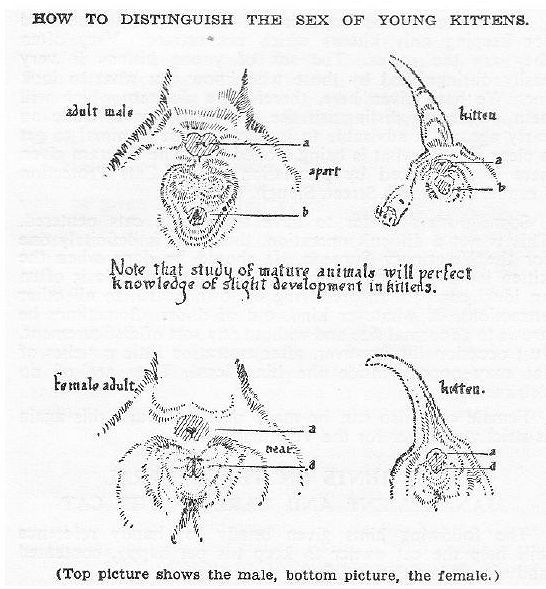
HOW TO DISTINGUISH THE SEX OF YOUNG KITTENS.
From the fourth to the sixth month is a very important period in the kitten's life, for it is then that he loses his milk teeth and begins to grow his permanent ones. This derangement in the cat's life sometimes causes fits. (See notes under Teething.)
We referred at the beginning of this chapter to the need for keeping only kittens which are wanted. Very often they are the males. The sex of young kittens is very easily distinguished by those who know just what to look for. We have given here, therefore, a diagram which will help owners to distinguish the sex of kittens at quite an early age. It is advisable to inspect the adult animal to get a clear idea of what is being looked for. The diagram given here is reproduced by permission of the Cats Protection League, 29, Church Street, Slough, Bucks.
Some owners prefer to have their male cats neutered. This is not a difficult operation, though it is definitely one for the Veterinary Surgeon. It should be done when the kitten is about four months old. A neutered male is often an ideal companion, preferring his own hearth to all other attractions, of whatever kind, out of doors. Sometimes he grows to abnormal size and without any sort of disfigurement. Just occasionally, however, after castration little pouches of fat may appear inside the hind legs. They are of no detriment. Female cats also can be made neuter, though this again is strictly a matter for the Veterinary Surgeon.
SOME HINTS ON THE GENERAL MANAGEMENT AND CARE OF THE CAT
The following hints given briefly for handy reference will help the cat owner to keep his pet happy, contented and always healthy and fit:-
How to groom. Long haired cats if neglected soon get a matted coat. This should be disentangled with the fingers, or by opening the mats with the point of a pair of scissors. Prevention of this condition can be effected by a daily grooming which need not take more than a moment or two. With a long bristled brush and a comb of reasonable size (not a sharp toothed comb unless the coat absolutely requires it) brush and comb the fur the wrong way so that it fluffs out. Short haired cats also can be brushed and a gloss imparted to the coat by a gentle rubbing with a silk handkerchief. Grooming assists the shedding of the hair during the Spring.
Washing and dry cleaning. Cats do not welcome a bath and it need only be given in the direst necessity. Hold the cat firmly in warm water reaching to his stomach. With a soft soapy water wash the body coat, rinse thoroughly and then last of all carefully wash the head. Squeeze the water out of the coat and rub with a warm towel. Let puss keep by the warm fire until he is thoroughly dry. Take care that he doesn't catch cold by going too soon out of doors. Dry cleaning is generally preferable to a bath and much easier to give. In normal times a hot bran bath is excellent. It consists of heating bran in the oven until it can be just nicely handled and then rubbing well into the fur. Brush out and apply more hot bran, repeating the process until the cat is thoroughly cleaned. A final dusting and brushing with French chalk will complete the process. White cats can be cleaned by rubbing into the coat Fullers Earth, French chalk, or one of the excellent powders for the purpose which your pet shop dealer will supply. Black cats benefit if the coat is rubbed with a cloth dipped in warm Ammonia water. (Keep the cloth well away from the cat's eyes.) Next day rub down the coat with a soft cloth. Stains, such as grease on the cat's tail, can be removed by rubbing with Boric Acid powder.
Conditioning. A cat shows its good health and its general treatment by its appearance. Sometimes through no cause discernible to the owner there is an obvious lack of condition. This calls for a change in diet, which should be varied, and for the administering, according to directions given, of any of the good conditioners which can now be supplied. Seek the advice of your pet shop dealer on this point. Worms also may be the cause of lack of condition, and for this a good vermifuge should be given.
Care of eyes and nails. What to do for kittens which have difficulty in opening their eyes properly is described on page 22. Older cats occasionally have trouble through some foreign matter getting under the eyelid. In these cases the eye should be bathed toward the nose with warm Boracic solution, and a little Golden Eye Ointment then applied across the fold of the eyelids. Nails in cats seldom need attention, but if they become too long and dangerous the points can be removed with a pair of sharp nail scissors, or, better still, with nail cutters. Take care to snip off only the very point of the nail.
Cats as mousers. It is a mistake to think that the cat is
encouraged to go mousing by depriving him of his food. The domesticated cat catches mice and rats for the pleasure of hunting and not for food. He hunts best when he is full of the joy of life, which comes from proper (not excessive) feeding and good management. A perpetual ratter or mouser should be given constant attention to see that he is not losing condition, due to having eaten his prey. Rats and mice are not to be considered as wholesome food.
Teething. Kittens rarely have trouble with the growth of their baby teeth and the full set is often through by the time a kitten is weaned. At five or six months of age the baby teeth are gradually shed and new ones grow. Sometimes at this period the gums become sore so that the kitten cannot properly eat its solid food. Fits occasionally are caused at this period too. There are good medicines, often in the form of tablets, for use in such cases. A little medicinal paraffin can be given to ensure that the bowels are kept normal. Light food should be given if the kitten has teething trouble. Butchers' meat is best avoided, but boiled fish can be a part of the diet. Examination of the cat's mouth is always worth while. The full set of teeth includes twelve at the front, four tusks and twelve molars, six in the lower jaw and six in the upper.
What to do about your cat if you go to a new home. Cats love their homes; hence if you remove take every care that the cat knows all about it. Encourage him to settle in the new house. See that he is comfortable and contented whilst the furniture is being removed from one home and being put into another. It is a wise precaution to give him a light collar which contains his name and new address. Take with you to the new home the cat's usual box or basket, rugs, or anything else to which he has been accustomed. In his new home give him a little extra attention and try to keep an eye on him whilst during the first few days he is investigating his new surroundings. Finally, if he should disappear get in touch with the neighbours around your old home. Cats have been known to walk scores of miles to return to their old beloved haunts.
Cat breeding on a large scale. It is not within the scope of this booklet to deal other than briefly with the keeping of a large number of cats for exhibition or other purposes. The companion cat lives in the home, but where several cats are kept it is advisable to house them in well constructed and well ventilated buildings out of doors. Such houses should preferably face South and be on well drained land. Draughts, cold and damp must all be avoided. The buildings should be divided into compartments, or pens, each with its own window. Floor space for each cat should be at least four feet square, and exercise, say in an orchard, or in an enclosed field should be given liberally. A good sized box for the sleeping quarters should be placed in each pen and raised off the floor. Clean wheat straw, which should be frequently renewed, is sometimes used as bedding. A stud cat needs a house of his own, whilst expectant queens are best kept, if possible, in a spare room in the house in which the kittens can be born without disturbance.
THE CAT IN HEALTH AND AILMENT

Cats are not delicate creatures. Any little troubles to which they may be subject generally can be detected easily. Frequent examination of your pet, therefore, is advisable. Here are the signs of health in a cat:-
He should have plenty of flesh on him, but should not be too fat.
His bone should be firm.
The coat should be smooth, sleek and glossy.
The mouth should be sweet smelling, and the cat's breathing should be slow, rhythmical and quiet.
He should purr when he is stroked gently over the head.
There should be no sores or bare spots on the head or body.
The ears should be clean.
The eyes should be bright.
A sick cat appreciates good nursing, by which we mean attention from the owner to see that he is kept warm, that his meals are light and more frequent, and that if necessary his nose and lips are kept clean by washing with a small piece of cotton wool soaked in a very mild antiseptic and destroyed after use. The appetite should be tempted with small portions of some particularly interesting kind of food, such as a little meat jelly, or a sardine.
Now here are the most common ailments which may be met with in cats:
Abscesses. - Not often encountered, but sometimes occur as the result of a fight or an accident. Fur around affected part should be carefully cut away and the abscess fomented hourly with cotton wool dipped in hot water and squeezed out. When the abscess has been brought to a head it can be opened with a sterilised razor blade and the pus gently squeezed out. Wash the wound with a weak antiseptic and keep it clean until it heals. Where abscesses are in difficult positions and obviously causing the cat great discomfort the services of a Veterinary Surgeon should be sought.
Atrophy. - Cats suffering from atrophy gradually waste away, or do not make growth although they appear normal in every other way. Your pet shop dealer will supply Syrup of Hypophosphites to add to the drinking water, in daily doses of twenty drops, every other week, or one of the excellent medicines designed to increase appetite.
Bladder Trouble. - May affect a cat which has caught a chill through being in the damp. Symptoms are loss of appetite and frequent but unsuccessful attempts to urinate. A swelling can sometimes be felt in the abdomen. Treatment consists of applying warm cloths or a rubber hot water bottle to the abdomen and relief can often be obtained by administering a five grain tablet of potassium bicarbonate.
Canker. - The ears of the cat should frequently be examined to be sure they are clean. First signs of ear canker are a scratching of the ear, or the holding of the head on one side. Treatment consists of cleaning the ear with cotton wool wrapped around an orange stick to bring out the brown waxy-looking substance. Then put into the ear a pinch of canker powder which can be purchased from your pet shop dealer. Repeat the treatment daily until the canker is cured, using a fresh piece of cotton wool, since canker is contagious to other cats.
Colds. - Good nursing should be given to a cat which displays signs of a cold, or of influenza. Keep the patient warm and provide light and more frequent meals. Saccharated Carbonate of Iron can be given with the food in quantities of two grains a day for the kitten and six for the cat. If there is mucous from the nostrils smear the chest and the inside of the legs with a little camphorated oil, or apply any nasal specific up the nostrils.
Constipation. - Castor oil, olive oil, or liquid paraffin will generally relieve constipation. A teaspoonful is sufficient for a kitten over four months. A dessertspoonful can be given to the adult cat. Grass is a corrective for constipation. If the cat has no natural supply, grass can be grown for him in pots. Cocksfoot is the best variety of grass to grow specially for cats.
Convulsions. - See treatment for teething troubles.)
Diarrhoea.-Give a single dose of castor oil to remove the cause of the trouble from the stomach and then give the anti-diarrhoea powder which your dealer will get for you. Diarrhoea is sometimes caused through worms.
Distemper. - Symptoms of this infectious disease are general lassitude, loss of appetite, and often an obvious soreness of the throat. Vomiting frequently occurs. Treatment consists of keeping the cat warm and giving one of the distemper medicines specially made for cats. Half grain quinine pills three times a day also are beneficial. If the mouth becomes sore or if ulcers develop wash with a solution of Permanganate of Potash - ten drops to a cupful of aired water. Diet should be light and with meals more frequent and when the cat is recovering a good condition powder added to the principal meal of the day will be of help. In all cases of distemper the patient should be isolated from other cats and given the best nursing possible. Any sort of chill should be avoided.
Eye Trouble. - Eye trouble in kittens is dealt with on page 22. In adult cats eye troubles are rarely encountered. A cold in the eye can be relieved by washing with Boracic solution and applying Boracic ointment or Golden Eye Ointment. Dislocation of the eye, due to an accident, is a natter for the Veterinary Surgeon, who often can put right the most distressing cases.
Fleas. - Objectionable insects in the coats of cats will never be found if cats and kittens are kept in clean boxes with the bedding frequently changed. If fleas should be suspected dust the coat with a good insecticide and apply also to the cat's box which also should be sprayed with disinfectant. A little daily grooming for longhaired cats is recommended, especially in summer time.
Poisoning. - If poisoning of a cat is suspected immediate efforts to make it vomit should be made. A dose of ipecacuanha wine or of warm salt water should be given and the services of a Veterinary Surgeon obtained as soon as possible. This is important, since there are different kinds of poison which cats may inadvertently pick up, and each requires expert diagnosis and treatment. The bowels should be kept open.
Skin Troubles - (including eczema, mange and ringworm). - Eczema generally results from an unbalanced diet. For adult cats an additional supply of raw meat, including a little liver, or of fish (if these have been lacking from the daily menu) should be given. The affected parts should be cleaned with Boracic solution and one of the well known sulphur ointments should then be applied. A cardboard collar may be fitted round pussy's neck to prevent him from licking the sores. A good condition or cooling powder is advised, and where worms are suspected steps for their ejection should be taken.
Mange is found on the neck and head and is characterised by a distinctive smell. The cat suffering from mange should be isolated and the affected places treated with a mange sulphur ointment daily for 4 or 5 days, followed by a gentle but thorough washing before the treatment is continued. Mange is very contagious and even the person attending to a cat suffering in this way should take every precaution of cleanliness. Mange pills, or conditioning powders, are almost essential in the cure of this complaint. It must be tackled in its early stages and every effort made to prevent the spread of the trouble. In serious cases it is wisest and often kindest to have the sufferer painlessly put to sleep.
Ringworms in cats are not frequently encountered, but like mange are highly contagious. The services of a Veterinary Surgeon should be sought at the earliest sign of this complaint.
Stomach Troubles. - Symptoms are usually sickness and diarrhoea. A cure is effected by giving Bismuth and Soda, or one of the medicines which can be bought from your pet store. Attention should be given to the diet. Feed light meals such as a little well boiled fish. Anti-gastritis powders are useful in all cases of stomach trouble. Note: Infrequent vomiting by the cat to remove swallowed hair, or after eating grass, is no cause for serious worry. It is when the vomiting becomes suddenly frequent that stomach trouble should be suspected.
Worms. - Many cats and kittens are affected by worms. Worm powders or capsules suitable for puppies can also be given to cats according to the directions. An adult cat can be given three of the normal worm tablets. A kitten of 8 or 9 months two, with half the dose for a kitten 4 months old. Under this age worming should not be resorted to. Pregnant queens should be wormed as directed in the chapter on Breeding. Symptoms that the cat is troubled by worms are a ravenous appetite, plus a loss in condition and bodily weight. The coat goes into poor condition and the cat generally looks "starved."
A little knowledge of home first aid will be of use if your cat gets into trouble from scalds or burns, or hurts a limb during play or by accident. Such troubles, however, are rarely met with, for not only is the cat swift of motion and light of foot, but he has a knack of getting out of trouble almost before he has got into it. Not for nothing has he been called "the creature of nine lives." Look after him and he will be the constant friend of your fireside for many years.