WORKING WITH DOMINANT BLUE EYES (DBE) IN ESTABLISHED BREEDS
Dominant Blue Eyes caused by PAX3 gene mutations (DBE) is a complex issue. PAX3 mutations cause white-spotting where the white spots may be minimal and may be limited to blue eyes. When discussing DBE, it is important to distinguish which mutation is being discussed. This article covers general concerns and some specifics.
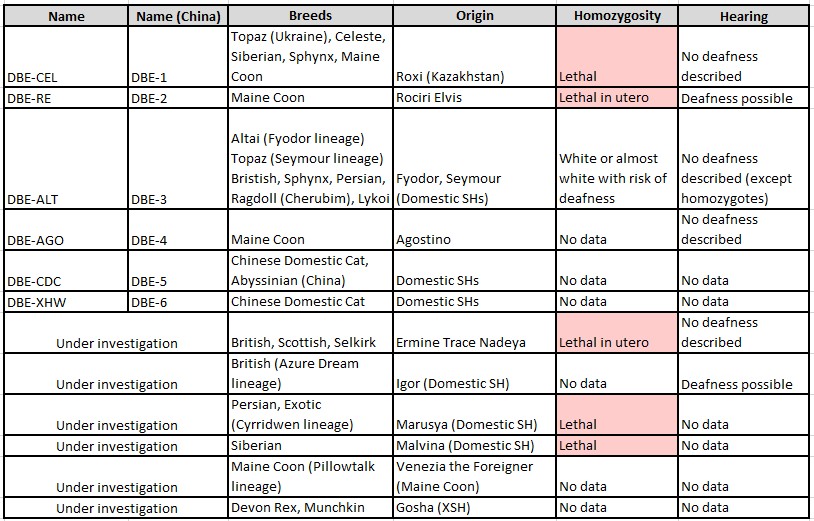
There are several different DBE mutations, and not all are currently testable.
SUMMARY
DBE (all variants) does not always result in blue or odd eyes. Some genetically DBE cats do not exhibit blue eyes and are known as "latent" DBE. DNA testing is important to identify "latents".
Some (not all) DBE mutations may be associated with health issues.
DBE genes must be kept out of standard lines of Dominant White, Bicolour, Tricolour, Van and Harlequin cats (KIT gene) and Colourpoint/Sepia cats (TYR gene) in all breeds where those colours/patterns occur. There is already suspicion of DBE genes in cats that are registered as white, bicolour etc in some regions of the world. This can remain hidden for several generations.
DBE (all variants) blue eyes and DBE odd eyes look different from to W61 (KIT) blue eyes, W63 (KIT) odd eyes, bicolour blue/odd eyes, and W67 (Siamese) blue eyes, and must be kept separate from these i.e. do not cross a PAX3 mutation cat with a KIT mutation cat.
Deafness is caused by white markings adjacent to the ears and not solely linked to DBE genes - the KIT gene is also linked to deafness.
DBE x DBE breeding is generally inadvisable, hence DNA testing is essential to identify cats with and without a DBE gene. Mixing different DBE genes has been shown to be detrimental. Breeding a DBE mutation that is associated with malformations or health problems should be discouraged. Serious breeders should avoid stock from breeders who are unwilling to have their DBE cats DNA tested prior to sale - they have something to hide.
An outright ban on DBE cats is not the best solution as these mutations may already be widespread and may be hiding in breeds where blue-eyes white/bicolour cats occur. A ban could lead to cats being registered with dodgy information to hide their ancestry. Breeders mighty move to other organisations, making DBE ancestry less transparent. An outright ban could lead to breeders setting up alternative registries and then it becomes an uncontrollable free for all.
Gene flow should be one way: standard gene pool cats can be used in DBE breeding programmes, but offspring should not go into the standard gene pool.
A breeding programme should have a goal other than just "pretty cats" or "marketable novelty."
PEDIGREE/REGISTRATION IMPLICATIONS
DBE status or ancestry is not always apparent from pedigrees; some may have hidden in plain sight. DBE-ALT may have originated many generations ago in silver and golden tipped/shaded series British Shorthair (BSH) selectively bred for green or aqua-green eye colour, and escaped from BSH into Russian random-bred cats. There is no evidence of the gene being introduced into BSH through outcrossing. This means it could be native to the BSH and present in lines that have never been tested. Some goldens were probably registered as green-eyed because there wasn't an option for blue-eyed and because they had aqua eyes.
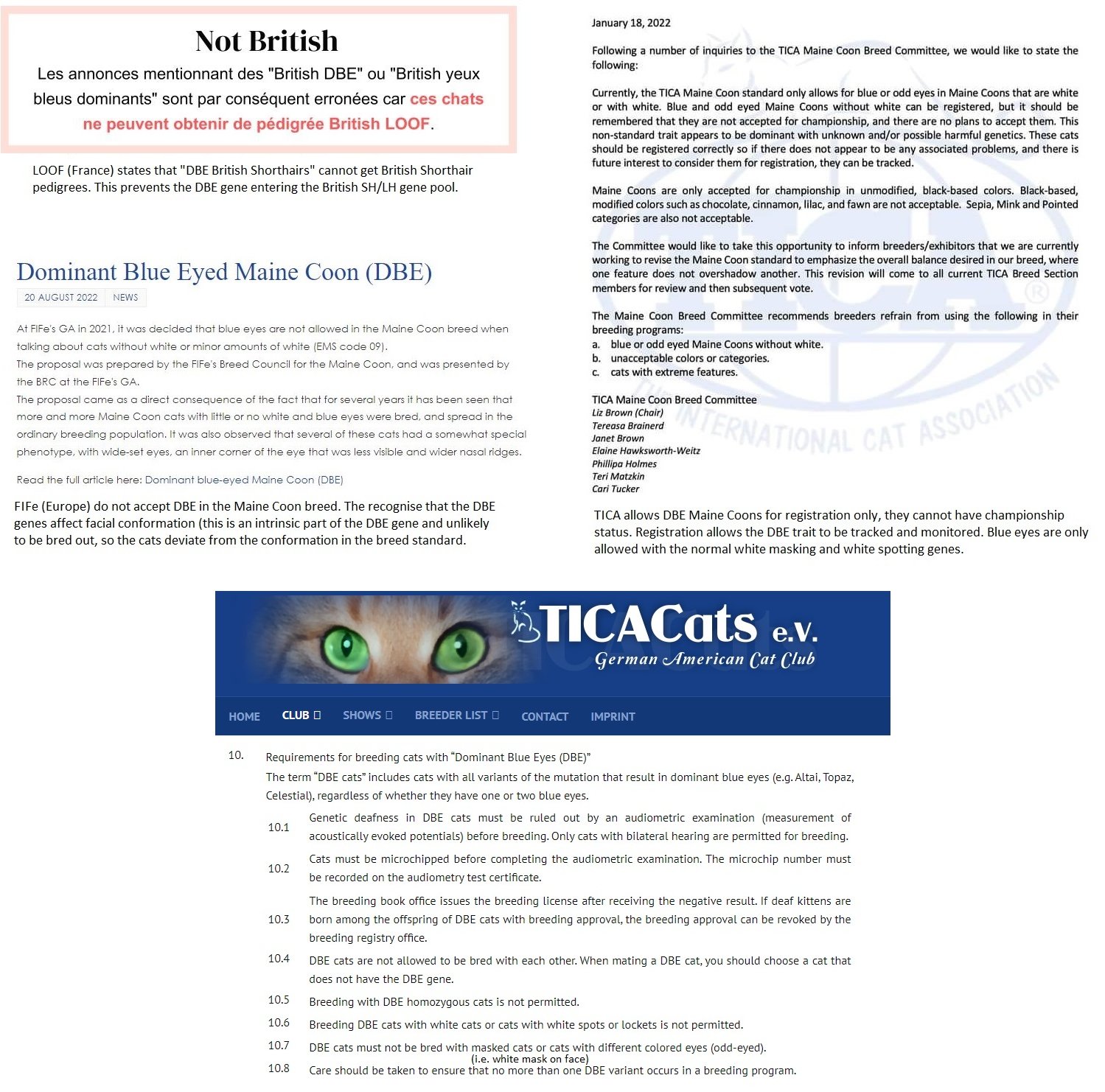
Segregate DBE cats from the main (standard) gene pool and not allow non-DBE phenotype offspring into the main gene pool unless they've been DNA tested and do not have a PAX3 mutation (depending on registry policy.). Latents must not go into the main gene pool. There may end up being a subgroup of British DBE Shorthair/Longhair, DBE Maine Coon etc. The pedigrees should indicate which PAX3 mutation is involved.
In the EMS codes there must be a suffix indicating which DBE mutation is present. Pedigrees and registry annotations should have codes showing which (if any) DBE gene is involved, in addition to the normal colour/pattern codes.
Any time a cat is imported or transferred from another registry that allows DBE it must be DNA tested to determine if a DBE mutation is present, and if so, which mutation.
Only one DBE gene should be allowed in the DBE version of a breed, because breeding together different mutations has already been shown to be detrimental because it potentially "knocks out" the PAX3 gene.
For all breeding with DBE genes, emphasis must now be on accurate registration, sensible breeding regulations, mandatory DNA testing of cats with DBE ancestry, and BAER (hearing) testing of DBE gene cats with a high degree of white. Cats from DBE lines can be genetically DBE but not have blue eyes (latent) and only DNA testing can confirm absence of a DBE gene.
HEALTH AND CONFORMATION
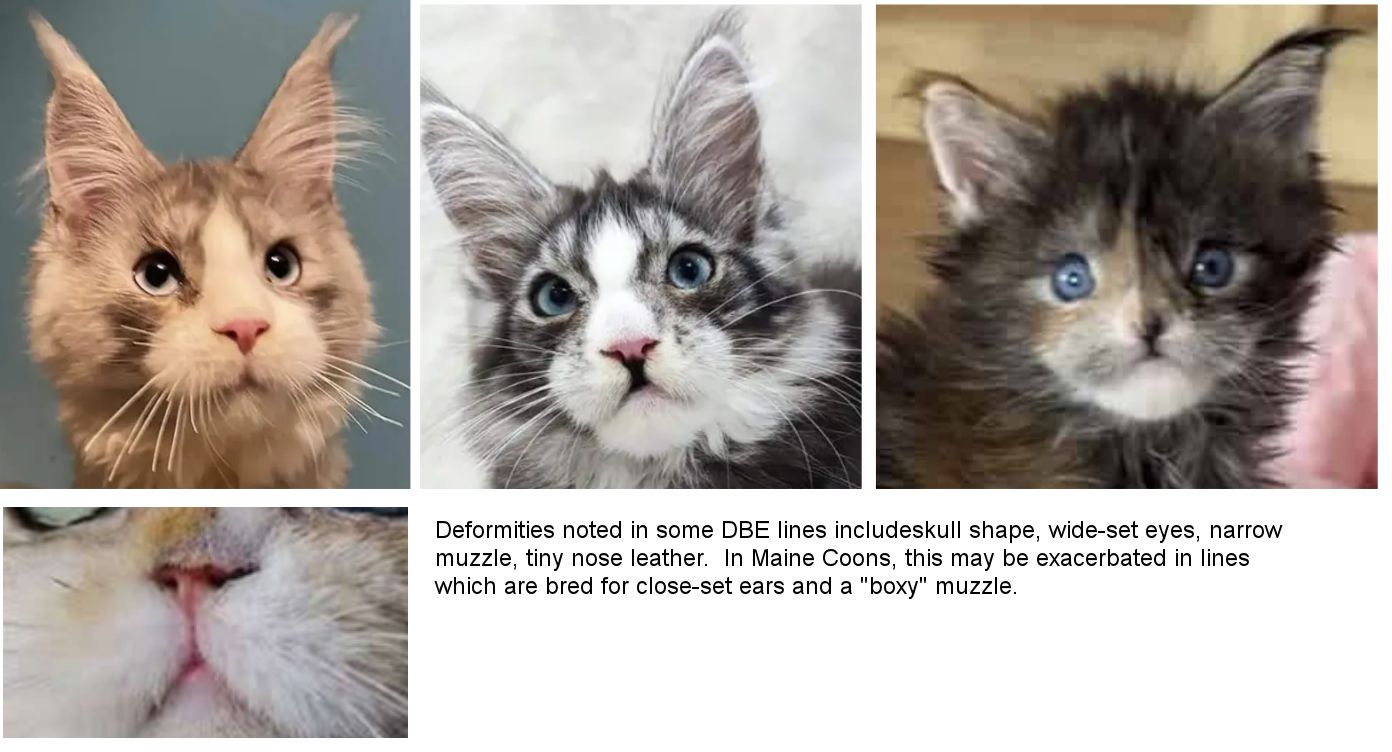
Not all DBE mutations cause health problems. DBE cats should not be referred to as "cats with Waardenburg syndrome". They are "cats with PAX3 mutations". A syndrome is a set of traits inherited together and there are far worse syndromes in cats - Manx and Scottish Fold being examples of mutations linked to serious disabling effects regardless of how carefully they are bred. DBE variants shown to carry significant health risks should be phased out (the American Ojos Azules was linked to serious cranial defects and is already extinct). The DBE-RE gene (in Maine Coons) causes cranial issues to varying degrees and head shape does not meet the conformation standard. It is used in some Maine Coon programmes, but should not be introduced into other breeds.
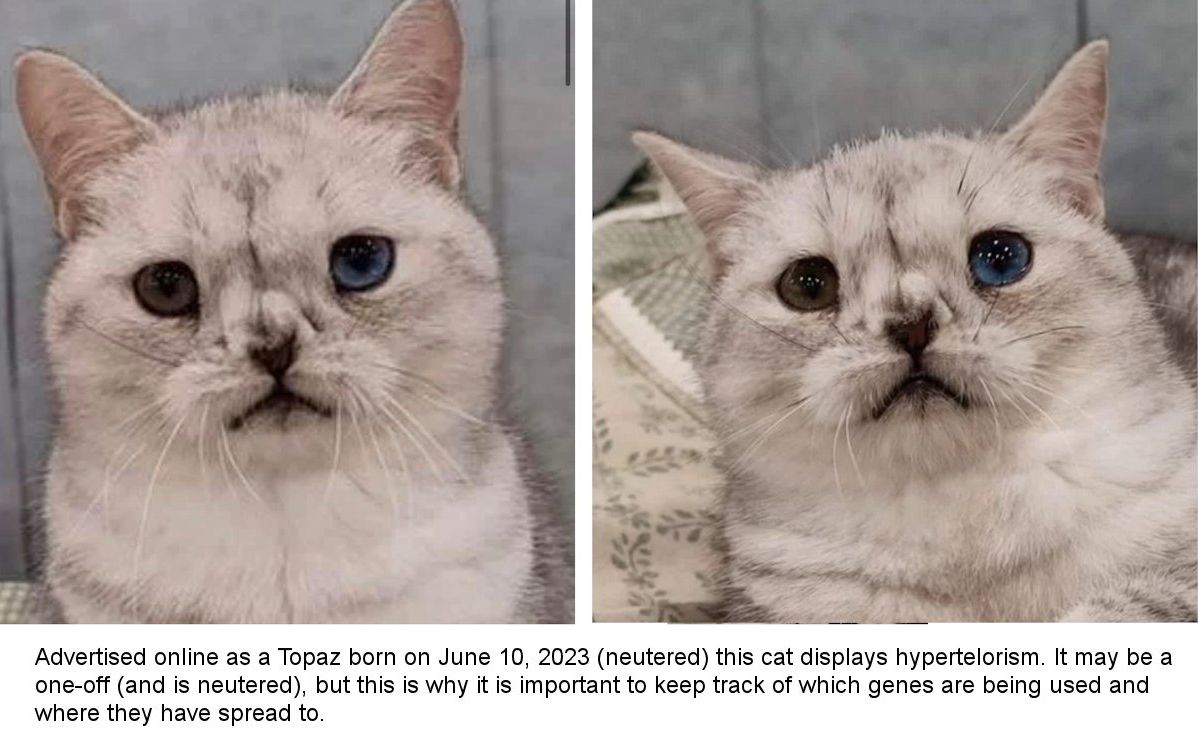
The DBE mutation must be a well-studied gene that is not linked to high mortality or deformity. ALT and CEL seem safest as far as is known. Judges must penalize any deviation from standard for face shape, or there must be a new standard for the DBE version of a breed. This means they would need a separate class at shows or it is unfair on the original non-DBE version.
DNA testing should discourage those who breed undocumented cats and register the progeny as being from different parents; having a mechanism for working legitimately with DBE cats within an existing breed means there should be no incentive for such frauds.
THE WFA "DBE PROGRAMME" (RUSSIA)
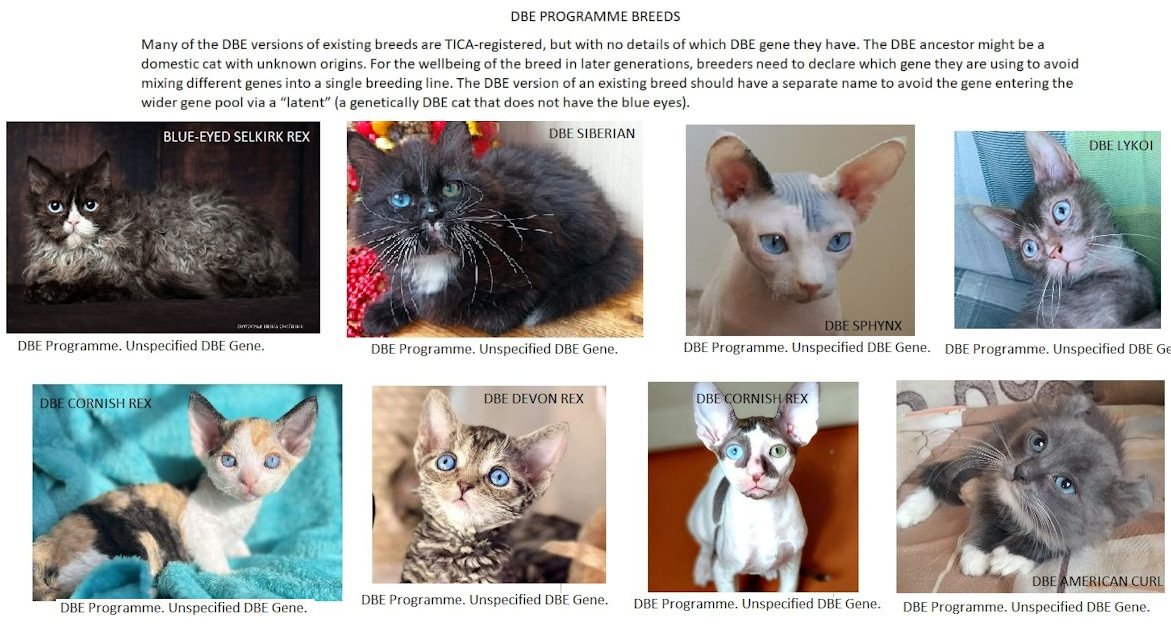
The Russian WFA expanded the number of breeds which are permitted to include the DBE trait: British Shorthairs/Longhairs, Scottish Folds (non-folded Scottish Shorthairs/Longhairs are interbred with British Shorthairs/Longhairs) and Maine Coons (both original and polydactyl). DBE has been introduced into further breeds in Russia and neighbouring countries under the "DBE programme" umbrella: American Curl, Bambino, Cornish Rex, Devon Rex, Lykoi, Selkirk Rex, Siberian, Sphynx and DBE cats are advertised on Russian Facebook pages/groups as being available to mate to Singapura and Bombay breeds. None of these specify which gene is used. There appears to be little control over which DBE genes are being introduced, some appear to come from outcrosses to local domestic shorthairs with unknown mutations. To prevent issues caused by DBE gene interactions registries should prohibit mixing different DBE genes in a single breed. In Europe the most widespread DBE genes are the DBECEL [DBE-1] (Roxi) and DBEALT [DBE-3] (Seymour) genes. Some registries require DBE versions of breeds to be given new breed names to keep their gene pool separate from their non-blue-eyed ancestor breed.
There are multiple DBE versions of British Shorthair/Longhair cats in Russia and neighbouring countries and it is almost inevitable that these will be interbred later on with unknown consequences. In Canada, Blue-Eyed Maine Coons have both the Rociri Elvis gene and the Altai gene. If breeders combine these genes they may see a repeat of the Topaz situation when 2 DBE genes were combined (poor immune systems, kitten deaths). There are also multiple lines of Munchkin with different DBE ancestors. At present they are widely separated - one in Russia (Karagaisky gene) and the other (Altai gene) in Australia - and unlikely to be bred together. Some DBE versions of existing breeds are TICA-registered, but with no details of which DBE gene they have. TFor the wellbeing of the breed in later generations, breeders need to know which gene they are using to avoid mixing different genes into a single breeding line.
Since the discovery of the Altai gene, Dominant Blue Eyes has become "the next big thing". Anyone who acquires any unneutered DBE cat (often randombred and possibly with an unknown gene) can create a DBE version of a breed.
DBE is also becoming popular in China, mostly using genes from Ukrainian cats.