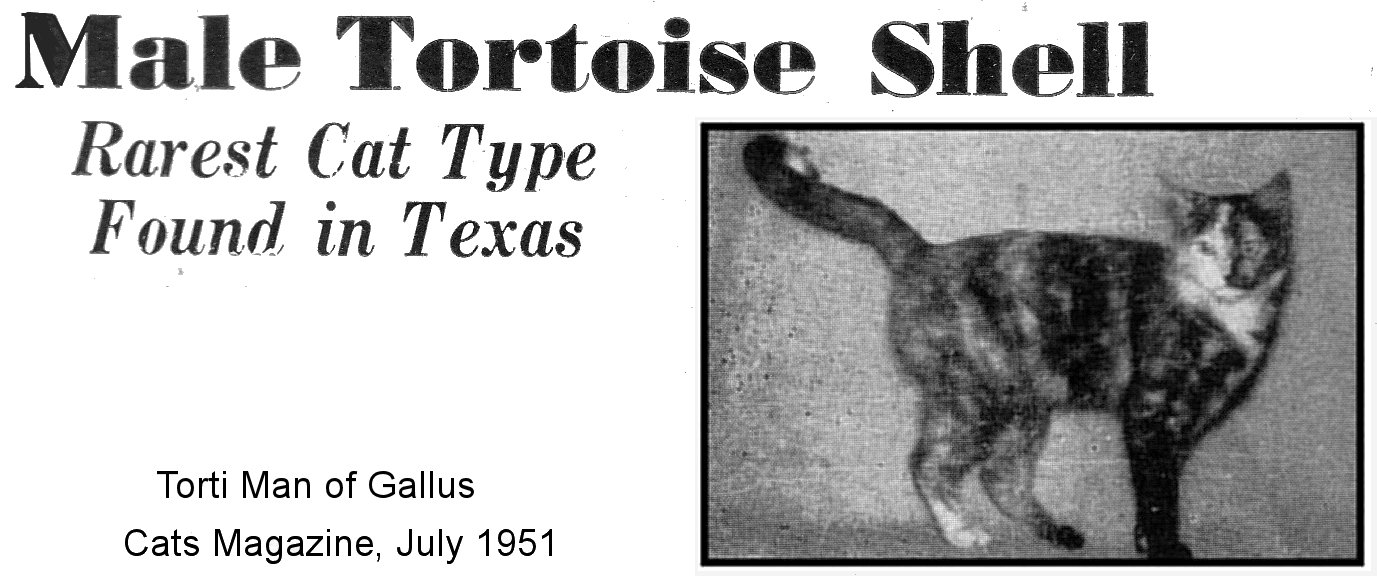
TORTI MAN OF GALLUS.
This was a famous tortoiseshell male born in 1950, who sired a number of kittens. Bearing in mind that the red gene is on the X chromosome, some of the breeding data makes no sense unless Torti Man passed on both red and non-red, which is highly unusual in fertile tortie males. In addition, 3 out of 4 planned matings resulted in smokes, but none of the previous litters had silvers or smokes. This all leads me to suspect that some of the kittens attributed to Torti Man were not actually sired by him and that the females mated with a second male.
MALE TORTOISESHELL. RAREST CAT TYPE FOUND IN TEXAS
"Once in a blue moon," so the phrase goes, a Tortoiseshell male kitten appears, and those in the know believe they have "hit the jackpot". Of course they must wait on time to determine if they are permitted to own the rare specimen, and time usually decrees it not to be, since Tortoiseshell male kittens seldom live beyond the span of kittenhood. A year ago (1950) a Tortoiseshell male kitten was born in Texas. Today he has grown into a strong, well-developed Tom Cat. He is owned now by Mrs. C. A. Hahn of St. Louis, well known breeder-exhibitor. She calls him Torti Man of Gallus. The unusual cat was sent to Mrs. Hahn by her son, residing in Texas, who, fortunately, knew oi the rarity of such specimens.
Other than sex, the male Tortoiseshell is no different than any other Tortoiseshell, all of which are females. Mrs. Hahn reports however, that Torti Man of Gallus has its "blaze" in cream on the right side of his face, while on the three females she possesses it appears (in cream) on the left side of their faces. The "blaze" is a splash of solid color, usually cream or red, that extends perpendicularly from the nose upward, spreading fanlike.
Since 1945, when CATS Magazine was founded, the Hahn Male Tortoiseshell is only the third reported Tortoiseshell male cat that has come to the attention of the American Cat Fancy. There have been some male Tortoiseshells born, but unpublicized by their owners, quite naturally, simply because said owners have not been aware of the rarity of the sex in this classification. The first of the male Tortoiseshells to be reported by the Cat Fancy occurred in 1947 at Portland, Oregon, when a male Tortoiseshell was exhibited at the Rose City Cat Club show. Sex of the entry was not determined by the owner. The fact that the cat was a male was discovered by the judge, Phil Jacobs, while in the process of officiating. The owner was not a "member" of the Cat Fancy and entered her cat in the household pet class of the show. A check was made by CATS Magazine with the owner for information about the rare Tortoiseshell, but all mail was returned with the notation that the owner had moved and left no forwarding address. As far as is known the "famous" male was never shown again. It is presumed that the owner received several offers for her cat after it was "discovered" at the exhibition, however she probably decided that her pet was worth more to her as a cherished companion.
Last year (1950), a male Tortoiseshell cropped up in Denver. It was duly advertised for sale in the classified columns of CATS Magazine. Whether it was purchased has not been learned. A drawback in the sale could have been the asking price which was over $100. In the Cat Fancy a hundred dollar bill for a specimen, other than a "proven male" or one with a successful show record is indeed as big a rarity as a male Tortoiseshell at a year old.
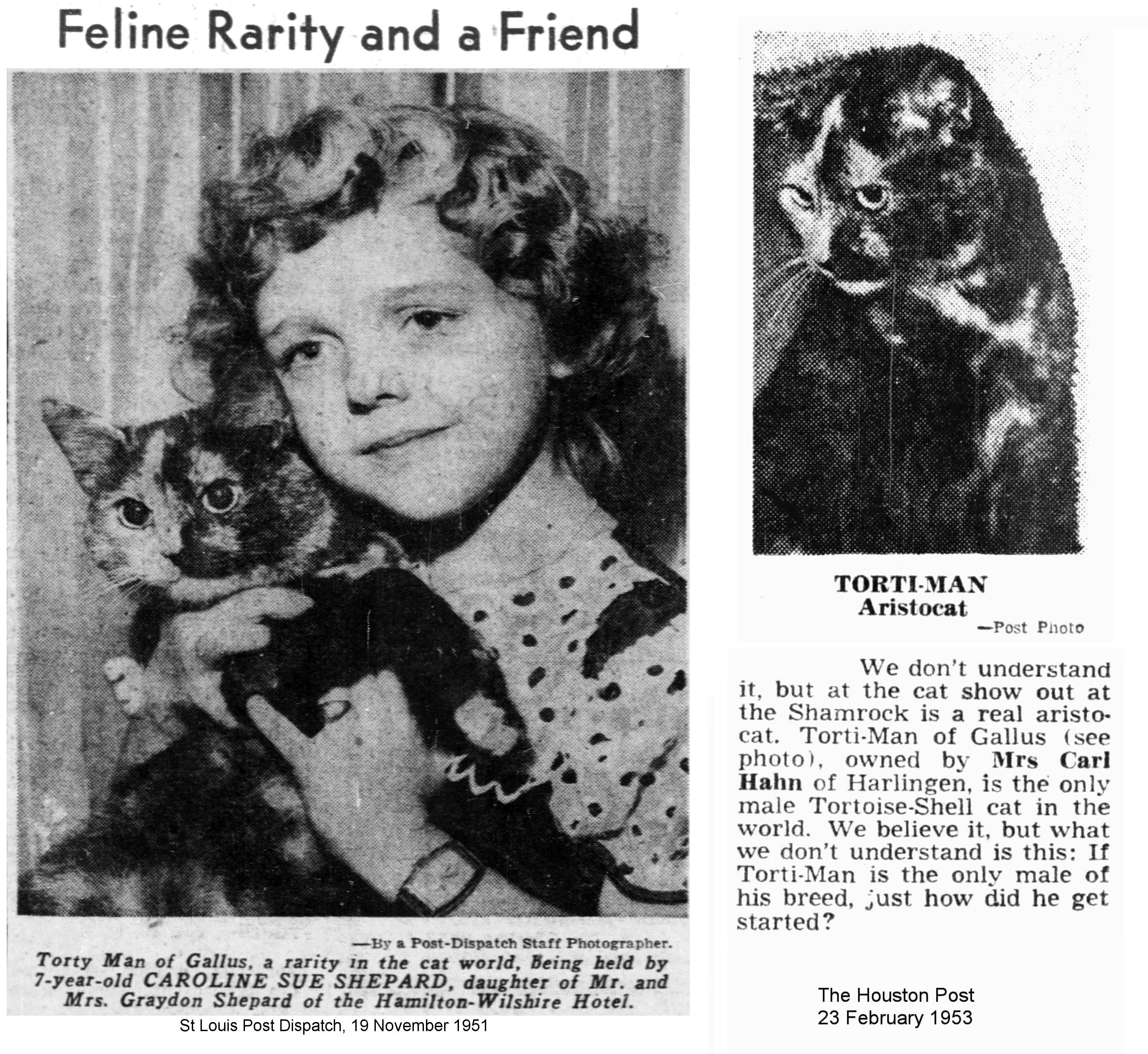
RARE CAT ON DISPLAY. Male Tortoise-Shell Wins in Its Class.
About 700 aelurophiles. more commonly known as cat lovers, marveled when an entry thought to be unique the world over put in an appearance yesterday at the Hamilton-Wilshire Hotel at combined competitions of the Greater St. Louis Cat Club and the Central States Solid Color Cat Club. The rarity, Torty Man of Gallus, triumphed in its class over-all females entered. There weren't any male entries and for a very good reason. The cat's owner, Mrs. Carl A. Hahn, 2138 Blendon place, said she has been informed by the Cat Fanciers' Association that no other male tortoise-shell cat is known to exist. At least 100,000 female tortoiseshell cats are in existence, it was estimated by Mrs. Willard Shy, an officer in both the St. Louis and Central States organizations. Tortoise-shell cats are cream, black and red. Torty Man's origin is shrouded in mystery. "Sire and dam unknown," the catalogue says. The cat, a stray, decided to live with Mrs. Hahn's son Herbert, of Harlingen, Tex., when it was a kitten, and he gave it to her last spring.
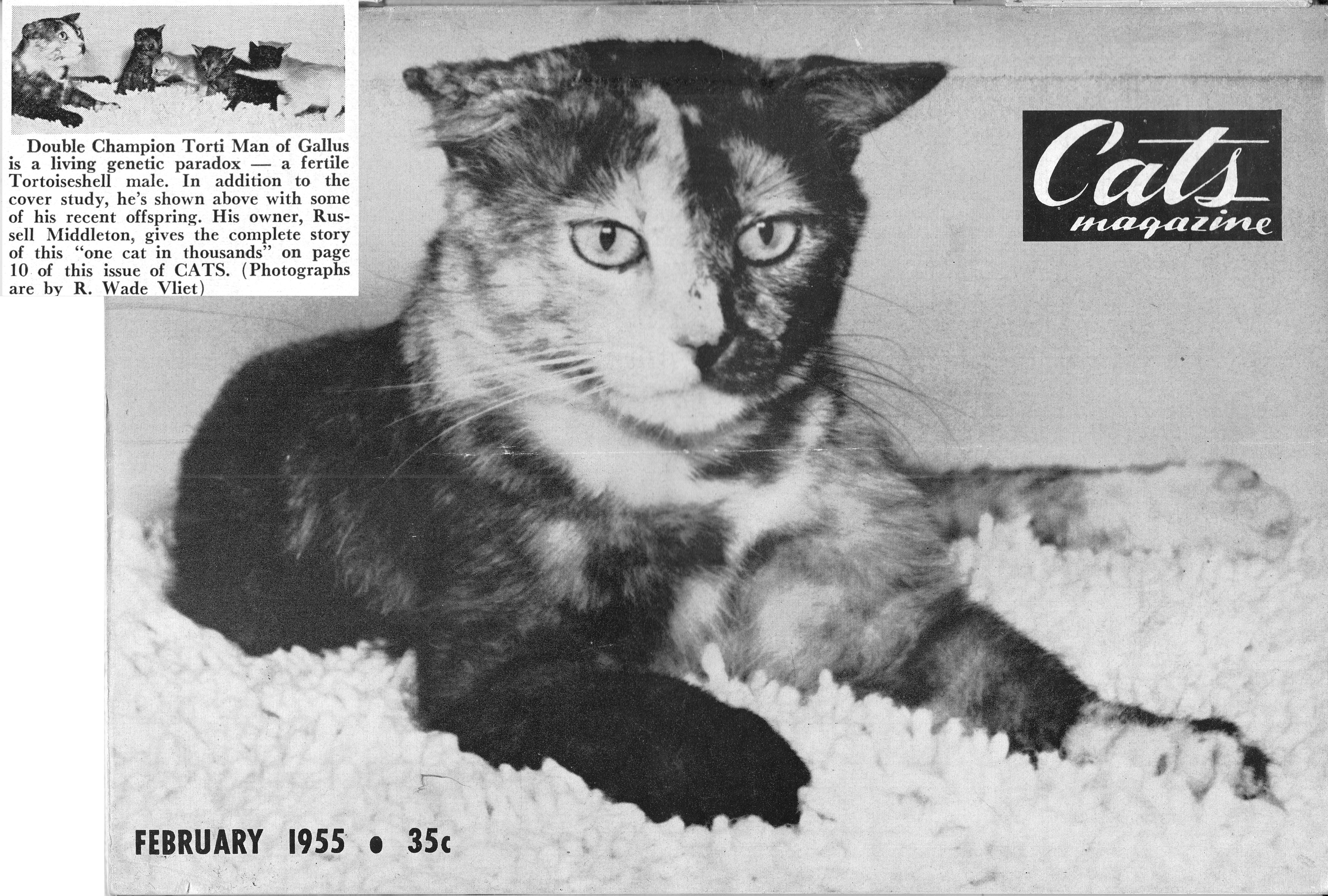
ONE CAT IN THOUSANDS
Tortoiseshell cats are quite common, not only in Domestic Shorthairs [American Shorthairs], but also in Persians and Manx. There probably are thousands of Tortoiseshells born every year, but they are almost invariably all females. Only once in many thousands of births does a male Tortie appear. Double Champion Torti Man of Gallus is that one male in thousands of Tortoiseshell cats. He is a Domestic Shorthair and a true Tortoiseshell. His red and cream patches are well defined, he has no white, and he has the characteristic "blaze" of the Tortie. Nothing is known of his breeding background. He turned up as a stray kitten in the spring of 1950 at the home of Herbert Hahn on High Street in Harlingen, Texas. Mr. Hahn gave the kitten to his mother. Mrs. Carl Hahn, owner of Gallus Cattery, who was then living in St. Louis.
Torti Man's first show was the Greater St. Louis Cat Club Show in November, 1951, where Mrs. O'Neill awarded him his first Winner's ribbon. After Mrs. Hahn moved back to Texas, she entered Torti Man at Dallas in November 1952, where he was awarded Winners ribbons by Mrs. Graham and Mrs. Rotter. At Houston in February, 1953, he completed his CFA championship under Mrs. Rotter. I saw Torti Man the first time at the Dallas show in November, 1952, and it was love at first sight. Every time I saw Mrs. Hahn after that I tried to persuade her to sell him to me, but she would not part with him. In January, 1954, illness made it mandatory that she give up most of her cats, and she let me have Torti Man.
He was entered in three shows in February. At Dallas he was shown under Mrs. Hunt and Mrs. Goforth. At San Antonio he was shown under Mrs. Revington and Mrs. Strange, and at Houston, he was shown under Mrs. Mabie and Mrs. Keller. In each all breed and specialty show he was given a blue ribbon and I believe that every time he has been shown he has been best of color. He was the 1954 All-Southern Domestic Shorthair Tortoiseshell male, but was a few points short of the All-American award. Torti Man completed his A. C. A. Championship in October, 1954, taking his winners points at the Media and New Orleans shows under Mrs. Fiedler, Mrs. Kleim and Mrs. McNaughtan.
At some of the shows, when the clerk has told the judge that the next class would be male Tortoiseshell, the judge has said, "I will believe it when I see it". A quick check has always been convincing. Many judges have remarked that they had never expected to judge a Tortie male. When Mrs. Mabie judged him at Houston, she held him up before the audience to see and remarked, "Not only is he a male, but he must be a ‘rounder', judging from that ear". She was referring to his right ear, which is cauliflowered as nicely as any prize fighter's cauliflower ear, and which was acquired in combat, although not for a commercial prize.
A legend about male Tortoiseshell cats is that in the very rare instances when they do appear, they are always sterile. I have been unable to find any report of a male Tortie siring kittens. Torti Man did not know about this legend. Under the spell of the soft Rio Grande moon he had a sly romance with Ch. Winsome Peg of Gallus, one of Mrs. Hahn's fine Brown Tabby Manx females. The result was a litter of six kittens of which three were tailless. One female kitten was a Tortie. The litter was born June 25, 1951, but was lost.
[Messybeast note: Winsome Peg bred as genetically black according to her registered offspring. If Torti Man sired this litter he was breeding as a red.]
The first romance was followed shortly by an unarranged meeting between Torti Man and Susie Q, a black Manx female and Susie had four Black kittens. One kitten was tailless, one had a stub and two had long tails. Not playing favorites, Torti Man engineered a rendezvous with Patches, a Tortie Manx female. Her sire was Mackerel Silver Tabby and her dam was Black. Of her four kittens born February 26, 1952, one was a Black tailless male, one was a Brown Tabby female with stub tail, one was a Red Mackerel male with long tail, and one was a Tortoiseshell female with long tail.
[Messybeast note: With Susie Q, we can't deduce anything because we don't know the kittens' genders. If Patches was tortie, one of her parents must have passed on the red gene to her, but both are genetically black; the paternity of her litter seems dubious.]
Another unplanned mating with Ch. Winsome Peg resulted in a litter of five, born March 23, 1952. Peg's sire was Ch. Carbon Copy, Black, and her dam was Winnie of Blendon, Brown Tabby. One kitten was a tailless Brown Mackerel female; one was Cream Mackerel with stub tail; the other three had long tails, one being a Brown Mackerel male and two were Tortoiseshell females.
[Messybeast note: Winsome Peg was genetically black, so any red gene would be from the sire.]
Unfortunately, none of the 19 kittens from the Manx females survived to maturity, but better luck was experienced with a mating by Torti Man with a Domestic Red Tabby belonging to a neighbor. This litter of five was born July 10, 1952. There were two Tortoiseshell females, a Red Tabby male, a Red Tabby female and a White male.
[Messybeast note: a red tabby female requires 2 copies of red, but tortoiseshell females need 1 copy of red (in this case from the dam) and one non-red (=black) – which would have to be from the sire. The solid white male would mean 1 copy of dominant white or 2 copies of white spotting, but none of the planned litters inherited white spotting from Torti Man so I suspect another male sired the white kitten unless it was a rare spontaneous albino; the author mentions that none of his solid or tabby offspring had white markings.]
Messybeast note: because most of the litters were unplanned, the paternity of the kittens is dubious. Either Torti Man transmitted both red and non-red, possible but rare with chimeras, the females may have mated with additional males unseen by the owners.
Knowing that Torti Man was a proven sire, I was intrigued with the idea of trying to produce other Tortoiseshell males by line-breeding his daughters and granddaughters back to him or by in-breeding his offspring. As the first step on that project, he was mated four times in the spring of 1954 with the following results:
1. A mating with Ch. Sandust Jezebel of Re-Ru, female, produced seven kittens. One was a solid Black male, one male was solid Red, one female was Cream, one female was a Smoke, and there were three Red Mackerel Tabby males.
[Messybeast note: the dam was a tortie American Shorthair. The cream female kitten would need a red gene from both parents, suggesting Torti Man was transmitting red. The appearance of silver (smoke) in this litter, but not in any previous litters supposedly sired by Torti Man, suggests silver is from the dam or the involvement of an additional male.]
2. A mating with Creolle Belle, a Tortoiseshell of unknown breeding produced six kittens: 1 Red Mackerel Tabby female, 3 Smoke males and 2 Smoke females.
[Messybeast note: the red female kitten would need a red gene from both parents, again the appearance of silver (smoke) in this litter suggests the involvement of a different male.]
3. A mating with a Calico female of unknown parentage, produced three kittens which died at birth. One was a Red Mackerel male and two were Calico females with large red and black patches over the back and white legs, belly and face.
4. A mating with another Calico female of unknown parentage produced two Red Mackerel tabbies and one Smoke kitten.
[Messybeast note: once again, the appearance of silver (smoke) in this litter suggests a different male got involved. Was this calico female Creolle Belle again?]
All but two of the Smoke kittens had white belly spots. None of the Solid Color or Tabby kittens had any white on them.
[Messybeast note: Torti Man probably did not pass on the white spotting gene.]
Perhaps the fanciers who have a greater knowledge of genetics than I have will be able to analyze the results of these matings. Unfortunately, only one of the four queens has a known ancestry. The pedigree of Jezebel is as follows:
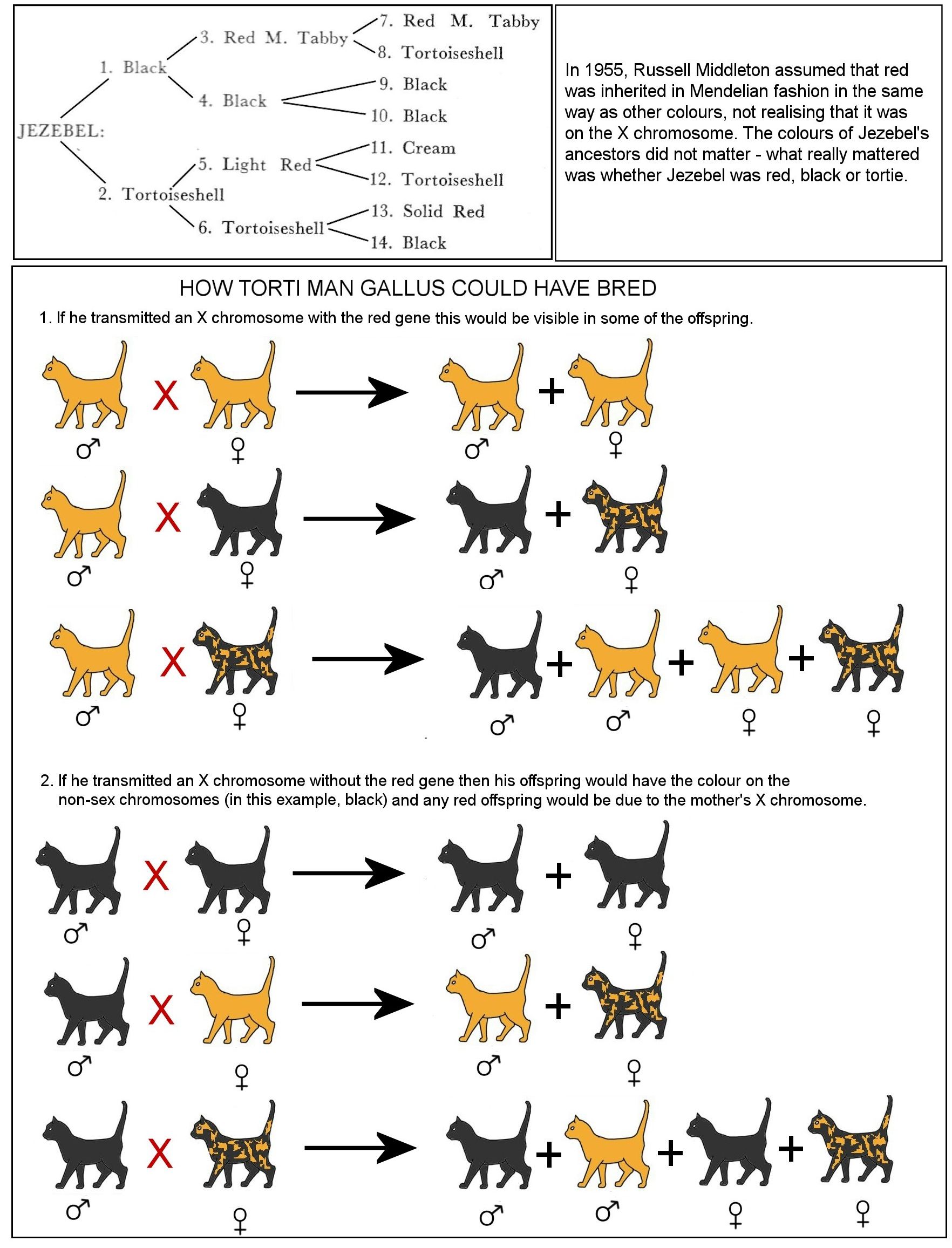
The solid Red and solid Black background of Jezebel undoubtedly account for the Red, Cream and Black kittens in her litter, but I would like to know the significance of so many Smokes, there being seven Smokes out of a total of nineteen kittens, and there were one or more Smokes in three of the four litters.
In the four litters that Torti Man has sired for us, there has not been even one Tortoiseshell, although there were two Calico kittens from one of the Calico queens. I am, of course, greatly disappointed in this because I had hoped to have a Tortie female kitten to mate back with her sire.
We are keeping the Red male and the Cream female from Jezebel and the Red Mackerel Tabby female from Creole Belle. It is our present plan to mate the two females back to their sire for their first litter and then mate them to the Red male for their second litter. I would like to have some predictions from genetics students on what we will get from these matings. I would also like to have some suggestions as to whether and how Torti Man might be used to produce more Tortie males.
Regardless of whether we are able to produce another Tortoiseshell male, Torti Man is a grand cat and a joy to own. We feel, however, that we should not be selfish with him, and shall give fan-ciers an opportunity to see him at as many shows as possible throughout the country.