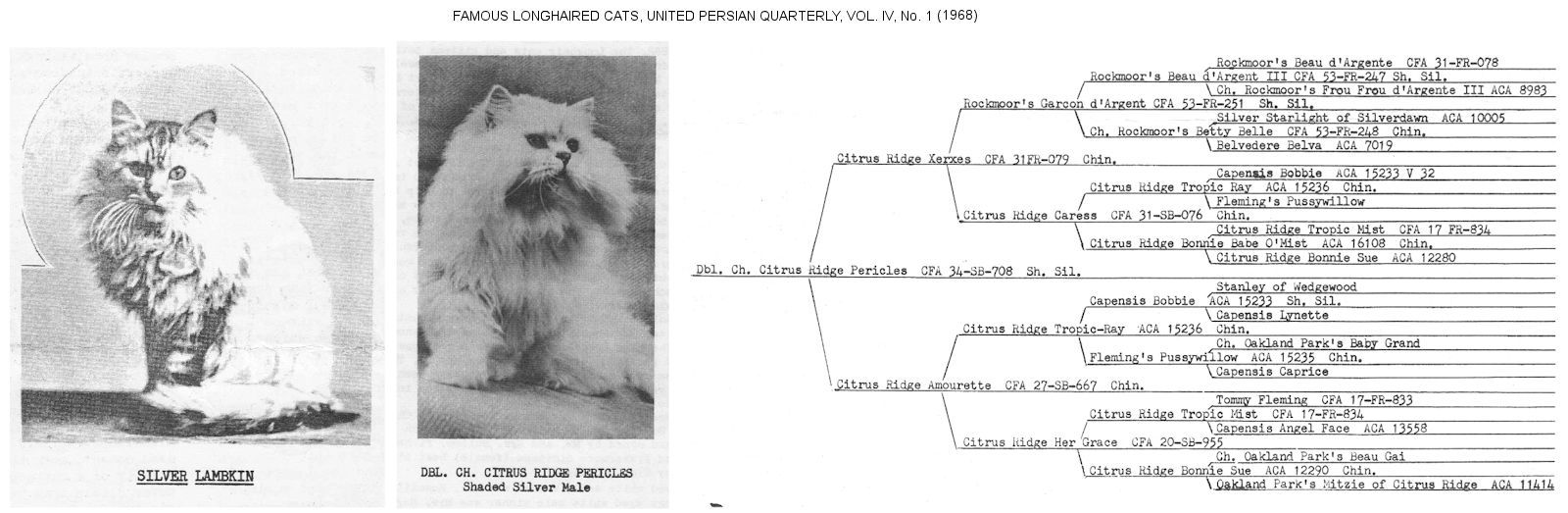
Some cuttings from 1968 "United Persian Quarterly." These cuttings were saved by Joyce Hughes, much of the content relates to the problem of extreme typing.
VOL. IV. NO. 2 (YOUR EXPERT OPINION PLEASE)
TO MRS. TRACY:
REPLY FROM MRS. TRACY:
Definitely, a cat should not be given the "benefit of the doubt". It's impossible to judge the balance of the cat if it refuses to stand. I can understand this in a young novice, but after a cat has been introduced to the show room a few times and still refuses to stand, then I believe this cat should be left at home in preference to one that will show well. This goes right back to temperament; perhaps this cat is not only shy, but will throw this trait to its offspring. I'm sure most of us are not deliberately breeding for this type of cat.
I certainly do think excessive powder should be stressed more as a fault. Having shown LH's, I know this is not necessary. I like to think I have never presented a cat with exces-sive powder in its coat. By proper year-round care, this is NOT necessary.
It may be necessary to "haul" a cat in and out of a cage a FEW times when breaking ties, but excessive handling in my opinion is not necessary. In my personal opinion, this is extremely hard on the cats. They may yet have to go to another ring, and if so, you may have them highly upset long before they get there if you do this. It is not fair to the cat, nor the owner, since if the cat "blows", it is the poor owner that is highly criticized. This is not at all fair, either to the owner or the cat. I think most cats are to be commended for putting up with this and not getting upset.
The question on temperament is what I term a "touchy" question! I don't believe a cat should be shown if it's difficult to handle. If this cat is that hard to handle, yet has never bitten, then to me, regardless of how well-behaved he or she is at home, it should be KEPT home, either for breeding purposes or (if it throws this temperament to its kits) then as a pet only. This type of temperament should not be carried on! This again depends on the integrity of the breeder. Surely, it's heart-breaking to have an excellent cat that behaves this way and to pull it from the show room, but it can, and should, be done. I myself have done it with some of my own that were potential Grand Championship material. I was one of the lucky ones; they did not throw this trait to their offspring. At home these cats are happy, healthy cats - and this is just where they are going to stay!
Since a "Best of the Best show is so very new yet, there are bound to be "bugs" to be worked out. What the final answer is, I don't Know. However, I'm wondering if perhaps all 2nd Best Cats - in both LH and SH divisions, could be brought up for consideration; it's very possible this could work out.
The question about judges exchanging information is again a "loaded" question! Frankly, I don't know the answer to it. Certainly I don't think judges should discuss their possibilities for Best Cat. This is not fair to the breeders. In this day and age, there are so many truly good cats being shown that any number of them could well be Best in Show. When you have four judges doing the same cats, it is quite possible for each to come up with a different cat and all be right! This, to me, is as it should be; why have four judges if you expect them to all do exactly the same thing all the time. This again goes back to each judge finding something he likes better in another cat. As for the wording and putting this into rule form, I'll leave that to someone better qualified to do it than I am.
Bites - this seems to be one of the "hottest" debates of today on cats, and well it should be, for it seems to be getting worse instead of better. This is my personal opinion only - again! I have seen bites not perfect that I did nothing about as long as it wasn't extreme, and the only time I took it into consideration was if I found another cat just as good with a perfect bite. However, there are too many cats showing up with such an extreme bite, or an abnormal head, that I have gotten quite concerned. To me these cats are deformed, and I cannot for the life of me see why anyone wants to continue on a line with this serious fault. As for crooked teeth, nose3, heads that are malformed, I feel that these cats should no longer be used in a breeding program. And I also feel that no judge should put this cat up for any award - if the judge is aware of the fault. I'm sure that many of these faults are not as visible from the close distance a judge sees a cat as they are from afar, i.e., the exhibitor's seat in the audience. No doubt I have been guilty in the past of a cat with this fault slipping by me. However, in the past two years I've tried to be very alert to these faults, and if I've missed some, I hope I do better in the future! To quote another judge - and also the Standards - the standard calls for "round underlying bone" (head). This is pretty hard to miss if you check for it. Also, there are 40 points allowed for head type and eye color, so it is not difficult to heavily fault this type of cat. Certainly these cats are not show cats, nor in my opinion are they breeding cats either! I personally would not knowingly buy a kitten from a bloodline predominant for this fault. I firmly believe this is a serious fault, and have seen several I know can't help but be miserable with this condition. You cannot tell me this is a happy cat! We as breeders are supposed to be breeding for happy, well-adjusted cats, and a deformed cat is not one of these! Actually I could write a "long letter" about this, but I can only really say that I do believe some drastic action needs to be taken by both the breeders and CFA; in fact ALL ASSOCIATIONS should be concerned about it. I will say this - how many people do we know with a perfect bite? This no doubt applies to cats also, but there is a great difference in a slight undershot or overshot bite and a gross deformity. I feel that anything that obviously is harmful to the cat is taboo both in showing and breeding.
No, I do not put cats of bad temperament or bad conformation in my finals - unless it would be something I honestly, did not catch (conformation-wise). I feel we all can miss something, but I would never knowingly give an award to a cat such as this. I hope I have not been guilty of putting up a cat where winners should have been withheld. I do know I've (in the past) been highly criticized for withholding on a Champion with which I found something wrong. As for my trying to "sneak" a cat such as this past four judges - NO - I would be too embarrassed to even attempt this. A championship does not mean this much to me. I like to think I'm an honest breeder and exhibitor.
I do not usually pay any attention to any exhibitor benching a cat. There have been times I have and have also spoken to them. However, at no time have I ever discussed the cat being benched with them, unless it was to tell them to put it right on the table. (It might have been the only one in a class that I had not done and I had been waiting on it.) If it had been a cat known to be hard to handle I would ask them to stay with it and talk to it while I was going over it. I have found that many times if a cat is scared it will relax when it hears its owner's voice. The question of an "isolation booth" is excellent; I'm sure we all feel we are in one at sometime during some shows!! as for awards, when a judge "decides" to be a judge they had better also grow a "thick skin", for no matter where you hang a ribbon, someone is going to complain. I will say only this, as I've said many times before: I am trained, and hired by the clubs to judge the CATS, and this I try to do. Friend, foe, or unknown exhibitor, it is the quality of the cat that is foremost in my mind. I do not feel I am qualified to "judge" people. In a small show where do I look? - everywhere. Just what else can any of us do? You'd be a genius if you didn't see people, cats, etc. Honestly, what would you or could you do under these circumstances? Bear in mind, we are human along with everyone else!
I have been blessed with clerks that have been friendly, thank goodness ! I'd hate to think I had to spend two long days with a clerk who refused to talk to me. It certainly is not normal behavior to keep completely silent for two days. Also, Maybe I'm a "kook", but I do have an interest in many other things besides cats. I've been known to discuss many things with my clerks: children, home life, politics, clothing, world conditions, our farm. After all, I think first and foremost in the minds of all cat fanciers should be: CATS AND EXHIBITING are a hobby. We do this because we love the cat. Must we give up all other interests in life for cats? We would not be a very well adjusted person if we were to do so.
Were I to consider a champion in contention for a final win, I prefer talking to the exhibitor after finals. I would say the exhibitor should contact the clerk as to when the judge can talk to them about their exhibit. It is then the clerk's duty to let the judge know, giving a catalog number, so the judge may write their comments in their book. As I said before it's impossible to remember all cats' faults and good points in a large show. But, by all means, let the clerk know immediately since the judge will need this information while the cats are still fresh in their minds.
TO MRS. BEAN:
2. Do you honestly believe exhibitors WILL forgive a judge who misses a kink they know is there? In my opinion, a judge who did that would be labeled immediately as favoring the exhi-bitor and his reputation would go down to the bottom of the heap.
3. Do you mean that when a judge expresses himself to the audience, that he is doing it to make an impression on the Show Committee or the exhibitors so that he will be re-invited? Don't you think the judges should do something for the Sunday gate? Does changing for finals make the judging any better or any worse? Or does it just add elegance and importance to the finals?
4. Do you feel it a misinterpretation of the Show Standards to award a final win to an extreme cat? What would you do with a kitten you produced with the extreme look? Can you really say some of the top winners are ugly?
REPLY FROM MRS. BEAN:
If an uncouth, whisky-breathing exhibitor berates the judge, I most heartily agree that he should be stopped in his tracks, and removed from the showroom if necessary. The show committee has the duty to maintain order and this includes protecting the judge. If the exhibitor has a complaint, let him present it in the manner prescribed in the show rules.
There are kinks and kinks, of course, including the so-called nervous ones that come and go. It would seem to me quite understandable for a normally alert judge to slip up on one tail out of 350, and I doubt if his career would be ruined forever, if at all. Yes, I do think there are many exhibitors who are tolerant of honest mistakes, so long as they are not repeated indefinitely. I recall a show at which a relatively new judge failed to see a crooked jaw on a silver - rather an unusual fault in that color. All the silver exhibitors could see it, but not one of us complained, though to us that is an even more glaring fault than a slight tail deviation would have been. An exhibitor who can t forgive an occasional mistake is a pretty poor sport and also lacks imagination. How many mistakes would we exhibitors make if we were handling more than a ton of cats in two days, even assuming we knew all the standards?
I said nothing at all about a judge expressing himself to the audience as a means of getting asked back. I myself enjoy a judge who explains a close decision or mentions a new standard or exclaims about some unusually fine feature of an exhibit; such comments are interesting and informative and add to the pleasure of the show, particularly to the onlookers who are not themselves cat fanciers but have paid their money to see the show. The only limitation I would think proper would be to keep the comments short enough that the other judges are not held up or the close of the show unduly delayed.
The same goes for changing clothes for the finals. As I said originally, I think it's great, and in some cases marvelous! I hope it would have no effect on the quality of the judging. I'm wondering if my questioner has any reason to think it might?
I think it not only a misinterpretation of CFA Show Standards, but a clear violation of them to award a final win to a cat who is so extreme as to appear "exaggerated", "distorted" or "grotesque". These are CFA's words, not mine. The clauses I quoted on page 13 of the January issue are taken directly from the Preface to CFA Show Standards. Perhaps because it is a Preface, judges do not have occasion to refer to it as often as to the individual class standards. And yet it is the very heart of the matter. How can anyone possibly condone a judge's ignoring the most basic principles of the entire Standard?
I can indeed say that some CFA top winners are ugly, and I will venture to suggest that the great majority of exhibitors if asked - would agree with me. Let me state my position once more on this. A funny typo in the January issue changed the word "glowering" to "flowering", but I am sure the sense of the statement remained clear: What I said was, "In Persians, a sweet expression is still a requirement. How, then, is it possible for the glowering cat with protruding jaw (I should have added "crooked") and tear runnels down the cheeks to be so often preferred to cats who meet the standards equally well or better and still have that sweet expression?" And the young breeder who exclaimed "That monstrosity!" is by no means alone. For another, you need look no further than the Letters column in the January issue. Mrs. Volke obviously wrote her letter long before the first part of this colloquium appeared, but it reads as if we had compared notes. I quote in part:
"If ...the cats in the finals are the most extreme type, some with protruding tongues and malocclusions, why do the breeders who strive for beauty and conformation and show less extreme type, bother to continue to enter? The best example of breed does not have to be so extreme as to be grotesque. What price will we pay for glory? Breeders are supposedly working towards the improving of the breed. Are the runny eyes, snorting through the nose, missing skull bone, malocclusion and large tongues an asset or a detriment? Would we think a child so afflicted, pretty?"
Let me say here that I would not wish a judge to put up a long-nosed, slab-sided ungainly specimen, however sweet the expression. What we do have the right to expect is that CFA judges follow CFA standards - INCLUDING THE BASIC PRINCIPLES OF THE PREFACE and not continue the way of "the more extreme the better and devil take the consequences!"
The question is asked what I would do with a kitten I produced with the extreme look. Perhaps I may be forgiven if I answer that I have already produced and shown a few that are as extreme as I wish to produce, and they have had their fair share of wins under most judges, and occasionally more than I myself would give them. Here again it is a question of how extreme is extreme? If you mean what would I do with a kitten which stopped short of grotesqueness and ill health, if it had a lovely flat face and short nose and wide-open innocent clear eyes and otherwise conformed to standard, my answer is that I would show it as widely as my money permitted. But if the extremeness went beyond that point into grotesqueness, I hope I would have the judgment to keep it home and breed it to a less extreme cat in the hope of getting the progeny back into good balance. If I myself got carried away and showed it, I hope I would have the good fortune to show under a judge that would remind me of my saner moments and get me back on the beam.
I'm afraid that at most shows today there just isn t the time for a judge to make unlimited comments. That belongs better in judging schools. I see no justification either for a judge to embarrass an exhibitor by going over a poor specimen point by point, and it would be unpardonable to do it without the exhibitor's permission. If there is a particular point a judge wishes to mention, surely he can do this in an inoffensive way by stressing the presence of this good point in one exhibit, not the lack of it in another.
I agree that there is no excuse for a breeder to be always the last to get a cat up to the judging ring. Judging schedules are almost always published in the show catalogs these days. If an exhibitor has several cats up at one time, it should be possible to enlist the aid of a friend or to get some of the cats up as numbers go up without waiting for the numbers to be announced.
The new bite rule is a good one and long overdue. I believe most exhibitors would go along with having it even strengthened, since it is hard to imagine anyone with the callousness to go on showing a cat that is demonstrably dangerous. ^ And unless the exhibitor expects the judge to carry on his duties with leather gloves on, why does he think it s all right for the exhibitor to wear them?
The second part of this question suggests that judges may sometimes themselves be at fault, and to this I must agree. At a recent show a little fellow I had not shown much was unfortunate enough to find himself in the hands of a judge with rather odd notions of what constitutes good showmanship. The poor little fellow was tossed about, flipped over and up and around; as a result he was so upset that in the next ring he wet all over the judge. The latter judge handled cats beautifully and gently, and I had a very real regret that my little lad hadn't let go earlier where it might have done some good. I therefore agree with the questioner that some form of report should be instituted by CFA to permit show committees to comment on such poor handling of exhibits.
I suppose that if the standards defined color faults of a cat going out of coat, with proper penalty stated, it would have to do the same for cats just coming in, and this gets a little complicated. For instance, I am told that reds and creams frequently show faint tabby markings early in the season that disappear when the coat is full. I know that in some lines of shaded silvers, the tipping of the early coat is too light and chinchillas too dark, and at the end of the season both may be overdark for the lovely sparkling effect we want. Much as I should like to have this put into the standards and allowance made for it, I'm afraid logic won't let me go along with it. There are so many variations possible and at such different times for different bloodlines that we would be asking our judges to guess and not to judge. With kittens, allowances can easily be built into the standards, but with adults, it's only fair that they should be judged as they are on the day of the show, regardless of what they were before or may be later.
If a cat doesn't show to advantage, we should be willing to take the consequences. I have one cat that I consider better than another who is more showy. I can't complain if the first one refuses to smile for the judge and ask for the win.
The no-powder rule has been kicked around a good deal by CFA. Wishy-washy as it now is, the complaint of exhibitors is not that it is enforced, but that it is not enforced when it should be. Most exhibitors are pretty careful about removing powder from their exhibits, and they resent seeing others present cats in clouds of powder. I should like to see the rule reinstated as it was before 1960, with all the weasly words removed.
It is hard on the cats to be hauled in and out excessively. Aside from the few occasions when it is truly necessary to break ties, I think it should be avoided.
Judges themselves can quite properly use the present rule that a cat not amenable to handling shall be disqualified for that ring. Beyond that I doubt if a rule could be written that would be entirely fair, and I'm not sure it's necessary. That cat of mine that loses to a lesser one of our household penalizes herself. She doesn't scratch or bite or even wiggle, but she gives the judge an indifferent look that says she couldn't care less for a win, and the judge is often moved to agree with her.
In this way temperament already does enter into the decision, as I think it should.
I suppose the original idea in bringing up the winners of the small specialties (the "congress of specialties") to compete on an equal footing with the winners of the large specialties of all-longhair and all-shorthair for Best of the Best final wins, was to bring up a lot of cats to make a better show. But to allow a cat who is best out of maybe three cats to compete with those who have been awarded Best out of two or three hundred doesn't seem to make much sense. This can result in the anomaly of a cat coming out as perhaps second best that was never closer than tenth best in every ring but the tiny specialty.
It would seem easy enough to correct this inequity and still have a Best of the Best finale, and one that is perhaps more meaningful. One way - the simplest but probably not the best - would be for the judge of each of the two congresses of specialties to pick out the best, second best, BOX or third best, and so on from the specialties that judge has handled. These then would compete on an equal footing with the others from the all-longhair and all-shorthair rings. True, this could mean that if there were two great cats present, one longhair and one shorthair, there could be as few as two contenders for the Best of the Best. It wouldn't make much of a show, but it would be fair.
Another solution would be to bring up bests and second bests and maybe BOX and/or third, fourth and fifth bests, from each judge (again with the small specialties represented by their weeded-out bests and second bests, etc. - I think this should be done under any solution). Some sort of a point system could be employed; a judge's best cat could perhaps earn, say, five points, second-best four, BOX (if not also second best) 3. If the 5-best-system was used, all five could be brought up (or if not physically brought up, at least counted up). The cat who totals the highest is automatically Best of the Bests, and receives the crown; next highest is second best and so on. In a tie, the officiating Best of the Best judge could decide.
A rule that judges should not confer during a show seems so obvious that the only sensible explanation that there isn't one already is that nobody thought it necessary. It appears, though, that in some few cases it is necessary, and so it should be added. It could be worded very simply, as for example, "Judges may not compare notes or discuss exhibits with other judges during the show."
To me the reference to distortion in the Show Standards Preface covers malformed jaws and poor occlusion, and from the October colloquium (1968) it is quite clear that some of our (Continued, Page 11, Column 2)
MISS VIRGINIA WOLFE (CONTINUED)
If I have a clerk that is interested in becoming a judge I offer whatever help I can. Again, time does not permit full discussions, but I am happy to answer specific questions if they are of interest to the clerk.
When an exhibitor places a cat on public display, and presents it to the judge for evaluation, he is in the truest sense inviting comment, pro and con. He or she is saying "Here's my cat what do you think?" Why then should there be objection to further discussion between judge and future judge? Upon what right does this infringe?
MRS. JOSEPH ALEXANDER (CONTINUED)
Everyone should be conscientious in determining when their cats will be called for judging. It is a help if the schedule of judging is placed on the wall behind the judge's table rather than just in the catalog. I agree no one should handle more cats than he is able, and by that I mean allowing sufficient time for grooming so as to present the cat3 in good show condition and at the proper time.
Yes, I am in favor of a "bite law" or any other law which would remove cats which are always bad actors out of the show ring. I cannot suggest at this writing how such a law should be worded. I do believe that much thought and consideration must be given to forming such a law. It is possible that a cat usually very placid and easy to handle can, from some particular agitation on a given day, object to handling and show his displeasure to the extent that the judge might be wary of him. I could not, in all fairness, label him a "bad actor" unless it occurred again at another show. So, if we had such a law, we would have to decide how many chances do we give a cat. I would not hesitate to label a cat a "bad actor" if his own master can't remove him from the cage without the use of gloves or what have you. Yes, I like the idea of a form on which show committees can make reports to CFA on the Judges' handling of cats or any other pertinent information.
It would be difficult to accept the fact that only one judge out of four was perceptive enough to put up as "best" a cat which did not appear in any of the finals in the other three rings, the other three judges putting up the popular exhibit regardless of condition. I still have great faith in majority opinion.
The incidents of the inadequate Himalayan judging were given merely as an example to indicate that if certain judges feel insecure in judging rare breeds which they see infrequently, they should do something about it. The breeders mentioned were exclusively in Himalayans, devoting all their time, energy and thought to that one breed. In my opinion, they would know as much of their only breed as the judges who don't breed them. The standards for the Himalayan are EXACTLY the same as for Persians, when, in fact, they ARE NOT Persians. To be more accurate, a change should be made in the standards for Himalayans. As an example, let's take the nose. The standard calls for a short nose without specifying what, exactly, is short. In Persians we feel if the nose is no longer than its width, it is a short nose. Seldom, if ever, will you find a Himalayan with a nose that short. Instead, it is more often twice the length of the width and more. Himalayan breeders still have a great challenge before them. True, the breed is improving and becoming better known, but the ultimate goal of perfection, according to the standards, is still in the future, if, in fact, it will ever be achieved. Will the Himalayan breeder really ever establish a line wherein they will continu-ally get a good percentage of quality kittens by breeding Himalayan to Himalayan not just one in a blue moon - or will they, after so many generations, have to go back to the Persian to regain type?
It goes without saying that the more familiar a judge is with the various breeds, the better equipped he is to judge them. And I repeat the acme of perfection in becoming truly familiar with a breed is to breed it yourself. We cannot expect our judges to breed every breed - most of them do breed something in longhairs and shorthairs, perhaps all of them. They can learn about the rest and if they see enough of them, they should have no problem in judging. It is only when a judge is not sufficiently exposed to some of the more rare breeds that incorrect judging can occur. In this case, he should avail himself of every opportunity to bone up on those breeds which cause him any uncertainty.
FAMOUS LONGHAIRED CATS
Famous Longhaired Cats is a regular feature of the Quarterly honoring longhaired cats who have made significant contributions to the breed, either through their own accomplishments or through traits passed on in their progeny. Suggestions of cats for future articles are welcome.
As can be noted from previous QUARTERLY writings, namely, "The Origin of the Silver Persians - a Historical Reprint" (Vol. III, No. 4), and letters Martha Wise (Vol IV, No. 1), various names among the earliest silver Persians are indeed prominent as founders of the breed. As Mrs. Wise points out, "Chinnie" must be regarded as deserving of the title of founder of the silvers. Though Chinnie was most certainly, not the first silver (chinchilla) to exist, nevertheless, as silvers became accepted by the fancy in the 1880s it was Chinnie s offspring and descendants who established the breed and became the "best in show" winners. All that is known of Chinnie s origin is contained in a letter from her breeder, Grace Hurt, to Mrs. Vallance who purchased Chinnie: "Madam, - The kitten I have to sell is quite pure bred. The mother I bought ... when quite a kitten from prize parents. The father is one we bred partly from Mrs. Radford s breed and partly from a splendid tom cat that was found living wild at Babbicombe, and that we had in our possession for some months ... She is very handsome and has good points - brush, ear tips, and so on - but I consider her rather small...." But it is not Chinnie whom we salute in this "Famous Cat" article, rather, it is a grandson of hers, "Silver Lambkin". His story is best told by quoting from The Book of the Cat by Frances Simpson (Cassell and Company, Limited, 1903). Miss Simpson called upon Mrs. Balding (Miss Dorothy Gresham) who owned Silver Lambkin to write an account f tin early days of the silvers. She writes about Silver Lambkin and his mother "Beauty" (Bridgyate Beauty) as follows:
"But undoubtedly the best result of the 'Fluffy' and 'Chinnie' alliance was 'Beauty', from whom as already stated, came the 'Silver Lambkins.' (ed. note: The "Silver Lambkins" referred to here were a pair of females born prior to Silver Lambkin, the male.) As a kitten she became the property of Miss Howe, of Bridgyate, near Bath, and later, by a breeding arrange-ment with the Miss Greshams (now Mrs. Bridgwater and Mrs. Balding), had three remarkable litters of chinchilla kittens, the first by 'Rahman,' who shortly afterwards strayed from home and was lost. This was the litter which produced four queens, including the two 'Silver Lambkins,' and which (with the exception of one renamed 'Mimi, ' who went to America with her owner) all unfortunately died.
"The second of Bridgyate 'Beauty's' litters was by Mrs. Shearman's 'Champion Perso,' a magnificent light smoke with remarkable coat and wonderful mane, winner of a large number of first and special prizes. In this lot was a tom kitten destined to be a pillar of the chinchilla stud book, the 'Silver Lambkin,' named after his deceased half-sisters. The chief beauties of this remarkable cat are his size and muscular frame, the length and thickness of coat, and the enormous frill inherited from 'Champion Perso, ' which spreads Elizabethan like round his shoulders and falls to his feet in front, a cascade of silvery white fluff several inches long. To 'Perso' may be traced in some degree 'Silver Lambkin's' success as the sire of unmarked cats, and to Beauty' their pale colour, green eyes, and perfect shape, which have won for her descendants by 'Lambkin' upwards of 150 first prizes. At the time 'Silver Lambkin was bred there was no chinchilla stud cat, and no one had thought of trying to breed chinchillas, for whom, as before stated, there was no encouragement at shows or at home.
"The third litter which brought further fame to 'Beauty was by 'Bonny Boy.' who in the early 'nineties was placed second in the class for silver tabbies at the Crystal Palace, but was considered by admirers of chinchillas to be the best cat in the whole show - an honour, however, which came to him a month later when at Brighton he was awarded the special for the most perfect specimen of the Persian breed in the exhibition; he had previously been claimed at Sydenham, by the Hon. Mrs. McLaren Morrison, at his catalogue price...and was afterwards renamed 'Nizam. 'Beauty's' litter by 'Nizam' consisted of one male and four females, two of which, as 'Twin and I' - so named because they were so exactly alike won first prizes and medals wherever shown. Another was sold by me to Mrs. Martin, which, as 'Lambkin Queen', was the foundation of the afterwards noted cattery at High Wycombe. 'Twin' eventually went to Mr. Lawton, who renamed her 'Queen of the Mist.' Mated with 'Silver Lambkin' she produced 'Sea Foam,' the first chinchilla to win a prize in a class solely confined to cats of the colour. There was an amusing coincidence about this win, inasmuch as after considerable trouble had been taken to get a separate class for chinchillas, the judge gave the first prize to a heavily marked silver tabby, thus totally ignoring the desired object. This occurred at the Crystal Palace in 1893 or 1894. The two first classes ever given for chinchillas were this one and that given at Cruft's first cat show at Westminster, held in March, 1894.
"The next that was heard of 'Twin' was that she had succumbed from the effects of swallowing a needle. 'I' registered as 'I, Beauty's Daughter,' remained the whole of her lifetime at The Lodge, Penge, where, when paired with pale blue 'Champion Bundle,' 'Southampton Duchess' was the result, the latter the mother of the 'Silver Lambkin's' most sensational son 'Champion Lord Southampton,' who was sold by Mrs. Greenwood for (60 pounds), when he became the property of Lady Decies, this being probably the highest price that has ever been given in England for a cat of any variety. 'Champion Lord Southampton,' who has been a very great winner, is remarkable for the lightness of colour and slight markings of his kittens, this being undoubtedly due to the strain of blue in his blood. Many beautiful cats own him as sire...
"Other famous progeny of 'Silver Lamkin are 'Silver Mist,' 'Watership Caesar' (who won the gold medal at Boston, U.S.A., for the best cat in show, 1902), 'Silver Tod Sloan,' 'Silver Owl,' Mrs. Bluhm's 'Silver Lily,' 'Silver Squire,' and 'Mowgli,' the last named bred by Mrs. Dunderdale, but later the property of Mrs. Smyth, of Forest Hill, one of the most enthusiastic admirers of chinchillas, who has in her possession the stuffed figure of 'Beauty.'
..."The club's (Chinchilla Club's) present challenge trophy for chinchilla kittens is a solid silver model of 'Silver Lambkin,' offered by the hon. secretary for competition amongst its members; it is also open to members of the National Cat Club, in acknowledgment of the compliment paid by the latter to the original in choosing his statuette to surmount their challenge cup. The little history of the origin of this special has never appeared in print before, and as I was not present at the committee meeting referred to, 'I tell the tale as 'twas told to me. When the challenge cups of the National Cat Club were designed in 1897, it was decided that the beauty and interest attached to them should be enhanced by immortalising on each the most representative cat of the long-haired and short-haired varieties. For the latter the great 'Xenophon was chosen without hesitation. Then came the more difficult task of deciding upon a recipient for the distinction from the long-haired ranks, which claim so much of the beauty and wealth of winnings of the cat world as to render the singling out of one a matter of consideration. To hasten the termination of the discussion Mrs. Stennard Robinson sent for a collection of cat photographs which had been left to her by the late Miss Portman, the well-known 'Kara Avis' of the Lady's Pictorial. Amongst these the hon. secretary of the N.C.C. pointed out one - with no name attached - as the most beautiful photograph of the lot. This was recognised by most of the committee as being 'Silver Lambkin,' so the honour fell to him.
"By some error at the makers' the long-haired cat was placed on both challenge cups, and it was determined by the club that the superfluous model which had to be removed and replaced by 'Xenophon' should be mounted as a letter-weight and given as a challenge prize for kittens, to be won three times before becoming the property of the winner. After some keen competition, covering about half a dozen shows, Mrs. Martin won it outright in 1899, when it was replaced by the present exactly similar model."
Lambkin was born in 1889 and died at the age of seventeen years in 1906. His stuffed body is on display in the Natural History Museum at South Kensington in London. Thus, at the dawn of the silvers we have Silver Lambkin, named after his two deceased sisters, the "Silver Lambkins" who swept the boards at the Crystal Palace from competitors of all colors, sire of sires, pillar of the chinchilla stud book, immortalized in silver on the challenge cup of the National Cat Club (England). JSF
FAMOUS LONGHAIRED CATS
Mrs. Arthur Smith is, and has been for many years, one of the best known silver breeders in the fancy. Her Citrus Ridge Cattery in Miami was registered with CFA in 1936 though her actual breeding began in 1928. She has graciously written a few words about the early years of the Miami cat fancy, and one of her most famous and best loved cats, "Dbl. Ch. Citrus Ridge Pericles".
Whan I entered the fancy in Miami, this was completely an ACA town, so all the shows and clubs here were under that affiliation. I belonged to two of these clubs and one year managed an ACA show here. A well known (at that time) fancier came down from New York and stepped in giving me lots of help which I really needed as I was new in the fancy and this was the first show I had managed. She exhibited with us and then started a CFA club, the Miami Florida Cat Fanciers. After I joined them, she and I managed the first CFA show (in Miami) together. I am the remaining charter member of our club, and so am on the honorary role.
Two of the older breeders of silver Persians here in Miami are still neighbors in our Northwest Section, namely Mrs. J. B. Kirk who operated the Rockmoor Cattery, and Mrs. Margaret Doucet Slade who was Oakland Park's owner. Both were strictly silver breeders but no longer have any cats. The Capensis Cattery was owned by Mr. & Mrs. Stanley Mathews and their son, Earl. They, also, were strictly silver breeders, and were well known judges of that time. In addition, they formed a very important unit of the first Miami cat club in the 1920 era. The first show I exhibited in was about 1927 following the great hurricane of 1926 which took a terrible toll all along our Florida coast both in homes and lives. At the time I was raising brown tabbies. I bought my first silver in the early 1930's and have raised most all colors of Persians.
The fact that this was ACA territory explains the FR and ACA numbers on the pedigree of my dear old Pericles. I do presume from the mail I receive that Pericles appears on pedigrees in this country as many times as any male. He sired many really lovely cats and some of his kittens are now living to a ripe 18 and 19 years. His own life was a long and happy one. I used him for stud and show up until he was nearly fourteen. Often I would throw Pericles over one shoulder with another male over the other shoulder and they would never show any dislike for one another as I carried them to and from the show ring. He was such a sweetheart all his life. This disposition went down through his many offspring who would surprise the judges by playing coy and rolling on the judging bench just asking for affection. All his kits had wonderful heads, eyes, and dispositions.
I do wish I could get another male just like Pericles even today. I often think that all around he was superior to anything that I have bred. His coat was truly gorgeous, long and flowing. He did, after ten years, turn light enough to be judged as a chinchilla. For about six years beginning in 1948, Pericles was All-Southern Shaded Silver male. He sired Citrus Ridge Eo of Esperence who was All Eastern Shaded female for several years. Ch. Citrus Ridge Perriditto was a lovely son who in turn sired All American Shaded Silver, Ch. Citrus Ridge Perki Pasha. Perki had a beautiful full coat of very even shading and a wonderful cobby body. He carried a tail that measured fourteen inches across. I have never had such a plume on any cat since. There are many more of his offspring who have made wonderful records.
I still think breeding good silvers is the most puzzling yet gratifying of all colors, and I have had my share of most of them. Pericles' head was very broad with small well placed ears. He had a fine broad chest and a really full feathered tail that was only about five inches long. His big green wide open eyes gave him an expression reflecting alertness and sweetness at all times. He was quite spoiled too as he would only eat by hand feeding when at the shows where he was several times Best or Best Opposite Cat.
Pericles was born March 20, 1947 and died March 30, 1961 at the age of fourteen.