FERAL AND OUTDOOR CATS: SHELTERS AND REHOMING
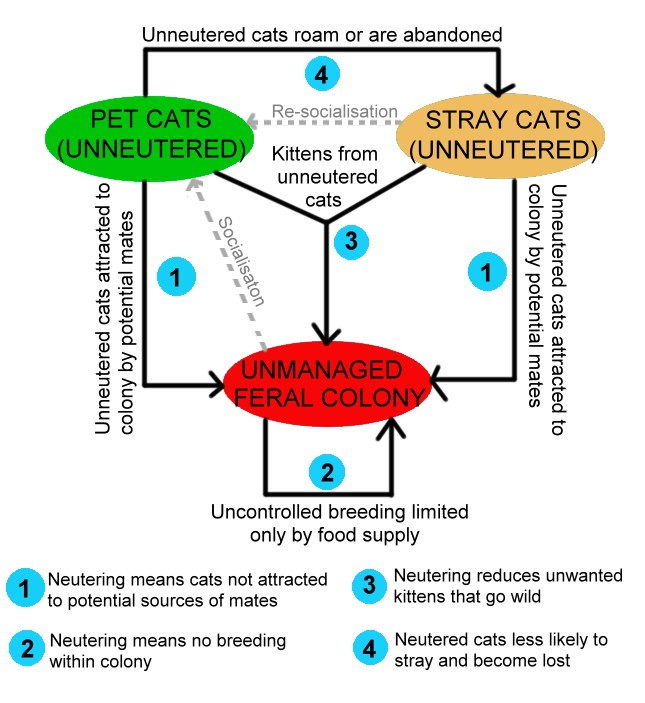
The diagram below shows the relationship between pet cats (owned cats), stray cats (unowned cats) and feral cats (wild cats).
Feral control alone cannot work. Responsible ownership is required to reduce the number of cats which go feral.
Studies in the US indicate that 30-60% or unneutered cats will stray or go feral. Entire males roam in search of mates and may become lost. Unspayed females may be impregnated by feral males, the owner my dump the kittens (and possibly the mother). Unspayed females will also roam if they can smell a tomcat nearby. Roaming cats are attracted into feral colonies where there are potential mates. Some cats simply stray too far from home and become lost. Many young cats are abandoned when no longer kittens, partly because they are no longer cute and fluffy, partly because of the expense of neutering.
It is important to neuter pet cats to reduce the likelihood of straying and to prevent unwanted kittens which may themselves stray and breed.
NOT JUST SOMEBODY ELSE'S PROBLEM
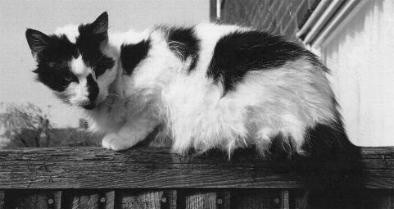
Some time ago two black and white cats began making regular night-time raids through the cat flap to pillage my own cats' food. Nothing unusual in a street where there are plenty of pet cats, except that a survey of the neighbourhood revealed that no-one actually owned them (most people thought they were mine!). It seemed that they had been dumped in "the cat lady's" garden by someone who just could not be bothered to contact a cat shelter.
"Tom" and "Fred" were unneutered adult males and close buddies rather than rivals, so they must have been raised together. They were so people-shy that they were virtually feral, vanishing as soon as they realised I had spotted them. They liberally sprayed my kitchen, to the great delight of my spayed girls and the not-so-great delight of myself.
What should I do? Should I chase them away? Should I supply food for them and suffer a kitchen reeking of tomcat? They weren't my cats, so I had no duty to see to their welfare. The family two doors away temporarily solved the problem by setting their dogs on the two cats. Tom never returned and Fred ceased spraying and slept in the kitchen at night which still left me with a tomcatty odour about the place.
All my cats are neutered so the presence of a full tom was not going to cause me any family planning problems. The wildlife here is not endangered so there was no need to eliminate a single feral cat. Not all owners in the area were responsible enough to have their cats neutered (though I had been working on them) and Fred was a big, unneutered tom ready and willing to do his duty for catdom. There was no urban animal problem in the area, but Fred could change all that.
Calling him somebody else's problem was not going to make the problem go away. He had established a stable territory and found food so I made it my responsibility to make him socially acceptable. I borrowed a box-trap and caught several of my neighbours' cats, my own cats (until they wised up to the trap's purpose) and some wildlife before I finally caught Fred. I got a good look at my pungent captive. His face was scratched and his fur was full of grime. He was whisked off for neutering next morning and was returned to me that evening, still swearing but two lumps short of a tomcat. The vet had ascertained that Fred did not pose a health risk to other cats so I released Fred in the familiar territory of my garden and he limped off into the dusk without a backward glance.
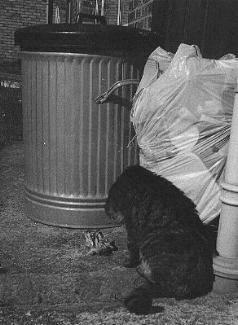
It was weeks before I saw him again and I barely recognised the old rascal. The scratches on his face had healed. The once-grey areas of his coat were white and he was in better condition. I set up a mirror near the kitchen so that I could see him come in to eat without him seeing me. The cat hairs in his usual sleeping place proved that he still 'lived here', but he no longer left a distinctive odour.
Fred was not 'my cat', but he lived on my land so it became my responsibility to either eliminate him or neuter him. Had I had him destroyed, another stray would soon have taken over the vacant territory. It isn't good enough to simply feed strays, they must also be prevented from adding their offspring to the stray and feral population.
There are many responsible cat lovers and breeders who make it their responsibility to help strays which turn up in their neighbourhood, but there are also far too many cat lovers who turn away saying 'it's somebody else's problem' or allow their own unneutered cats to roam and breed. These strays aren't somebody else's problem, they're everybody's problem. It's up to every cat lover to do something to reduce the stray cat problem - by ensuring that their own cats don't stray or breed (no, not even one litter), by or aiding cat welfare organisations and by educating their friends.
FERAL CAT SHELTERS
Feral and outdoor cats manage quite well as long as they can find shelter, especially in harsh weather. If you are handy at DIY, you can build a shelter from scratch, but for those less adept, here are some simple ideas for providing inexpensive shelters.
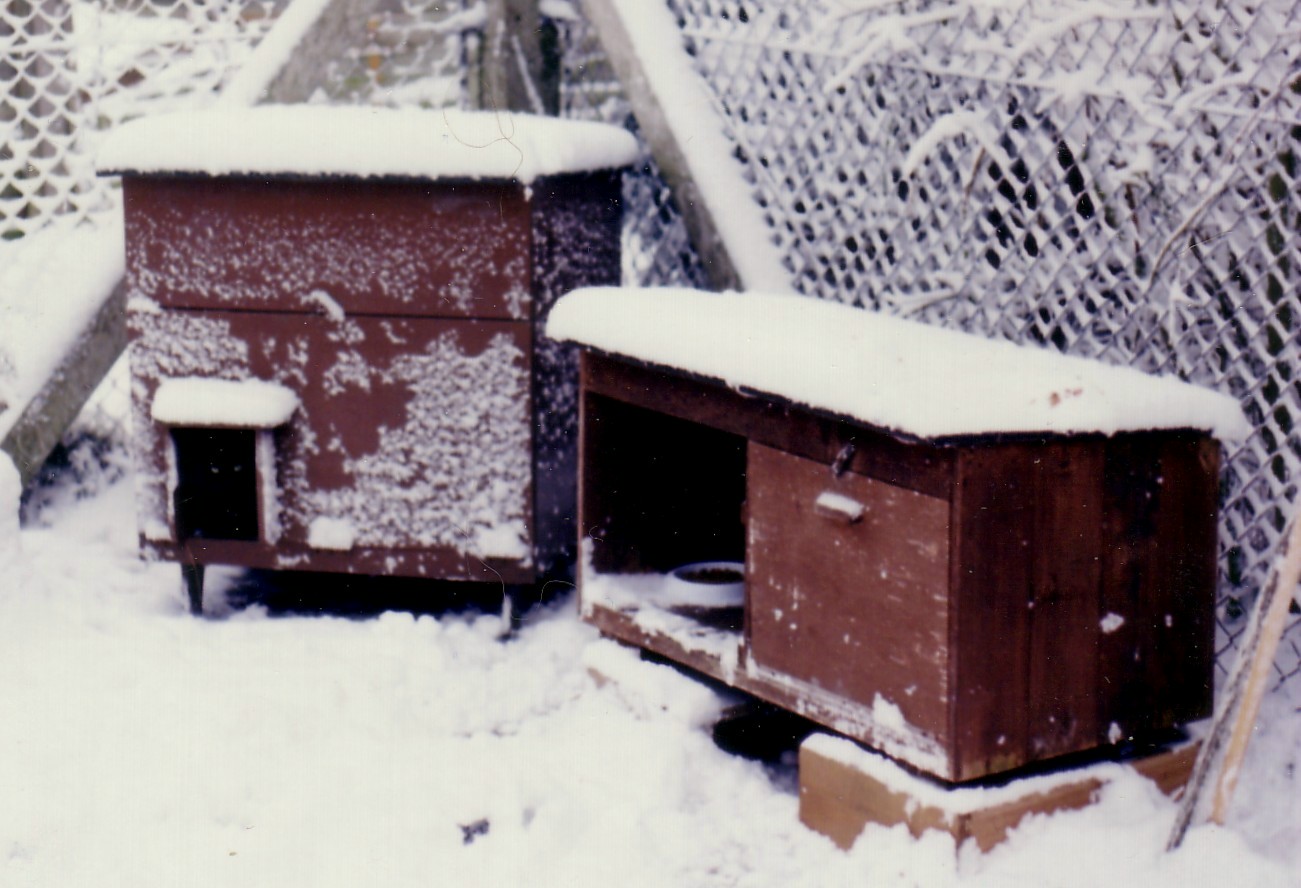
Outdoor cats, such as ferals or working farm cats, need warm, dry shelters, especially in winter.
The expanded polystyrene (Styrofoam) containers (“coolers”) mentioned are common in North America, but less so in the UK. If coolers aren’t available in your area, thick sheets of expanded polystyrene could be used instead.
1. The Rabbit Hutch.
I often see large rabbit hutches offered for sale very cheaply at the roadside. The type required is the 2-compartment outdoor type with a roof that slopes downwards at the back. Providing the hutch are sound, it can be made into a winter shelter.
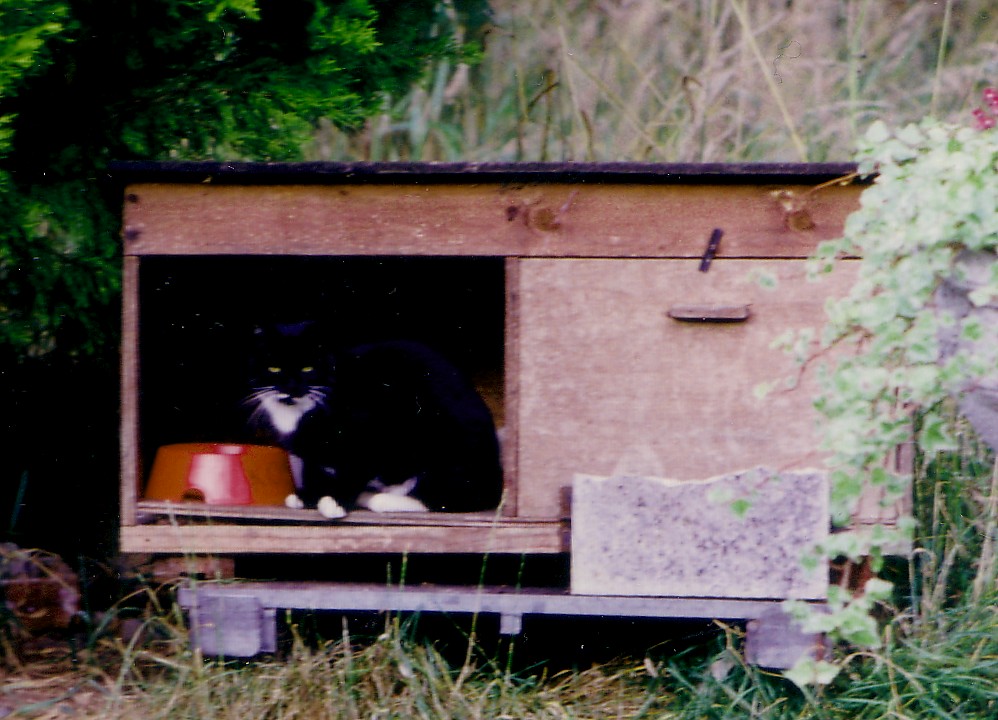
Converted Rabbit hutch.
Make sure the roof is sound and doesn’t leak. Roofing felt or, at a pinch, a sheet of weighted plastic laid on top can help keep it dry.
Replace the mesh-front of the larger compartment with a removable wooden front. This needs to be removable so the hutch can be cleaned when the cat is not in residence.
Remove the wooden front of the rabbit sleeping compartment entirely to leave a “porch” area. Most feral cats prefer not to sleep too close to their food, so don’t place bowls in the porch area.
The large compartment can be lined with dry hay or old linens to provide warmth. These should be changed regularly to prevent build up of dirt and flea larvae.
The hutch should be placed raised from the ground (e.g. on bricks or on a pallet) with the entrance hole not facing the prevailing wind.
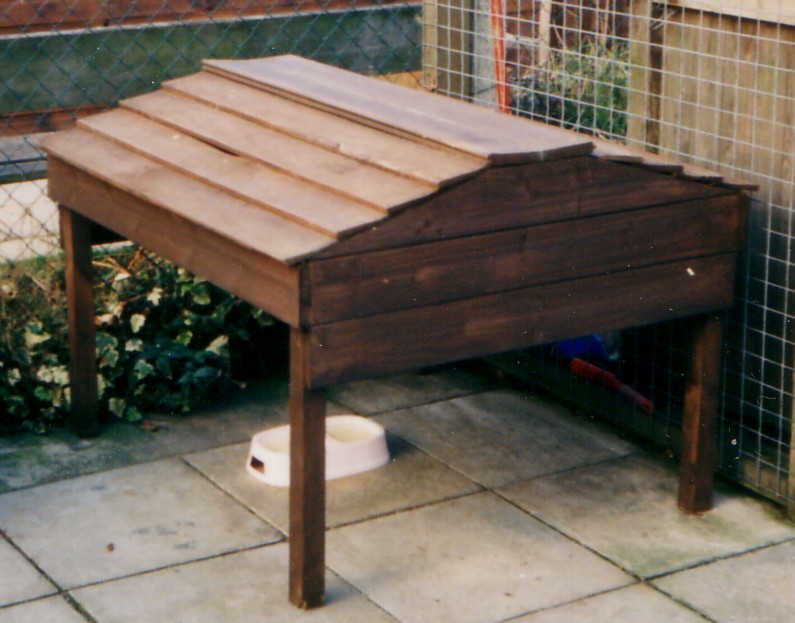
Separate covered feeding station
2. Storage Bin Shelter
This requires a large capacity plastic storage bin e.g. 18 US gallon/15 UK gallon/80 litres and an expanded polystyrene (US Styrofoam) container (cooler) that fits neatly inside the storage bin.
Cut a 20 cm (8 inch diameter hole) in the front of the storage bin and file away any sharp edges (a plant pot or similar can be used as a guide for drawing the hole). The cat will use this hole for entering and exiting the shelter.
Place the expanded polystyrene container inside the storage bin and cut a 20 cm (8 inch diameter hole) in the same place in the polystyrene container.
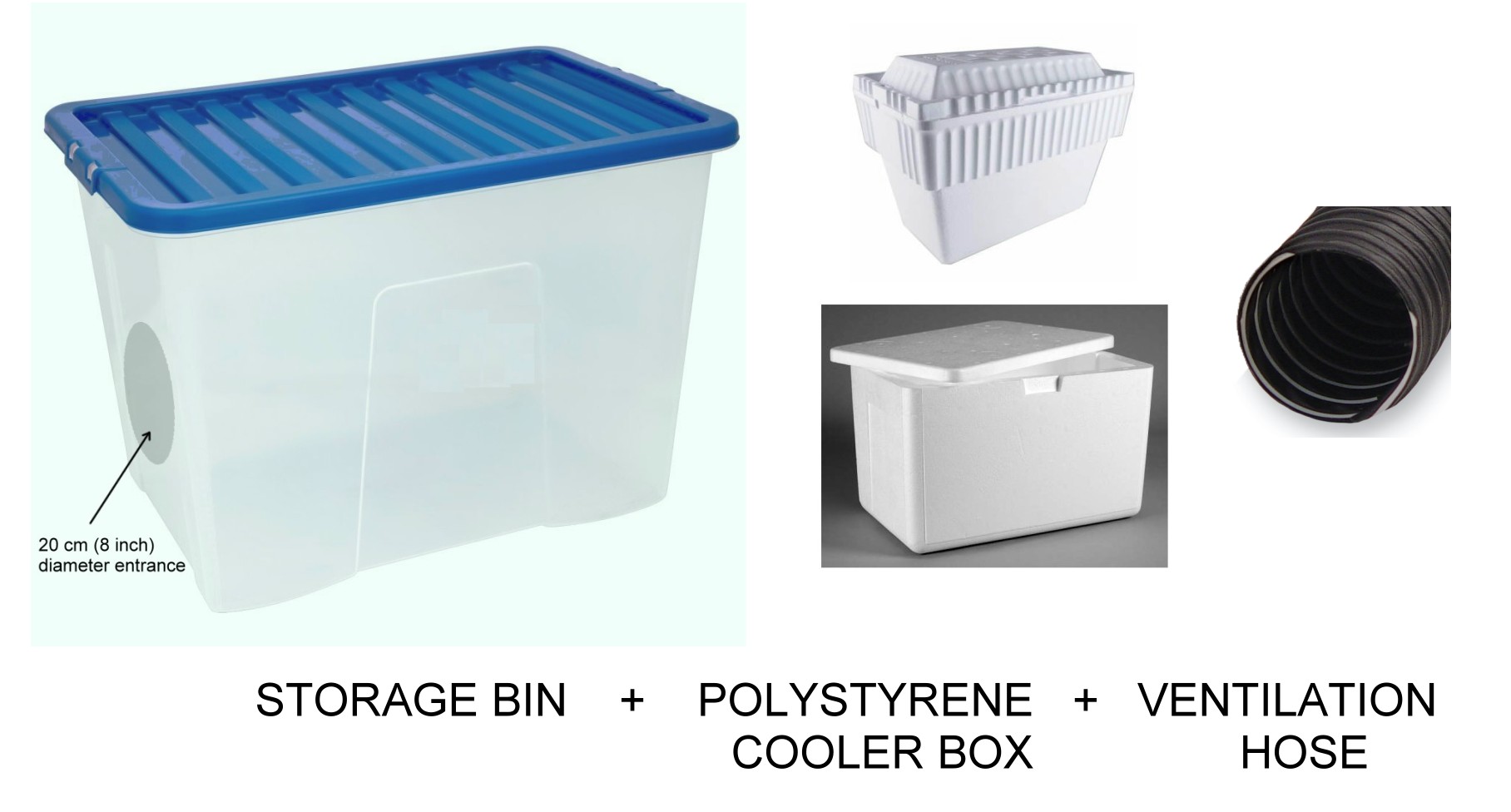
For extra insulation, pack straw into the gap between the polystyrene container and the storage container. Line the inner container with straw to make it comfortable for the cats.
Place the lid on the polystyrene container (if it didn’t have a lid, use a second container or a sheet of polystyrene) and tape the edges with duct tape. Fit the lid on the storage bin and tape it shut with duct tape.
Insert a short length of circular ventilation duct (the type that looks like an oversized vacuum cleaner flexible hose) through the entry hole(s) to act as a porch and prevent rain from entering.
Some feral cats don’t like entering an enclosed box as they feel trapped and vulnerable, so you might need to cut an additional exit hole on the opposite side of the container.
For use in windy or exposed areas, you can fit a door-flap of canvas, vinyl or heavy plastic to each entrance of the shelter.
3. Simple Polystyrene Box Shelter
Two large polystyrene containers can be duct-taped together and a hole made at one end for the cat to enter and exit and for bedding to be changed. Make sure all the joins are duct-taped to prevent draughts. Wrap a plastic sheet around the shelter to weatherproof it and ensure it is weighted down or pegged down. This sort of shelter is suited to placing in a sheltered location.
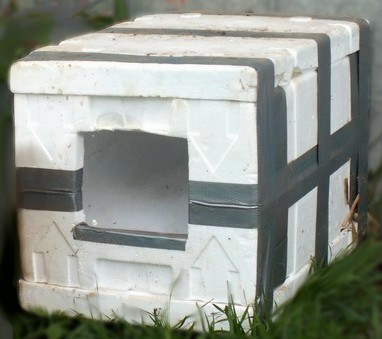
Two polystyrene (Styrofoam) insulated boxes taped together.
4. Purpose Built Shelters
For those with basic woodworking skills, it isn’t hard to build a basic wooden shelter. Various feral cat welfare groups have plans, dimensions , materials lists and instructions available.
The main points to consider are:
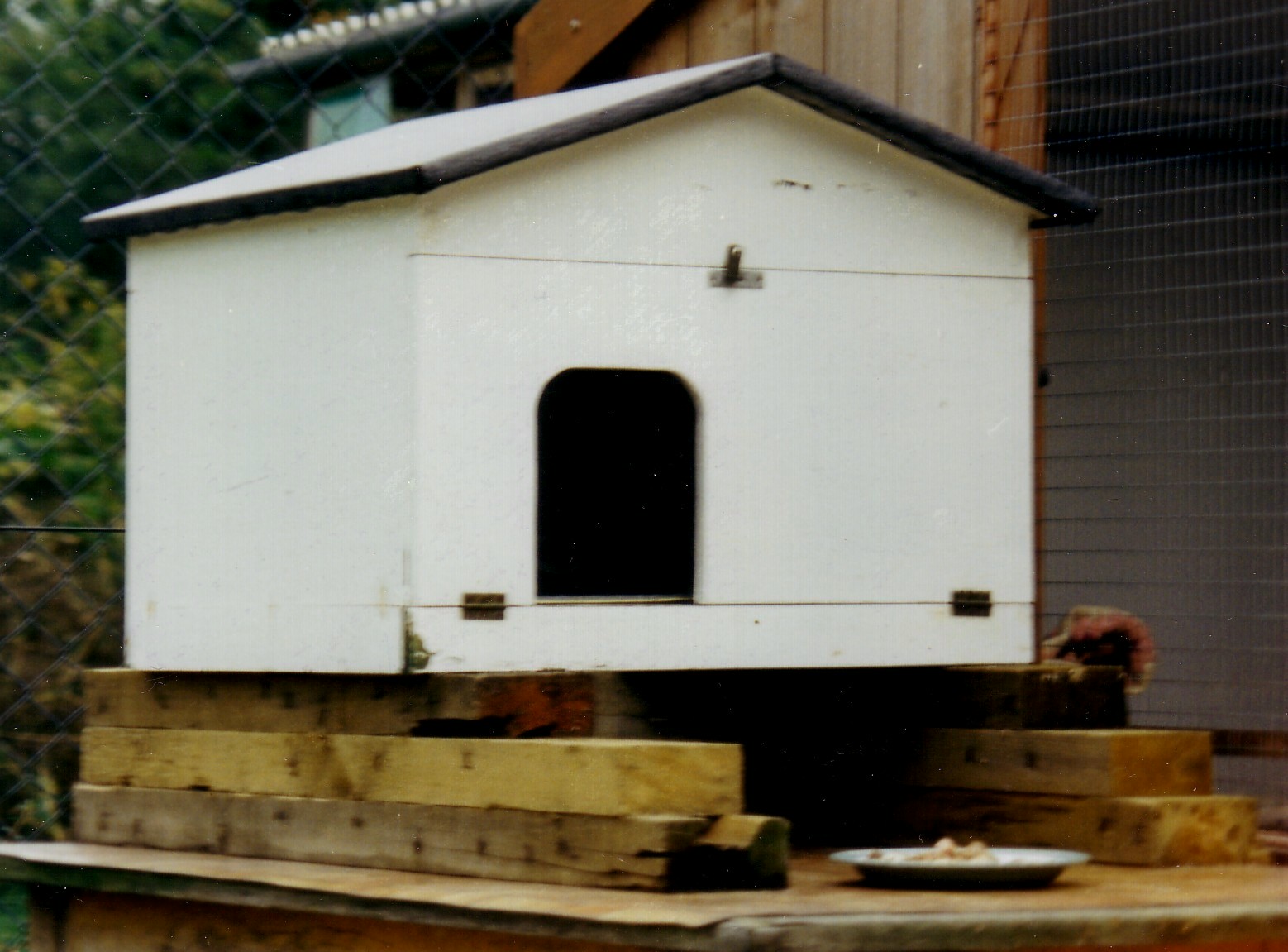
Apex-roof single cat shelter. This shelter has no legs and should be placed on bricks or other supports.
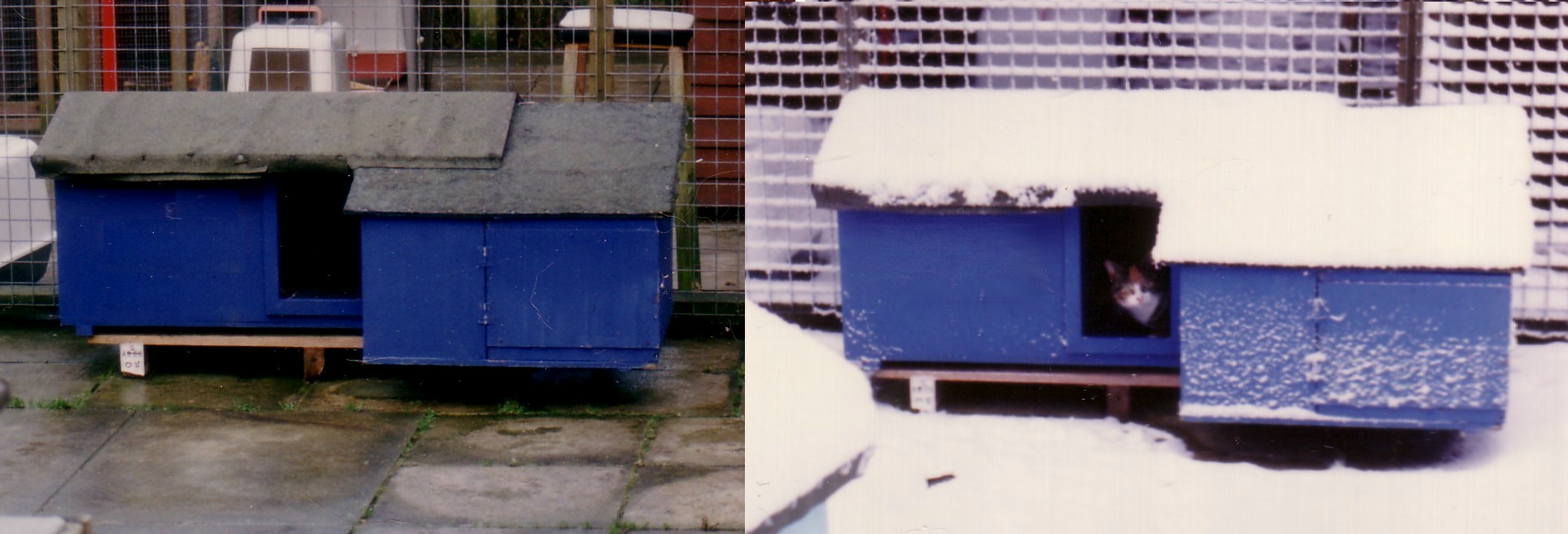
A deluxe two-bedroom shelter with shared porch; originally built for a factory cat! The left bedroom has a latched door at the side to allow cleaning. The right bedroom (big enough for 2 cats) has a latched door at the front. Alternatively, the left bedroom can be used as a feeding station for a non-feral outdoor cat.
Larger shelters tend to be heavy so you may wish to consider either adding trolley-wheels to the back legs or adding carrying-poles to the side so that it can be moved.
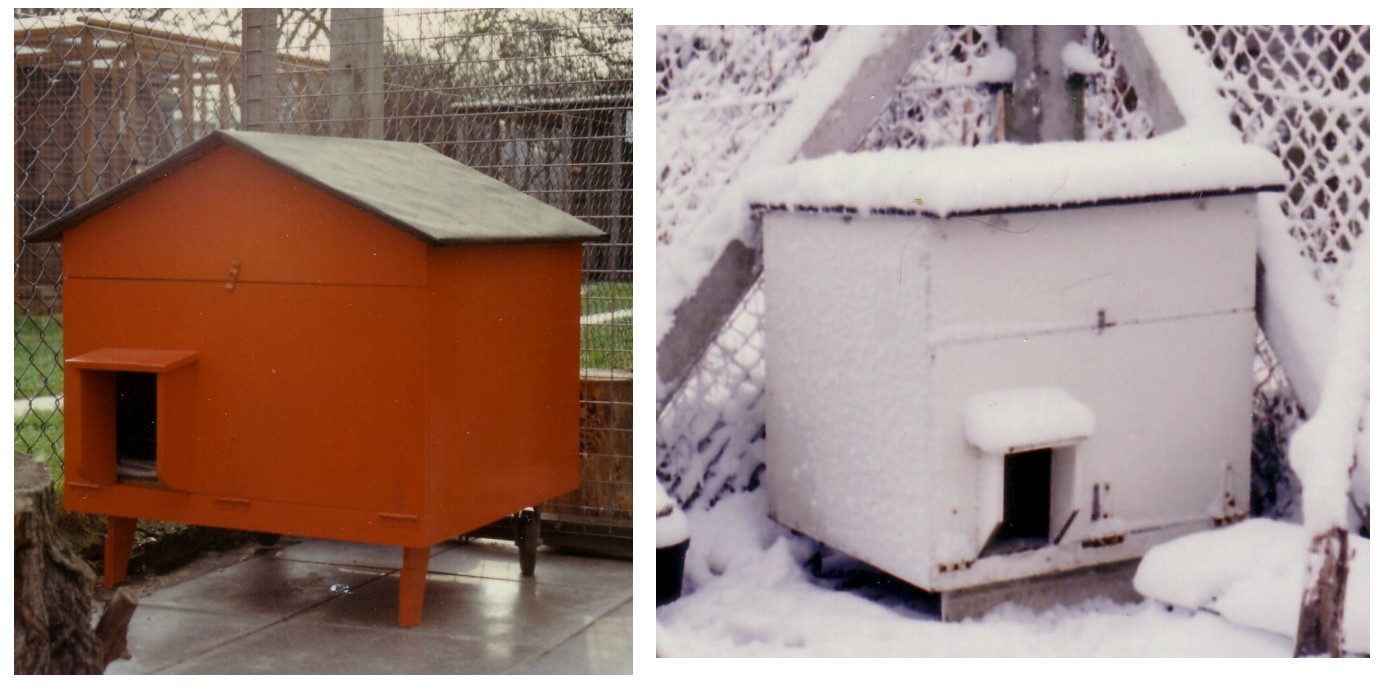
The apex-roofed red shelter and sloping-roofed white shelter have trolley wheels at the rear so they can be moved around by one person. The sloping-roofed white shelter has a single support at the front instead of legs. Large enough to accommodate a fleecy cat bed or cardboard box inside.
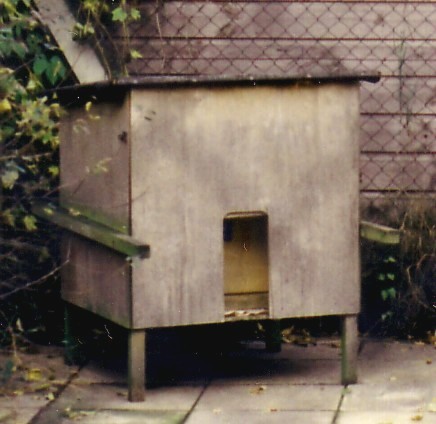
A larger and very sturdy shelter with a removable sloping roof. It has carrying poles fitted and requires 2 people to move it around. It is large enough to accommodate a fleecy bed or cardboard box inside.
HOMING SEMI-FERAL & NERVOUS CATS (OUTDOOR CATS)
This fact sheet was written for a Cats Protection shelter in the 1990s as an aid to adopters of cats temperamentally unsuited to living in a conventional domestic environment. If you are involved in feral cat relocation to farms etc, or you are planning to adopt outdoor feral cats, you may find the information useful. It may be freely adapted by organisations and individuals involved in rehoming feral cats into non-domestic situations.
ABOUT OUTDOOR CATS
Thank you for adopting one of our hard-to-home cats. You are helping a nervous or semi-feral cat which is not suited to life in a household. The following guidelines will help you during the crucial settling-in period.
These cats are not suitable as indoor pets. They are happy to live in large gardens, stables and smallholdings. Outdoor cats need a regular supply of food and a sheltered place to sleep. Given time and encouragement, an outdoor cat may become more sociable and want to come indoors.
Outdoor cats are homed on the understanding that the new owner will provide food and shelter. A well fed cat is a more efficient hunter than a hungry cat. A hungry cat only catches enough prey to feed itself. A well fed cat will also hunt for sport.
All of our outdoor cats have been neutered.
SETTLING IN
Confine your outdoor cat to one building for 4 weeks to become used to the smells and sounds of its new territory. Make sure that there are no gaps in the walls or broken windows through which it could escape. Please put mesh or curtain net over the windows. If the cat panics it may not recognise the glass as a barrier and could injure itself.
During this time the cat needs food, water and a litter tray. Be careful that it does not escape when you go in to feed it or change the litter tray.
Spend time with the cat while it is confined. Talk to it, read the newspaper out loud etc. This way it will get used to the sound of your voice. Although it may hide at first, it will be watching you.
LETTING THE CAT OUT
After 4 weeks, leave the door open so that the cat can come and go as it pleases. Continue to feed it in the same place for a while so that it knows where to find its food. You can move the feeding site once the cat knows its way around its new territory.
Sprinkling used litter (after flushing away the faeces) on the ground will help the cat to recognise its territory - and will let it know which areas to use as its toilet. This mimics its natural marking behaviour.
Although a semi-feral cat cannot be stroked or petted, it will come to recognise you as a food provider. It may greet you or follow you (at a distance) when you put food down. This is a great compliment.
If treated kindly, nervous and semi-feral cats may turn into friendly, even affectionate, cats. It will do this in its own time. Do not force attention on an unwilling or nervous cat.
HEALTH
All cats must be wormed at least once a year. This is very important for cats living outdoors as they quickly pick up worms from their prey or from the ground. Add the crushed wormer to strong smelling food such as pilchards.
If the cat is injured or ill, you will need to borrow a cat trap from the shelter or rescue organisation. You will be shown how to operate the trap. When transporting the cat, cover the trap or carrier with a blanket to keep the cat calm and put several layers of newspaper underneath the carrier (in case of 'accidents').
When taking an outdoor cat to the vet, warn the vet that it is semi-feral as he must use special equipment when examining it.
*************
Most semi-feral cats settle into their new territory well. They may disappear for a day or two on exploration trips, but will return for food. Continue to put food out as normal. If the cat does go missing, please let the rescue organisation know. It may turn up as a stray elsewhere.